

How to Create a Physician Resilience Plan Template
- Patricia Maris

- 9 hours ago
- 10 min read

Physician burnout is a crisis. But here's the thing: resilience isn't something you're born with. It's a skill you can build. And the best way to build it is with a plan. A physician resilience plan template gives you a structured way to protect your wellbeing, track your progress, and recover from the constant demands of clinical work. In this guide, you'll learn how to create your own template from scratch, using the 8 Pillars of Wellness framework. We'll walk through six usable steps: assessing where you are now, choosing the right pillars, designing micro-habits, scheduling them into your week, measuring results, and tapping into support systems. By the end, you'll have a personalized plan you can start using today.
Step 1: Assess Your Current Wellness Landscape
Before you can build a physician resilience plan template, you need to know where you stand. Think of it like a medical history for your own wellbeing. You wouldn't treat a patient without a diagnosis. Same goes for your resilience.
Start with a self-assessment across the 8 Pillars of Wellness: Willpower, Breathing, Hydration, Thoughts, Nutrition, Movement, Rest, and Sexual Wellbeing. For each pillar, rate yourself from 1 (needs urgent help) to 10 (thriving). Be honest. This isn't a performance review. It's a baseline.
Pillar | Current Score (1-10) | Priority (High/Medium/Low) |
Willpower | — | — |
Breathing | — | — |
Hydration | — | — |
Thoughts | — | — |
Nutrition | — | — |
Movement | — | — |
Rest | — | — |
Sexual Wellbeing | — | — |
A Self SWOT Template helps physicians identify Strengths, Weaknesses, Opportunities, and Threats in their personal resilience. You can use a similar approach for your own self-assessment. The key is to spot patterns. Maybe your Nutrition is fine but Rest is tanking. Or your Thoughts score is high but Breathing is low. That gives you a starting point.
Don't skip this step. Many physicians ignore their own warning signs until they hit a wall. A proper assessment makes your physician resilience plan template targeted, not generic. For a deeper look at measuring professional wellbeing, check out measuring healthcare professional wellbeing on the e7D-Wellness blog.
One more tip: do this assessment at a calm moment, not after a 14-hour shift. Your scores will be skewed. Pick a day off or a quiet evening.
Key Takeaway:A baseline self-assessment across the 8 Pillars turns your resilience plan from guesswork into a data-driven roadmap.
Step 2: Prioritize Key Pillars for Your Context
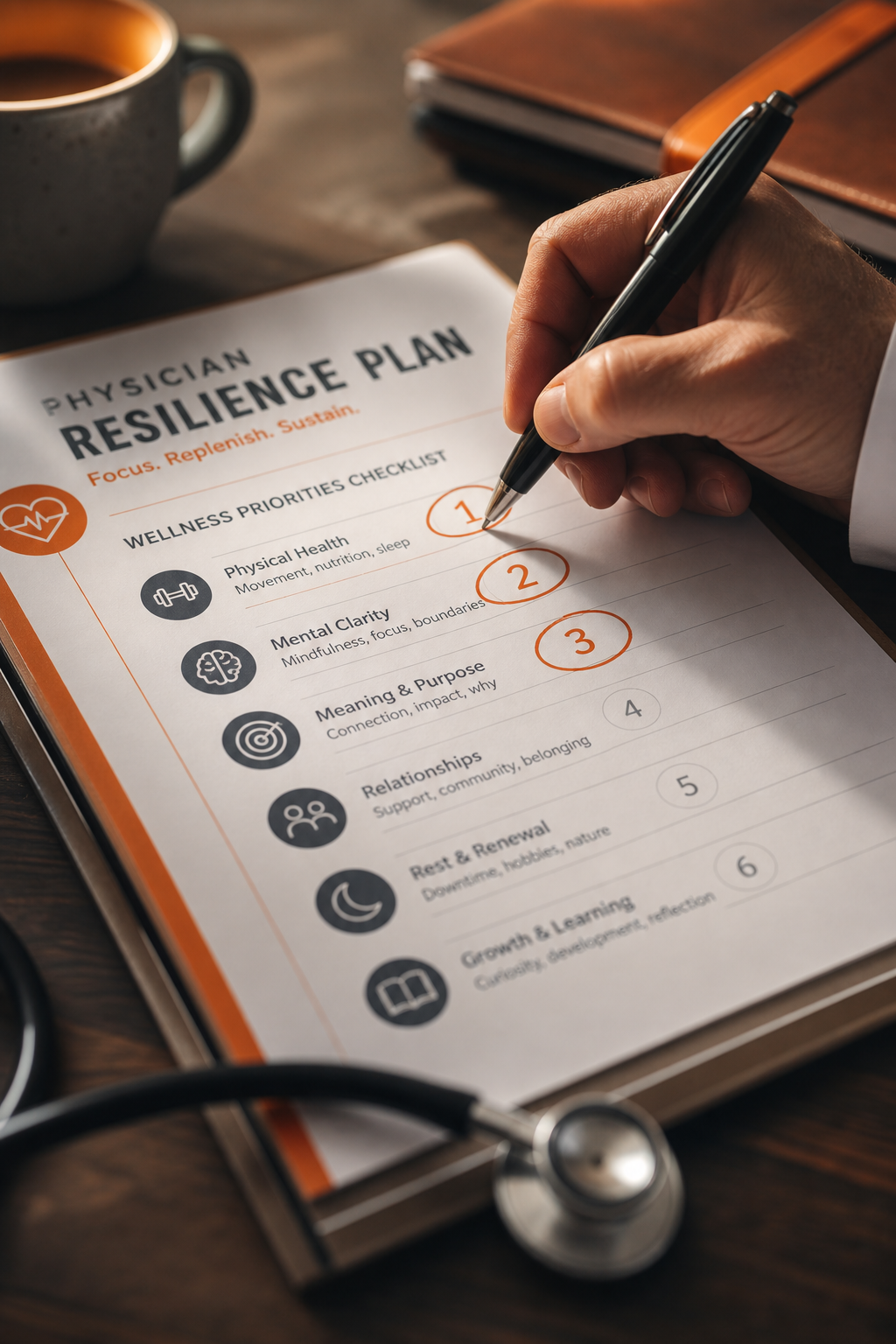
Now that you have scores, you need to decide where to focus first. Trying to improve all eight pillars at once is a recipe for failure. You'll burn out faster. Instead, pick 2-3 pillars that will give you the biggest return in energy and resilience.
Think about your daily work context. Are you a night-shift nurse? Then Rest and Nutrition are probably your anchors. A surgeon? Movement and Breathing might be more urgent. A psychiatrist? Thoughts and Hydration could be key. Your physician resilience plan template should reflect your real life, not a generic inspiration board.
Prioritization also means being realistic about your bandwidth. If you're already overwhelmed, don't pick a pillar that requires a big time investment. Start with something small, like drinking more water (Hydration) or taking three deep breaths before entering a patient room (Breathing). Quick wins build momentum.
Use the priority column in your assessment table. Label each pillar as High, Medium, or Low priority based on two factors: (1) your current score, and (2) how much impact improving it would have on your daily function. For example, if your Rest score is 3 and you're exhausted, that's High priority. If your Sexual Wellbeing is 7 and stable, that's Low priority for now.
You can also tie pillars together. Better Rest improves Willpower. Good Hydration boosts Thoughts. For inspiration, read about building willpower for healthcare professionals as part of your plan.
Remember, this isn't permanent. Revisit your priorities every month. As one pillar stabilizes, you can shift focus to another. The goal is continuous improvement, not perfection.
"Resilience isn't about doing everything. It's about doing the right things consistently."
Step 3: Design Your Daily Micro-Habits
Once you've prioritized 2-3 pillars, it's time to design micro-habits. A micro-habit is a tiny action that takes less than five minutes. It's so small you can't say no. Over time, these micro-habits stack into major resilience gains.
Let's say Rest is your top priority. A micro-habit might be: "After I brush my teeth at night, I will set my phone alarm for 7 hours of sleep." That's it. No elaborate bedtime routine. Just one trigger-action pair. For Nutrition: "When I pour my morning coffee, I will also fill a water bottle." For Movement: "After lunch, I will walk around the ward for two minutes."
Write each micro-habit into your physician resilience plan template. Be specific: state the trigger (when X happens) and the action (I will do Y). Avoid vague goals like "exercise more." That doesn't work. Use concrete cues.
Research supports this approach. A meta-synthesis published in the International Journal of Environmental Research and Public Health identified that resilient physicians use adaptive coping strategies, control in their professional lives, and tenacity. Micro-habits are the usable expression of those themes. You can at PMC8744634 .
Another tip: pair a new habit with something you already do. This is called habit stacking. For example, "After I document the last patient note in the morning, I will do 1 minute of box breathing." The existing routine becomes the reminder.
Start with just one micro-habit per chosen pillar. Once that feels automatic after a couple of weeks, add a second. Don't rush. The goal is consistency, not volume. For a usable tool, try this progressive muscle relaxation script as a micro-habit for Rest.
Pro Tip:Write your micro-habits on a sticky note and put it on your bathroom mirror or locker. Visual cues increase follow-through by 30%.
Step 4: Build a Weekly Schedule Template
Micro-habits are great, but they need a container. That's where a weekly schedule comes in. Your physician resilience plan template should include a simple weekly grid where you block time for your prioritized habits. This isn't a rigid timetable. It's a flexible framework that protects your pillars.
Start by mapping out your fixed obligations: shifts, meetings, commute. Then find the gaps. Maybe you have 15 minutes between patient rounds. That's a perfect slot for a Breathing micro-habit. Or a 30-minute lunch break where you can eat a balanced meal and take a short walk.
Don't try to schedule every minute. Leave buffers. A good weekly schedule has 3-5 resilience blocks per day, each 5-15 minutes long. That's manageable even on busy days. For example:
Morning:5-minute gratitude journal (Thoughts pillar)
Mid-morning:2-minute hydration check (Hydration pillar)
Lunch:10-minute walk (Movement pillar)
Afternoon:1-minute deep breathing (Breathing pillar)
Evening:5-minute wind-down without screens (Rest pillar)
Print this weekly schedule as part of your template. Check off each block as you complete it. The act of checking creates a sense of accomplishment and reinforces the habit.
Flexibility is key. If you miss a block, don't guilt-trip yourself. Just mark it and move on. The goal is to hit 70-80% of your blocks each week. That's enough to see real improvements in your resilience.
For a deeper understanding of resilience dynamics, the PMC meta-synthesis (cited before) emphasizes that resilience in physicians is dynamic and supported by both individual and organizational resources. Your weekly schedule is one of those individual resources. To complement it, explore how to build moral resilience with usable strategies from e7D-Wellness.
Step 5: Track and Adjust Your Progress
Your physician resilience plan template isn't static. It needs a feedback loop. Tracking your progress helps you see what's working and what isn't. Without tracking, you're flying blind.
Use a simple tracker: a table with the date, the micro-habit, and a checkbox. At the end of each week, tally your checkmarks. If you completed the habit 5 out of 7 days, that's a win. If you only managed 2 days, ask why. Was the trigger not strong enough? Was the habit too big? Adjust.
Also track your subjective wellbeing. Each week, re-rate yourself on the pillars you're working on. Did your Rest score go from 3 to 5 after four weeks of sleep hygiene? That's proof your plan is working. Write this data in a journal or a note on your phone.
Adjustment is part of the process. Maybe you picked the wrong pillar to prioritize. Or your micro-habit didn't fit your schedule. That's fine. Change it. The template is yours to customize. For example, if "drink 8 glasses of water" feels overwhelming, change it to "fill a water bottle at the start of each shift." Smaller steps work better.
Don't forget to celebrate small wins. Resilience is a long game. Recognizing progress keeps you motivated. Use the tracker to see how far you've come. For a tool that helps you measure compassion fatigue and burnout risk, see how to use a compassion fatigue test .
One more thing: schedule a monthly 15-minute review. Look at your tracker, your pillar scores, and your weekly schedule. Ask: what needs to change? What's working great? Then update your template. This keeps it alive.
Step 6: Use Support Systems and Resources
No physician is an island. Even the best physician resilience plan template works better when backed by support systems. This includes colleagues, mentors, professional resources, and sometimes outsourced help for non-clinical tasks that drain your energy.
Identify one or two trusted colleagues you can talk to about stress. Peer support is powerful. If your workplace has a wellness committee, get involved. If not, consider joining a physician support group, either local or online. The e7D-Wellness platform offers resources specifically for healthcare professionals, including confidential wellbeing assessments.
Also think about administrative burdens. Billing, coding, insurance claims, these can eat up hours and increase burnout. For mental health professionals in private practice, outsourcing billing to a specialized company can free up time for self-care. Services like a specialized medical billing service handle eligibility, claims, and denial management, reducing one major stressor.
Don't forget organizational resources. Your hospital or clinic might offer employee assistance programs, resilience training, or mental health days. Use them. Many physicians avoid these because they're afraid of stigma. But seeking help is a sign of strength, not weakness.
Finally, use educational resources. Read articles, listen to podcasts, attend workshops. The more you learn about resilience science, the smarter your physician resilience plan template becomes. for usable tips on preventing burnout.
Remember: support systems are not optional extras. They're core components of a sustainable resilience practice. Integrate them into your template from day one.
FAQ
What is a physician resilience plan template?
A physician resilience plan template is a structured document that helps doctors and other healthcare professionals build and maintain their personal resilience. It typically includes a self-assessment to identify areas of weakness, prioritized goals, daily micro-habits, a weekly schedule, a progress tracker, and resources for support. The purpose is to make resilience a deliberate practice rather than a reactive one. By using a template, clinicians can systematically improve their wellbeing and reduce burnout risk over time.
How do I start creating my own resilience plan template?
Start by assessing your current wellbeing across key domains like rest, nutrition, movement, thoughts, breathing, hydration, willpower, and sexual wellbeing. Rate each on a scale of 1 to 10. Then prioritize 2-3 pillars with the lowest scores or highest impact on your daily function. Next, design one micro-habit per pillar, a small action that takes less than five minutes. Finally, schedule these habits into your weekly calendar and track your progress. Use the steps in this guide as a blueprint.
What should be included in a weekly schedule for resilience?
A weekly schedule should include fixed blocks for your micro-habits, spread throughout the day. Aim for 3-5 blocks per day, each 5-15 minutes long. Include morning rituals, mid-day resets, and evening wind-downs. Leave buffers for unexpected changes. Print the schedule and check off each block as you complete it. Flexibility is key, if you miss a block, don't stress. The goal is consistency over perfection. Over time, these scheduled moments become automatic parts of your routine.
How often should I update my resilience plan?
Review your plan weekly by checking your habit tracker, and do a dee of your pillar scores and overall wellbeing. During the monthly review, ask what's working and what needs adjustment. You might need to change a micro-habit, reprioritize pillars, or tweak your schedule. As you make progress, shift focus to new pillars. The template should evolve as your resilience improves. A static plan won't serve you long-term.
Can I use this template if I'm a nurse or allied health professional?
Absolutely. While the example targets physicians, the 8 Pillars of Wellness and the step-by-step process apply to any healthcare professional, nurses, surgeons, psychologists, EMTs, medical technicians, therapists, and even veterinarians. The key is to customize the micro-habits and schedule to your specific work context, shift patterns, and stressors. The template framework is universal; the details are personal.
Is there evidence that resilience plans work?
Yes. Research on physician resilience shows that structured approaches can reduce burnout and improve wellbeing. A meta-synthesis of qualitative studies identified that resilient physicians use adaptive coping, have control in their professional lives, and use resources. A personalized physician resilience plan template operationalizes these findings into daily habits. While more research is needed, the core principles align with established psychological theories of habit formation and stress management.
What if I don't have time for a resilience plan?
That's exactly when you need it most. The template is designed to be lightweight. You're not adding extra tasks; you're replacing unhelpful patterns with tiny, effective actions. Start with just one micro-habit that takes 60 seconds. Once that sticks, add another. The time invested is minimal compared to the time lost to burnout, sick days, and reduced productivity. Think of it as preventive maintenance for your career and health.
Where can I get a ready-made physician resilience plan template?
You can download a customizable template from the e7D-Wellness platform, which includes the 8 Pillars framework, self-assessment, habit tracker, weekly schedule, and progress log. The platform also offers confidential wellbeing assessments to pinpoint your burnout risk. s tailored for healthcare professionals. Alternatively, you can create your own using the steps in this guide.
Conclusion
Creating your own physician resilience plan template isn't just another task on your to-do list. It's an investment in your ability to keep doing meaningful work without crashing. We covered six steps: assess your current state honestly, pick the pillars that matter most to you, design tiny habits that fit your day, schedule them into a flexible weekly plan, track your progress, and lean on your support systems. Each step builds on the last. The result is a personalized system that respects your time and your limits.
Remember, resilience isn't about being superhuman. It's about being intentional with your energy. Start small. Use the template as a living document. Adjust it as your life and work change. You don't need to overhaul everything overnight. One micro-habit, one week, one pillar at a time. That's how real, lasting change happens.
If you haven't already, take the first step today. Rate yourself on the 8 Pillars. Pick one habit to start tomorrow morning. Your future self will thank you. For more support, explore the e7D-Wellness resources at MarisGraph.com and start your journey toward sustainable clinical practice.


Comments