

Clinical Resilience Workshop Cost: A Step‑by‑Step Guide 2026
- Patricia Maris

- 11 minutes ago
- 10 min read
Running a resilience workshop can feel like a money maze. You’re a clinician who wants to boost team wellbeing, but the cost numbers keep you up at night. In this guide we’ll walk you through every step to size, plan, and control the clinical resilience workshop cost so you can get the most bang for your buck. You’ll learn how to set goals, spot cost drivers, build per‑participant budgets, compare in‑house and external options, save money, and track impact after the event.
Let’s dive in and make the numbers work for you.
Table of Contents
Step 1: Define Workshop Objectives and Scope
Before you even look at a price tag, ask yourself what you want the clinical resilience workshop cost to achieve. Is the goal to reduce burnout, improve teamwork, or meet a credentialing requirement? Write a short objective statement that is specific, measurable, and time‑bound. For example: "Reduce reported burnout scores by 15% within six months after a two‑day workshop for 30 nurses."
Having a clear objective lets you match every line‑item to a purpose. It also makes it easier to argue for funding with leadership because you can point to a concrete outcome.
Next, decide on the scope. Will the workshop be a single session or a series? Will you include role‑plays, breakout groups, or guest speakers? The broader the scope, the higher the clinical resilience workshop cost will be, but a tighter focus can keep expenses lean while still hitting the target.
To help you map out the scope, check out Understanding and Addressing Moral Injury in Healthcare . It offers a practical template you can adapt for your own objectives.
Now that you have objectives, create a simple worksheet that lists each goal, the expected impact, and a rough budget line. This worksheet becomes your north star for all later cost decisions.
When you share the worksheet with stakeholders, they’ll see exactly why each dollar is needed, which makes the clinical resilience workshop cost conversation smoother.
Finally, set a deadline for when you need the workshop ready. Tight timelines can drive up costs (e.g., rush fees for speakers), so give yourself enough lead time to negotiate better rates.
By the end of this step you’ll have a crystal‑clear purpose, a defined scope, and a baseline that will guide every cost decision.
Step 2: Identify Major Cost Drivers
The clinical resilience workshop cost breaks down into a handful of major drivers. Knowing these lets you target savings where they matter most.
First, consider venue costs. A hospital conference room might be free, but you may need to rent audio‑visual gear, seating, or catering. If you’re hosting off‑site, venue fees can jump quickly.
Second, think about facilitator fees. Professional resilience coaches charge per hour, and rates vary by experience and format (in‑person vs virtual). For example, Sofia Health reports that group sessions can cost $30‑$75 per person, while one‑on‑one coaching runs higher.
Third, account for materials. Handouts, workbooks, and any digital platforms you use all add up. Bulk printing can lower per‑unit cost, but you still need a budget line.
Fourth, factor in travel and lodging for guest speakers, especially if they’re coming from out of state. This includes airfare, hotel nights, meals, and local transport.
Fifth, don’t forget admin overhead: project manager time, marketing the workshop internally, and post‑workshop evaluation tools.
Here’s a quick checklist of cost drivers:
Venue & A/V
Facilitator fees
Materials & supplies
Travel & lodging
Administrative support
Marketing & communication
For a deeper look at how resilience coach pricing works, see Sofia Health’s resilience coach cost guide. It breaks down typical session pricing and shows how group rates can lower the clinical resilience workshop cost per participant.
Another perspective on workshop pricing comes from the Esalen Institute’s writing‑for‑shame resilience workshop, which outlines curriculum design and pricing structures for immersive sessions. Read more at Esalen’s resilience workshop page .
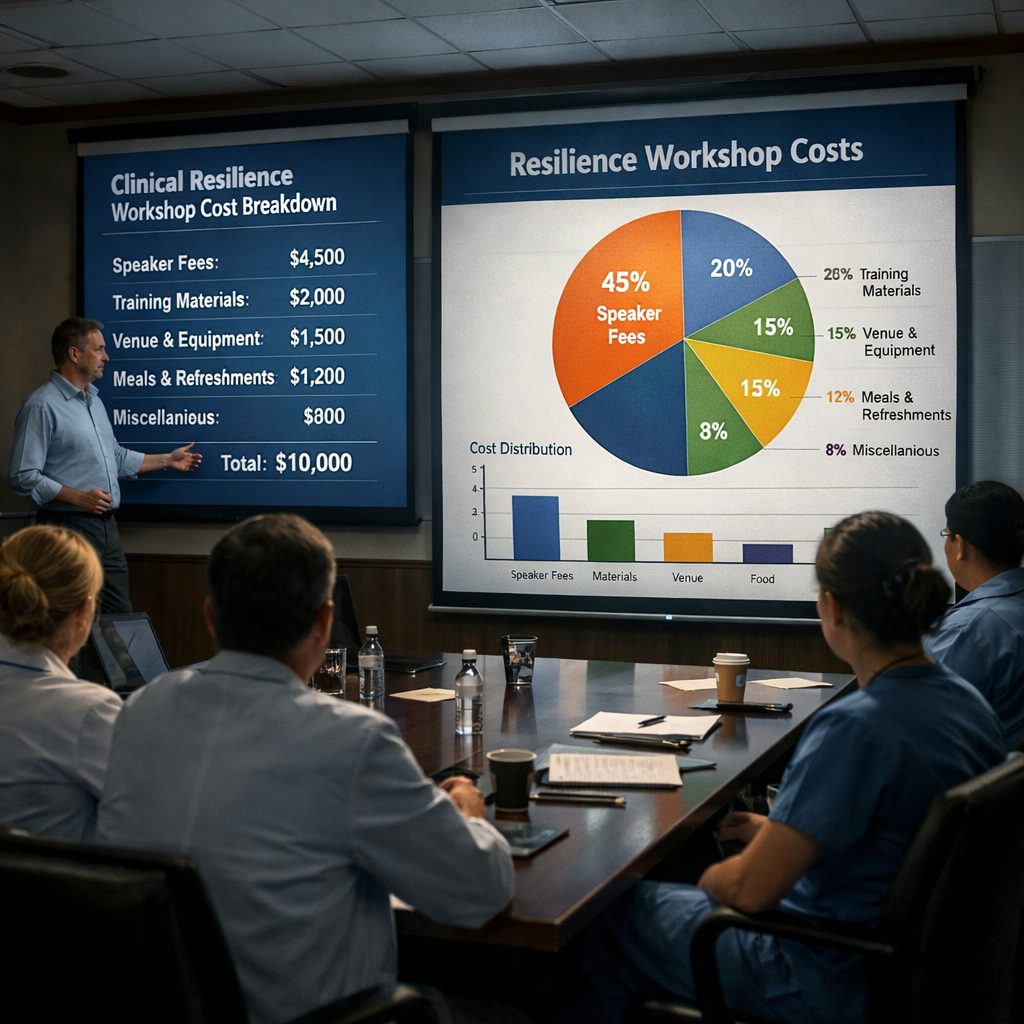
When you list each driver, assign a rough dollar range. This early estimate helps you see where the biggest chunks of the clinical resilience workshop cost sit, so you can prioritize negotiations or alternatives later.
Remember, the goal isn’t to cut every line‑item but to balance value and expense.
Step 3: Build a Per‑Participant Budget
Now that you know the major cost drivers, turn them into a per‑participant budget. This helps you answer the key question: "How much will each clinician cost us?"
Start by dividing total venue costs by the expected number of attendees. If you’re hosting 30 people in a space that costs $600, that’s $20 per person.
Next, allocate facilitator fees. Suppose a coach charges $1,200 for a full day. Spread that across 30 participants, and you get $40 per person. If you add a guest speaker with a $500 fee, that’s another $16.70 per attendee.
Materials often have a fixed cost plus a per‑person component. If you print a 30‑page workbook at $2 per copy, that’s $2 per participant.
Travel and lodging can be tricky. If you bring a speaker from another city and the total travel budget is $1,000, divide that by the number of attendees who will benefit , often the whole group, so $33.33 each.
Administrative overhead might be a flat $300 for project coordination. Spread that across 30 people for $10 per participant.
When you add everything up, you get a clear per‑person cost. Here’s a sample table:
Cost Category | Total Cost | Per‑Participant |
Venue & A/V | $600 | $20 |
Facilitator | $1,200 | $40 |
Guest Speaker | $500 | $16.70 |
Materials | $60 | $2 |
Travel & Lodging | $1,000 | $33.33 |
Admin Overhead | $300 | $10 |
Total | $3,660 | $122.03 |
Use this template to plug in your own numbers. Adjust the participant count if you expect cancellations , a smaller group raises the per‑person cost, while a larger group lowers it.
To see how other organizations handle budgeting, check out Emergency Resilience’s keynote pricing page. They discuss how they price workshops for high‑stress professions, giving you a benchmark for the clinical resilience workshop cost.
After you have a per‑participant figure, you can decide whether to charge participants, seek sponsorship, or absorb the cost as part of professional development funds.
Now embed the video that shows a sample budgeting walk‑through:
Watch the video, then return here to apply the steps to your own numbers.
Finally, create a simple spreadsheet that tracks each line item, the source (quote, estimate, contract), and the per‑person impact. This file becomes your living document for the clinical resilience workshop cost.
Step 4: Estimate ROI and Financing Options
Knowing the clinical resilience workshop cost is only half the story. You also need to estimate the return on investment (ROI) to justify the spend.
Start by identifying measurable outcomes: reduced turnover, lower sick‑leave days, or improved patient satisfaction scores. Assign a monetary value to each outcome. For example, if turnover drops by one nurse and the replacement cost is $80,000, that’s a direct saving.
Next, calculate the total benefit value over a chosen period (often one year). Compare that to the total clinical resilience workshop cost you built in the previous step. ROI = (Benefit , Cost) / Cost × 100%.
Let’s say your workshop costs $3,660 and you estimate a $15,000 reduction in overtime costs. ROI = ($15,000 , $3,660) / $3,660 × 100% ≈ 310%.
Financing options include:
Internal budgeting: allocate from training or professional development funds.
Grant funding: many health systems have wellness grants.
Sponsorship: partner with a vendor who offers resilience tools in exchange for brand placement.
Participant fees: charge a modest fee per attendee, especially if the workshop offers continuing education credits.
To see how other health groups fund similar programs, read Reviving Health Amongst Medical Professionals . It outlines how organizations use wellness budgets.
Another angle is to bundle the workshop with other initiatives, like a compassion fatigue assessment, creating a package that delivers more value for the same clinical resilience workshop cost.
Finally, build a one‑page ROI summary for leadership. Include the cost breakdown, projected savings, and a brief risk analysis. This concise document makes it easier for decision‑makers to green‑light the spend.
When you can show a clear financial upside, the clinical resilience workshop cost becomes an investment rather than an expense.
Step 5: Compare In‑House vs External Providers
One of the biggest decisions that affects the clinical resilience workshop cost is whether to use internal staff or hire an external provider.
In‑house workshops can be cheaper if you have qualified staff, but they may lack the fresh perspective or specialized training that external coaches bring. External providers often charge higher fees, but they bring proven curricula and can scale more easily.
Below is a comparison table that helps you weigh the pros and cons:
Factor | In‑House | External Provider |
Cost | Lower upfront fees; may need internal admin time. | Higher per‑session rates; includes prep and materials. |
Expertise | Depends on staff training; may need upskilling. | Specialized resilience coaches with certifications. |
Customization | High – you can tailor to org culture. | Moderate – providers offer templates you can tweak. |
Scalability | Limited by staff availability. | Easy to expand to multiple sites. |
Credibility | May be seen as internal training. | Often seen as best‑practice external input. |
To explore real‑world pricing, look at Sofia Health’s resilience coach cost guide. It details how group sessions can lower the per‑person clinical resilience workshop cost, which is useful if you consider an external provider.
Another example of an immersive workshop comes from Esalen Institute’s writing‑for‑shame resilience program. Their pricing model shows how a specialized curriculum can command a premium while delivering deep impact. See details at Esalen’s workshop page .
When you compare, ask yourself:
Do we have internal staff with the right credentials?
Can we afford the higher fee for an external expert?
What is the expected ROI for each option?
How quickly can we roll out the workshop?
Answering these questions will clarify which route gives the best value for the clinical resilience workshop cost.
Step 6: Apply Cost‑Saving Strategies
Even after you’ve scoped the workshop, there are still ways to trim the clinical resilience workshop cost without hurting quality.
First, negotiate venue discounts. Many hospitals offer free conference rooms if you schedule during off‑peak hours. Ask about in‑house catering credits instead of external catering.
Second, bundle facilitator hours. Some coaches offer package rates for multiple sessions. For instance, booking four sessions up front can shave 10‑15% off the total fee.
Third, use digital materials. Instead of printed handouts, share PDFs via a learning management system. This cuts printing costs and makes updates easier.
Fourth, use group rates for travel. If you need to bring in a speaker, book flights and hotels for the whole team at once to get corporate discounts.
Fifth, recruit volunteer co‑facilitators from within your organization. Senior nurses or physicians may be willing to co‑lead in exchange for professional development credit.
Here’s a quick checklist of cost‑saving tactics:
Ask for in‑house venue credits.
Negotiate multi‑session discounts.
Switch to digital workbooks.
Book travel in bulk.
Use internal champions as co‑facilitators.
For more ideas on cost‑saving in high‑stress training, see Emergency Resilience’s keynote pricing page. They outline how they adjust fees for nonprofit health organizations.
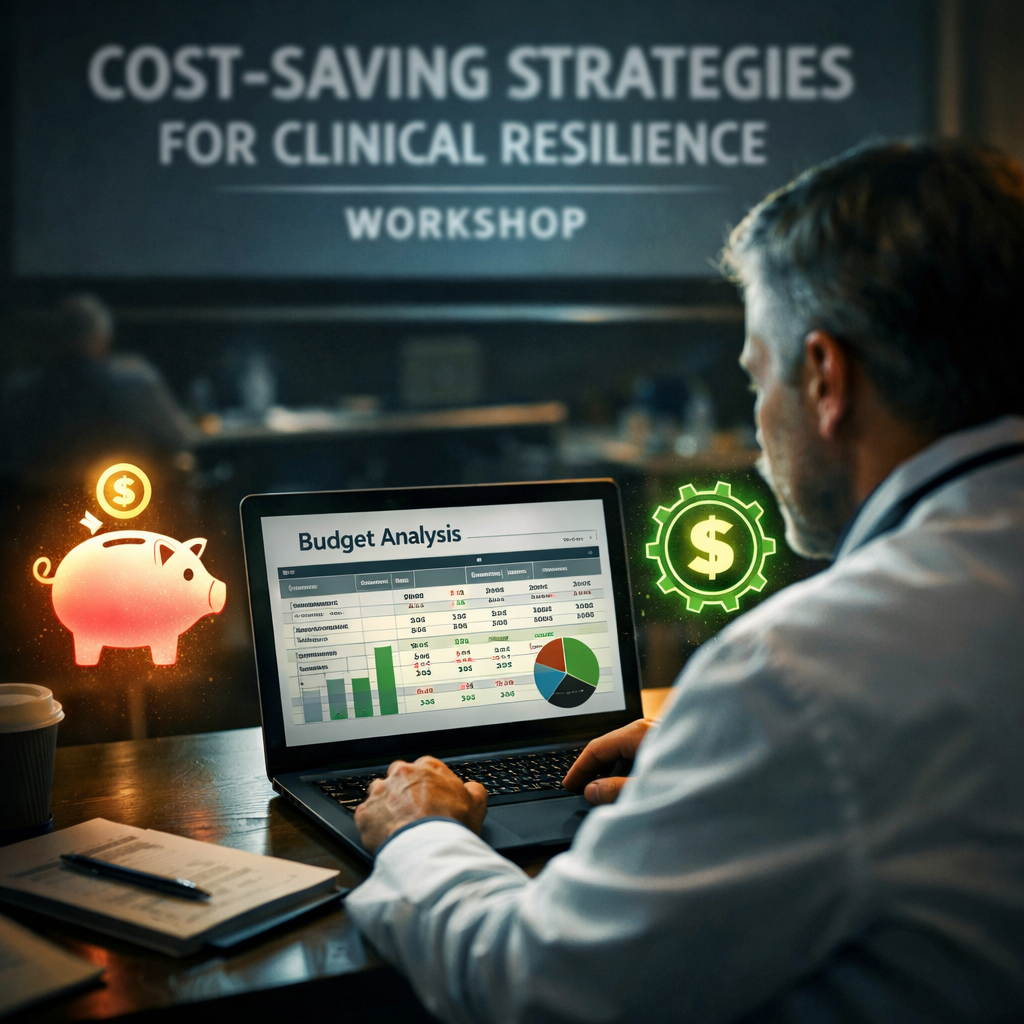
Finally, track every negotiation in a simple spreadsheet. Note the original quote, the negotiated price, and the date. This record helps you replicate savings for future workshops.
Step 7: Track Post‑Workshop Expenses and Impact
After the workshop, the work isn’t done. You need to monitor ongoing expenses and measure the impact to see if the clinical resilience workshop cost paid off.
Start by logging any follow‑up resources you provide, online modules, coaching calls, or printed guides. These are post‑workshop expenses that should be added to the total cost of ownership.
Next, collect outcome data. Use the e7D‑Wellness wellbeing self‑assessment before and after the workshop to gauge changes in burnout risk, compassion fatigue, and overall resilience.
Analyze the data against your original objectives. If you aimed for a 15% drop in burnout scores, calculate the actual percentage change. Translate that change into monetary terms (e.g., reduced sick days) to update your ROI calculation.
Document lessons learned: which activities got the best feedback, which parts ran over budget, and where you saved money. This will refine future clinical resilience workshop cost estimates.
To see a practical example of post‑event tracking, read Professional Support Systems . It discusses how organizations monitor wellbeing metrics after training.
Another useful resource on tracking impact is the article on no‑nonsense tips for healthcare pros, which highlights simple metrics you can collect without adding admin burden. Check it out at No‑Nonsense Tips for Healthcare Pros .
Finally, create a post‑workshop report that includes:
Total cost (including post‑event expenses)
Measured outcomes vs objectives
Updated ROI
Recommendations for next round
Share this report with leadership and use it as a template for future budgeting cycles.
Conclusion
Understanding and controlling the clinical resilience workshop cost takes a step‑by‑step approach. You start by defining clear objectives, then map out every cost driver, build a per‑participant budget, and estimate ROI. Comparing in‑house and external providers helps you pick the right delivery model, while cost‑saving strategies let you stretch every dollar. Finally, tracking post‑workshop expenses and impact ensures you can prove the value of the investment and improve future workshops.
Use the worksheets, tables, and checklists in this guide to turn the budgeting process from a headache into a roadmap. When you can show leadership that the clinical resilience workshop cost leads to measurable gains, like lower turnover, better patient care, and happier staff, you’ll find it easier to get funding and repeat the program year after year.
Ready to take the next step? Start by filling out the objective worksheet and reach out to a trusted facilitator or your internal education team. The sooner you begin, the sooner your team will feel the benefits of a well‑designed resilience workshop.
FAQ
What factors most affect the clinical resilience workshop cost?
Key factors include venue fees, facilitator rates, material production, travel expenses for guest speakers, and administrative overhead. Each of these line items can vary widely based on location, provider experience, and the size of the audience. By breaking down each factor and assigning realistic estimates, you can see where the biggest spend lies and where you have room to negotiate.
How can I justify the clinical resilience workshop cost to my hospital’s finance team?
Build a simple ROI model that translates expected outcomes, like reduced turnover, fewer sick‑leave days, and higher patient satisfaction, into dollar values. Compare those savings to the total workshop cost. A clear, numbers‑driven summary that shows a positive ROI (for example, a 300% return) makes a compelling case for funding.
Is it cheaper to run the workshop in‑house rather than hiring an external coach?
In‑house workshops can lower direct fees if you have qualified staff, but you may need to invest in training those staff members, which adds hidden costs. External coaches bring ready‑made curricula and may offer package discounts for group sessions. Compare both options using a cost‑benefit table to see which gives the best value for the clinical resilience workshop cost.
Can I reduce the clinical resilience workshop cost by using virtual delivery?
Yes. Virtual workshops cut out travel, lodging, and many venue expenses. You may still need to pay facilitator fees, but many coaches lower rates for online sessions. Plus, digital materials replace printed handouts, further trimming the budget.
How do I track the impact of the workshop after it ends?
Use pre‑ and post‑assessment tools, like the e7D‑Wellness wellbeing self‑assessment, to measure changes in burnout risk and resilience. Track metrics such as sick‑leave days, turnover rates, and patient satisfaction scores over the following months. Convert these changes into monetary terms to update your ROI calculation.
What are some quick cost‑saving tips for a limited budget?
Ask for free hospital conference rooms, negotiate multi‑session discounts with facilitators, switch to digital workbooks, bundle travel for speakers, and recruit internal champions to co‑facilitate. These tactics can shave 10‑20% off the overall clinical resilience workshop cost while preserving quality.
How often should I repeat the resilience workshop?
Many organizations run a refresher session every six to twelve months to reinforce skills and keep the ROI positive. Evaluate the impact after the first workshop; if you see sustained improvements, a yearly cadence often provides the best balance between cost and benefit.


Comments