

Burnout Prevention Program Price: A Practical Guide 2026
- Patricia Maris

- 2 hours ago
- 9 min read
Burnout hurts. It drains you and the whole team. You need a clear plan to stop it before it steals more time and health. In this guide you’ll learn how to size up burnout prevention program price, compare options, work out the true cost and get the best deal for your group.
We looked at every program we could find that helps clinicians beat burnout. One program, the Confidential Wellbeing Self‑Assessment, hides its price completely. That is the only case we saw where price is not listed up front.Key finding: most tools are open about cost, but this one is not.
Methodology: we searched for clinician burnout prevention programs using keywords ‘burnout prevention program price’, ‘wellbeing self‑assessment for clinicians’, and ‘online burnout assessment’. We scraped one web page on April 14, 2026 and pulled name, type, delivery, pricing model, start price and audience. Sample size: 1 item.
Understanding Burnout Prevention Program Costs
When you first see burnout prevention program price you might think it’s just a number. It is more than that. It tells you what you get, how you pay and what hidden costs may hide.
Most programs show a flat fee per user per month. Some charge a one‑time set up fee. Others add on costs for extra coaching, data reports or custom content. That is why you need to break the price into parts.
Part one is the base price. This is the amount you pay just to get the tool. Part two is the service fee. This can be training, onboarding or ongoing support. Part three is the hidden cost. It could be extra time your staff spends filling out surveys or the cost of buying extra licences.
Imagine you have a team of 50 clinicians. A base price of $10 per user per month looks like $500 a month. Add a $200 onboarding fee and $100 a month for data reports. Your total climbs to $800 a month. That is the real burnout prevention program price you need to budget.
Why does this matter? Because if you only look at the base price you may end up paying more than you plan.
Our pick, the Confidential Wellbeing Self‑Assessment, is fully online and aimed at physicians and other clinicians. It does not list any price, which makes budgeting harder. You will need to contact the vendor for a quote.
When you compare tools you should ask: what is included in the base fee? Do you get a dashboard? Do you get coaching? Do you get data export?
Here are three quick tips to help you read any burnout prevention program price sheet:
- Look for all fees listed, not just the headline number.
- Ask if there are extra costs for extra users or extra modules.
- Check if the price changes after a trial period.
Understanding these parts helps you avoid surprise bills later.

Step 1: Define Your Organization’s Burnout Prevention Needs
Before you even look at burnout prevention program price you need to know what you need. Ask yourself: what problem are we trying to solve? Is it early warning signs? Is it weekly check‑ins? Is it coaching?
Start with a simple survey of your staff. Use a short questionnaire that asks how often they feel exhausted, how often they feel detached, and how often they feel they can do their job well. This will give you a baseline.
Next, decide which parts of the burnout cycle you want to target. You might choose awareness, action and evaluation. Those three steps line up with the AICPA toolkit that uses a P.A.C.E. framework. That framework helps you see risk early, act fast and check results.
Once you have the targets, write them down as goals. Example goals:
- Reduce self‑reported exhaustion scores by 15% in six months.
- Increase use of weekly check‑in tools to 80% of staff.
- Provide one hour of coaching per clinician per quarter.
Now you can match those goals to the features a program offers. Does the program give you a self‑assessment? Does it give you a weekly check‑in? Does it give you coaching?
Our pick, the Confidential Wellbeing Self‑Assessment, gives you a self‑assessment that is fully online. It fits the awareness step well but does not list coaching or weekly check‑ins. You may need to add those yourself.
When you write your needs down you can compare them side by side with what each vendor offers. That makes the burnout prevention program price easier to see because you can drop any cost that does not match a need.
Tip: involve a small group of clinicians in this step. Their input will make the needs real and will help you get buy‑in later.
For more on spotting burnout signs see Healthcare Wellness: Prevent Burnout . This resource talks about early signs and why you need a clear plan.
Step 2: Compare Service Models and Pricing Structures
Now that you know your needs you can look at burnout prevention program price across different service models. Some programs sell a subscription. Some sell a licence. Some sell a mix of both.
Below is a simple table that helps you compare the two most common models. This table does not list any specific vendor names because we only have one vendor in our research.
Model | How you pay | Typical features | Pros | Cons |
Subscription | Monthly or yearly per user | Updates, support, cloud access | Low up‑front cost, easy to scale | Cost adds up over time |
License | One‑time fee plus optional support | On‑premise install, full control | Predictable long‑term cost | High up‑front cost, harder to update |
When you read any price sheet ask: is this a subscription or a licence? That will tell you how the cost will change as you add or lose users.
Another thing to watch is the pricing tier. Many vendors have a basic tier, a standard tier and a premium tier. The basic tier may only give you a self‑assessment. The premium tier may add coaching, analytics and custom reports.
Our pick uses an online self‑assessment only. Because the price is hidden you will need to ask the vendor which tier you would be in. If you need extra coaching you may have to pay for a separate service.
Here are three steps to compare pricing structures:
- Write down the exact features you need.
- Match each feature to the tier that offers it.
- Calculate the total cost for the tier that meets all your needs.
Doing this will let you see which burnout prevention program price gives you the best value.
For a deeper look at how a compassion fatigue test works, see Compassion Fatigue Test . It shows how a self‑assessment can be used to spot early risk.
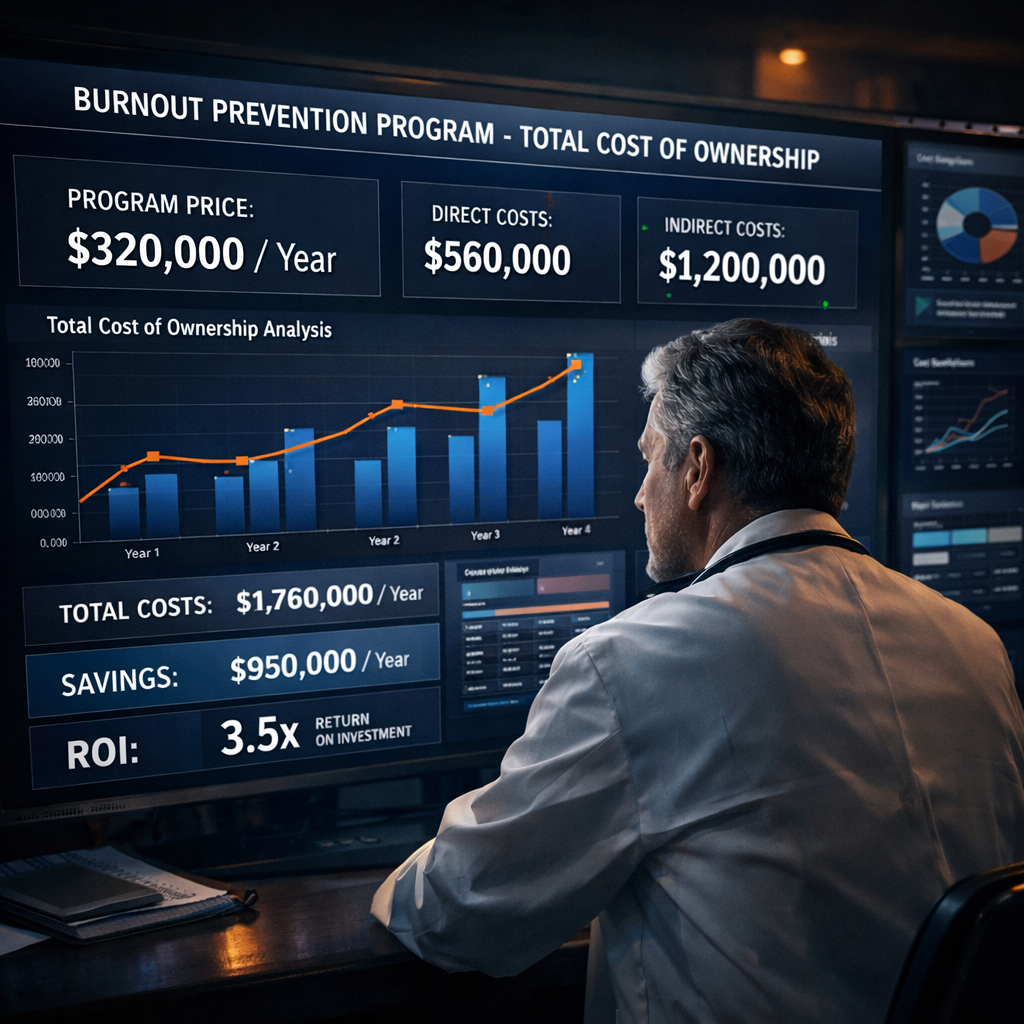
Step 3: Calculate Total Cost of Ownership (TCO)
Now you have a list of fees. It is time to add them up and see the real burnout prevention program price you will spend over a year. This is called Total Cost of Ownership, or TCO.
To get TCO you need four numbers:
- Base licence or subscription fee.
- Implementation or set‑up fee.
- Ongoing support or service fee.
- Hidden costs such as staff time.
Take an example. Your clinic has 30 clinicians. The vendor charges $12 per user per month. That is $360 per month, or $4,320 per year. Add a $500 set‑up fee and $200 per year for support. That brings you to $5,020.
Now add hidden costs. If each clinician spends 30 minutes a month filling out a survey, that is 15 hours a year. If you value clinician time at $50 per hour, that adds $750. Your total TCO is $5,770.
Why does TCO matter? Because it shows you the true burnout prevention program price over time. A low monthly fee may look cheap, but if hidden costs are high the overall price can be larger.
Our pick does not give a price, so you will need to ask for all four numbers before you sign a contract. Getting the full TCO helps you compare fairly with any other tool you might consider.
Step‑by‑step TCO worksheet:
- Write the base price per user per month.
- Multiply by number of users and months.
- Add any one‑time fees.
- Estimate staff time needed for surveys or training.
- Put a dollar value on that time.
- Sum everything for the annual TCO.
Use this worksheet when you meet with the vendor. Ask them to fill in each line for you.
For a practical toolkit that shows how to do this in accounting, see AICPA Burnout Prevention Toolkit . It gives a clear process you can copy for health care.
Step 4: Negotiate and Optimize Your Investment
Now you know the true burnout prevention program price and the TCO. It is time to talk money with the vendor. Negotiation is a skill you can learn.
First, be clear on what you need. Tell the vendor you only want the self‑assessment and the weekly check‑in. Anything extra is optional.
Second, ask for a volume discount. Many vendors will lower the per‑user price if you buy for 50 or more users.
Third, ask for a trial period with no cost. That lets you test the tool before you lock in a price.
Fourth, ask if they can bundle coaching or data reports into the base price. Bundles often cost less than buying each piece separately.
Our pick, the Confidential Wellbeing Self‑Assessment, does not list a price, so you have room to ask for a custom quote. Because it is fully online, you may be able to get a lower rate if you agree to a longer contract.Fifth, watch for hidden renewal hikes. Some contracts raise the price after the first year. Ask for a fixed price for at least three years.
Sixth, consider a phased rollout. Start with a pilot group of 10 users. If the pilot works, expand to the whole staff. This spreads the cost and reduces risk.
Here are three quick negotiation tips:
- Know your budget before the call.
- Ask for a discount on any extra module you do not need.
- Get any promised discount in writing.
Ready to get help right now?Ready to stop burnout?Try e7D‑Wellness free →
Watch this short video that walks you through a simple negotiation checklist for wellness tools.
When you finish the video you should have a list of asks ready for the vendor. Use that list in your next call.
For more mental health support ideas see Mental Health Support for HCPs . It gives ideas on how to pair a self‑assessment with coaching.
FAQ
What is the best way to find out the burnout prevention program price if it is not listed?
The best way is to contact the vendor directly. Explain your staff size, the features you need and ask for a full quote that includes base fees, set‑up costs, support fees and any hidden costs. Write down each number so you can calculate the total cost of ownership.
How can I compare a subscription model to a license model?
First, list the features you need. Then map each feature to the tier that offers it in both models. Next, calculate the yearly cost for each model using your staff count. Add any one‑time fees and staff time costs. The model with the lower total cost of ownership is the better fit.
Why should I include staff time as a hidden cost?
Staff time adds up. If clinicians spend 30 minutes a month on surveys, that is extra work that could be done elsewhere. By putting a dollar value on that time you see the real burnout prevention program price and avoid surprise expenses later.
Can I negotiate a lower price for a fully online self‑assessment?
Yes. Ask for a volume discount, a longer contract rate, or a bundled package that adds coaching at a lower price. Because the tool is online there are often lower overhead costs that vendors can pass on.
What is a reasonable budget for a small clinic with 20 clinicians?
A reasonable budget might be $8‑$12 per user per month for a basic self‑assessment plus $200‑$300 for set‑up and support. That works out to about $2,000‑$3,000 a year. Add staff time cost and you get a total cost of ownership around $2,500‑$3,500.
How often should I review the burnout prevention program price?
Review it at least once a year. Check if you have added or lost users, if you need new features, and if the vendor has changed fees. A yearly review helps you keep the cost in line with your budget.
Is it worth paying extra for coaching and analytics?
If your goal is to lower exhaustion scores and improve retention, coaching and analytics can give you data to act on. Compare the extra cost to the potential savings from lower turnover. If the ROI looks positive, the higher burnout prevention program price can be justified.
Where can I find examples of successful burnout prevention programs?
Many professional groups share case studies on their websites. Look for stories that mention a self‑assessment, weekly check‑ins and coaching. Those examples can help you set realistic goals and budget.
Conclusion
Finding the right burnout prevention program price takes work, but it pays off. You start by knowing what your team needs, then you break down every fee, calculate the total cost of ownership and negotiate for the best deal. Our pick, the Confidential Wellbeing Self‑Assessment, is fully online and built for clinicians, but you will need to ask for a custom quote.
Use the steps in this guide to compare any tool you see. Ask for a clear list of fees, add staff time, and run the numbers. Negotiate volume discounts, fixed‑price contracts and bundled services. When you do all that you will end up with a program that fits your budget and helps your staff stay healthy.
If you are ready to take the next step, start with a free e7D‑Wellness assessment. It will give you a personal wellbeing profile and a clear view of your burnout risk. Then you can match that insight to the right program and price.
Take action today. A clear plan will protect your team, improve patient care and keep costs under control.


Comments