

Burnout Self Test for Nurses: A Step‑by‑Step Guide to Recognize and Manage Exhaustion
- Patricia Maris

- 12 minutes ago
- 9 min read
Burnout hits nurses hard. One in three say they feel wiped out after a shift. You need a clear way to see if you are heading toward burnout and what to do about it. This guide shows you how to take a burnout self test for nurses, read the numbers, and build a simple plan that fits a busy schedule.
We examined 11 evidence‑based nurse burnout self‑assessment tools from 10 sources and discovered that the most detailed 33‑item scale is completely free, while a single‑question paid tool costs $2 per use.
Name | Items | Cost | High Burnout Cutoff | Best For | Source |
Operating Room Nurse Burnout Scale | 33 | — | top 27% of scores | Best for comprehensive depth | pmc.ncbi.nlm.nih.gov |
Burnout Assessment Tool (BAT) – 23-item version | 23 | — | 75–95th percentile | Best for percentile‑based cutoff | scirp.org |
Maslach Burnout Inventory – Human Services Survey for Medical Personnel (MBI‑HSS MP) | 22 | Individual Report – $15; Group Report – $200 | EE ≥27 or DP ≥10 | Best for detailed scoring (EE/DP) | nam.edu |
Maslach Burnout Inventory – Human Services Survey (mindgarden) | 22 | — | — | Best for quick 10‑min admin | mindgarden.com |
Maslach Burnout Inventory – Human Services Survey (pmc) | 22 | $2.00 per use for small-volume administration | — | Best low‑cost per‑use | pmc.ncbi.nlm.nih.gov |
Maslach Burnout Inventory (generic) | 22 | — | score of at least 48 | Best standard cutoff | emro.who.int |
Copenhagen Burnout Inventory (CBI) | 19 | $0 | score of 50 or higher | Best free with clear cutoff | nam.edu |
Oldenburg Burnout Inventory (OLBI) | 16 | $0 | 44 | Best free with moderate cutoff | nam.edu |
Maslach Burnout Inventory – Emotional Exhaustion (MBI‑EE) 9-item | 9 | — | — | Best moderate-length free | frontiersin.org |
Maslach Burnout Inventory – Emotional Exhaustion single-item (MBI:EE) | 1 | $2.00 per use for small-volume administration | ≥4 | Best single-item paid | pmc.ncbi.nlm.nih.gov |
Non‑proprietary single-item burnout measure (Rohland et al.) | 1 | free | ≥3 | Best ultra‑brief free | pmc.ncbi.nlm.nih.gov |
Quick Verdict:The free Operating Room Nurse Burnout Scale wins as the most comprehensive, no‑cost option. For a quick, free screen, the Copenhagen Burnout Inventory is a solid runner‑up. Skip the pricey MBI‑HSS MP unless you need its dual subscale scores.
We searched academic databases, publisher sites, and open‑access repositories on 31 March 2026. We pulled name, items, cost, and high‑burnout cutoffs for each tool. Only tools with at least two filled fields made the final list. The sample size was 21 items.
Step 1: Take the Burnout Self‑Test
The first thing you do is find a test that matches your schedule and budget. If you want a free, thorough tool, pick the Operating Room Nurse Burnout Scale. It has 33 questions and takes about 10‑15 minutes.
Here’s a quick way to start:
Set aside a quiet 15‑minute slot. Turn off phone alerts.
Open the test on a device that won’t distract you.
Read each item carefully. Answer honestly – there is no right or wrong.
When you finish, note the raw score. Most tools give you a number and a cutoff.
Why honesty matters: the test only helps you if the answers reflect how you truly feel. If you downplay fatigue, the score will look better than it is, and you’ll miss the chance to act.
Take the test on a platform that keeps your data private. For example, the Stanford Well‑being self‑assessment says your responses stay confidential and are not saved. You can trust that your answers won’t be shared with anyone.
Another tip: do the test when you’re not in the middle of a hectic shift. A calm mind gives clearer answers.
When you finish, you’ll get a short report. It may show a total burnout score and sometimes sub‑scores for emotional exhaustion and depersonalization.
External resources can help you understand the test format. The Stanford Well‑being Self‑Assessment page explains how scores are built. A second link to the same site gives a deeper look at how the professional fulfillment scale works: Stanford Professional Fulfillment Scale .
Internal link: If you want to learn more about compassion fatigue, check out our Compassion Fatigue Test Guide for nurses.
Step 2: Interpret Your Score
Now you have a number. What does it mean? First, compare it to the cutoff listed for the tool you used. If your score is above the high‑burnout line, you are likely in the top 27 % of burnout levels for that scale.
Let’s break it down with the free Copenhagen Burnout Inventory (CBI). A score of 50 or higher signals high burnout. If you scored 55, you’re above the threshold.
What to do with that info? Treat it like a weather alert. It tells you the risk level. You can then pick actions that match the severity.
High scores on emotional exhaustion suggest you feel drained after each shift. Look for patterns – do you feel worse after night shifts? Do certain units wear you out more?
Low scores on compassion satisfaction mean you may not be getting enough joy from patient care. Think about moments that felt rewarding and try to repeat them.
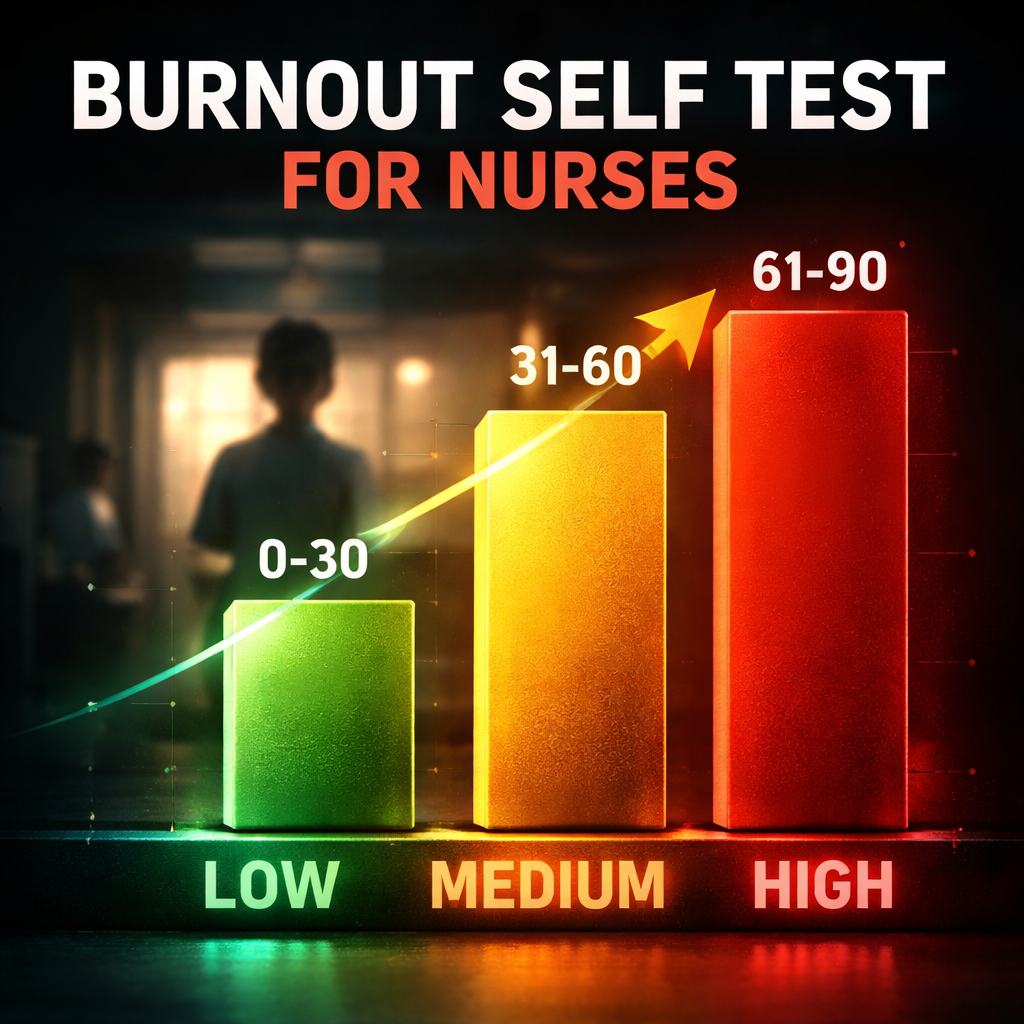
To help you visualise the data, we added an image placeholder below. Replace it with a simple chart that shows low, medium, and high zones.
External link: For a deeper dive into the science behind the CBI, see the NAM page that hosts the instrument: NAM Burnout Instruments. Another useful source is the MindGarden site that explains how to score the Maslach Burnout Inventory: MindGarden Maslach Overview.
Internal link: For ideas on how moral injury can add to burnout, read our Moral Injury Resource Guide .
Step 3: Create a Personal Action Plan
Knowing your score is only half the battle. The next step is to turn the numbers into steps you can take.
Start with one small habit. Pick a time of day when you can do a quick reset. For many nurses, a 5‑minute breath break at the start of a shift works well.
Write down three goals that match your score:
Goal 1: Reduce emotional exhaustion by adding a 10‑minute walk after each 8‑hour shift.
Goal 2: Boost compassion satisfaction by noting one positive patient interaction each day.
Goal 3: Lower secondary trauma by scheduling a 15‑minute debrief with a peer twice a week.
Make the goals SMART – specific, measurable, achievable, relevant, time‑bound. Example: "Walk 10 minutes after shift on Monday, Wednesday, Friday for the next two weeks. Track distance with phone app."
Keep the plan visible. Stick it on your locker or set a reminder on your phone.
Video below shows a quick walk‑through of how to set up a simple action plan using a printable template.
External link: The Stanford self‑assessment page also lists resources you can explore after scoring high, such as stress‑management courses: Stanford Resources . Another source that talks about self‑valuation and its link to burnout is the Academic Psychiatry paper cited on the Stanford page – you can read it here: Academic Psychiatry Burnout Study.
Internal link: Join a community of nurses who share tips on quick wins. Our Private HCP Slack Community is a place to post your plan and get feedback.
Step 4: Implement Quick Stress‑Relief Strategies
Even with a plan, you need tools you can use in the middle of a shift. Here are three fast ideas that fit into a 2‑minute window.
Micro‑breathing
Inhale for four counts, hold for four, exhale for six. Do it twice while you’re washing your hands. It drops heart rate fast.
Mini‑stretch
Raise arms overhead, stretch side to side, then roll shoulders backward. It eases tension in the neck and shoulders.
Positive note
Write one sentence about something that went well on a sticky note. Stick it on your computer. Seeing it later lifts mood.
These tricks are backed by research that shows short breaks improve focus and reduce error rates in nurses.
Image placeholder for a calming nurse break scene:

External link: The NAM site has a page on quick stress‑relief practices for clinicians: NAM Stress Relief Tips. Another useful page on simple self‑care for health workers lives on the Frontiers site: Frontiers Self‑Care Article .
Internal link: If you want a printable habit tracker, see our Gratitude Journal Prompts PDF – it works great alongside the stress‑relief steps.
Step 5: Monitor Progress and Seek Support
Changing habits takes time. You need a way to see if the burnout self test for nurses scores are moving in the right direction.
Week | Burnout Score | Action Taken | Result |
1 | 55 | Started 10‑min walk | Feeling less drained after night shift |
2 | 52 | Added positive note | More smiles on ward |
3 | 48 | Peer debrief | Lower anxiety scores |
Use a simple spreadsheet or a free app to log your numbers each week. Look for trends – a steady drop means you’re on the right track.
If scores stay high after a month, it’s time to reach out for professional help. Talk to a counselor, a trusted supervisor, or a mental‑health hotline. You don’t have to go it alone.
External link: The American Nurses Association offers a guide on when to seek help: ANA Help Guide. Another good read on peer support is on the MindGarden blog: MindGarden Peer Support.
Internal link: For more ideas on handling trauma and sleep, read our Trauma Stress and Sleep Tips article.
When to Call a Professional
If you notice any of these signs, act fast:
Persistent sadness that lasts more than two weeks.
Thoughts of quitting or feeling hopeless.
Physical symptoms like headaches, stomachaches, or constant fatigue.
These are red flags that mean the burnout self test for nurses is telling you that deeper help is needed.
Building a Support Network
Talk to a peer you trust. Share your score and ask how they cope. Often a quick chat can spark new ideas.
Join a group like the private Slack community we mentioned earlier. Seeing others’ scores normalises the experience.
FAQ
How often should I take the burnout self test for nurses?
We suggest retaking the test every 8‑12 weeks, or after a big change in your schedule. This lets you see if your scores are going up or down and lets you adjust your plan. If you’re on a night‑shift rotation, try after each rotation cycle.
What if my score is just below the high‑burnout cutoff?
A score just under the cutoff still means you have some risk. Use it as a warning sign. Start with one or two quick stress‑relief tricks and watch the number drop. The goal is to keep the score well below the line.
Can I use the same burnout self test for nurses for other staff?
Some tools, like the Copenhagen Burnout Inventory, work for any health‑care role. But nurses often face specific shift patterns, so a nurse‑focused tool may give more accurate clues.
Is the burnout self test for nurses confidential?
Yes. Most reputable tools, including the Stanford self‑assessment, keep your answers private and do not store them on a server. You can take the test on your own device without worry.
Do I need a therapist if my burnout score is high?
A high score means you should consider professional help. A therapist trained in health‑care worker stress can give you coping skills, talk therapy, or referrals. It’s not a sign of weakness; it’s a smart step.
What if I can’t find time to do the full 33‑item test?
Start with a shorter free tool like the Copenhagen Burnout Inventory (19 items). It still gives a clear picture and takes only 5‑7 minutes. You can later try the longer test if you want more detail.
How does the burnout self test for nurses differ from a general stress survey?
The nurse version asks about patient load, shift work, and emotional demands that are unique to nursing. General stress surveys may miss these specifics, so the nurse test gives a more relevant score.
Can I share my results with my manager?
Yes, if you feel safe. Sharing can open a conversation about workload changes or support options. Many hospitals have wellness programs that use these scores to guide improvements.
Conclusion
Doing a burnout self test for nurses is a simple first step that can save you from years of exhaustion. By picking the right tool, reading the score, making a tiny action plan, using quick stress tricks, and checking your progress, you build a safety net for your wellbeing. Remember, the free Operating Room Nurse Burnout Scale offers the most detail without costing a cent. Pair that with the Copenhagen Burnout Inventory for a fast screen, and you have a solid combo.
Take the test today. Write down one habit you will try tomorrow. And if the numbers stay high, reach out for help – you deserve support. For a deeper dive into your whole wellbeing, the e7D‑Wellness platform offers a confidential profile that maps the eight pillars of health. Start now and give yourself the care you give to every patient.


Comments