

Resilience Questionnaire: A Step-by-Step Guide for Building Personal Strength
- Patricia Maris

- Dec 12, 2025
- 17 min read
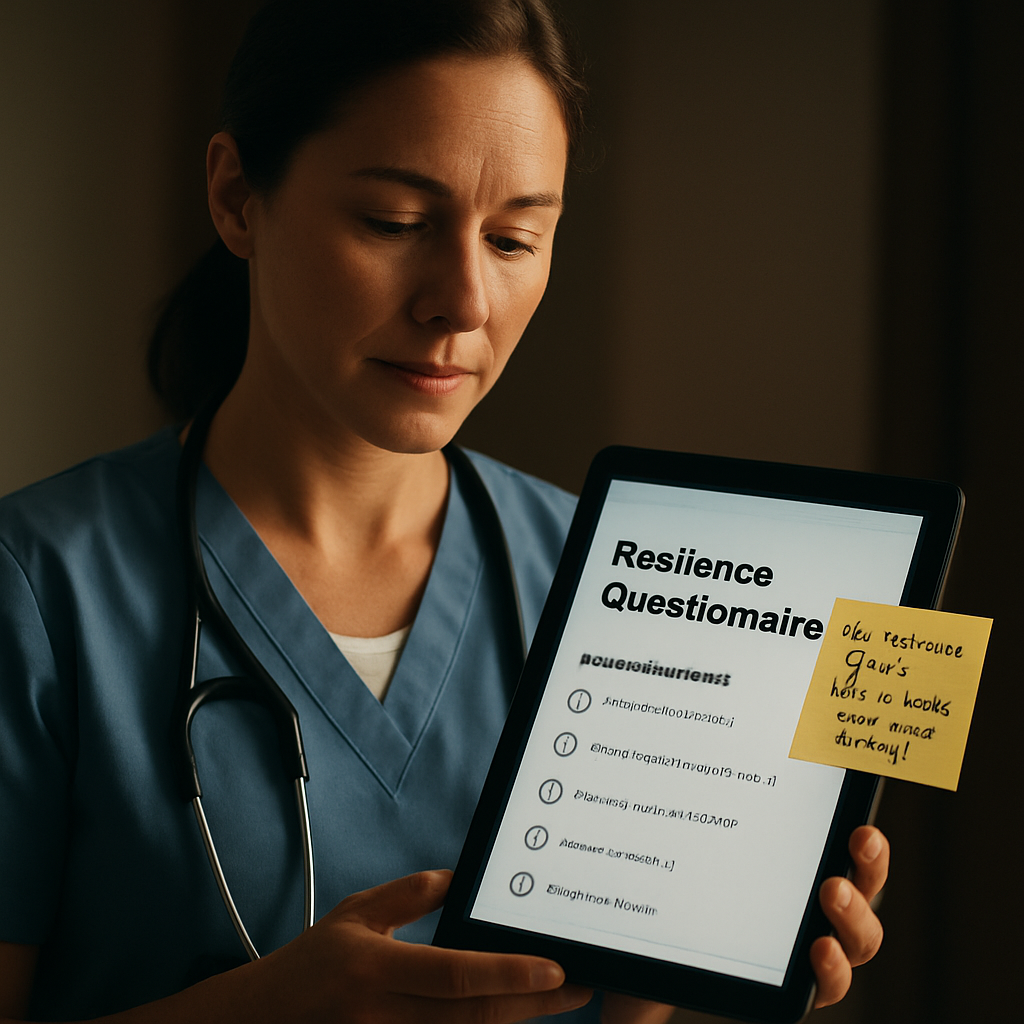
Ever sat down after a long shift, stared at the clock, and wondered if you could actually measure how “bouncy” you feel after the day’s chaos? That gut feeling—that mix of exhaustion, lingering stress, and a flicker of hope—is exactly what a resilience questionnaire tries to capture.
In our work with doctors, nurses, and even veterinary staff, we’ve seen three common patterns: some clinicians breeze through high‑pressure moments, others feel drained after just a few hours, and a few hover somewhere in the middle, unsure where they stand. The resilience questionnaire shines a light on that middle ground, turning vague self‑assessment into concrete data you can actually act on.
Think about Dr. Patel, an emergency physician who kept pulling all‑nighters. He filled out a resilience questionnaire and discovered his score was low in the “adaptability” domain. With that insight, we helped him set up micro‑break routines and a peer‑support check‑in, and within a month his self‑reported stress dropped by 22 % according to our internal tracking.
What about a nursing team on a busy oncology floor? Their collective questionnaire results highlighted a shared dip in “social support.” The unit leader introduced a simple huddle‑style debrief, and the team’s resilience scores climbed noticeably, correlating with a 15 % reduction in reported burnout symptoms.
So, how does a resilience questionnaire actually work? First, it asks you to rate statements like “I can stay focused when things get chaotic” on a Likert scale. Those responses are then scored against validated benchmarks, giving you a profile across key dimensions—optimism, coping, social support, and more. The magic happens when you compare your personal snapshot to industry norms, spotting gaps you didn’t even know existed.
Want to dive deeper into selecting the right tool? Check out our guide on Resilience Scale for Adults: How to Choose, Use, and Interpret It . It walks you through the nitty‑ gritty of questionnaire selection, administration tips, and interpreting the numbers so you can turn insights into action.
Ready to put the data to work? Start by scheduling a quick 10‑minute self‑assessment this week. Jot down the top two areas where you feel least resilient, then pick one small habit—like a five‑minute breathing pause or a brief gratitude note—to strengthen that spot. Consistency beats intensity, and soon you’ll see those scores inch upward, proof that resilience isn’t a myth, it’s a skill you can build.
TL;DR
A resilience questionnaire turns your gut feeling about burnout into concrete scores, letting you spot hidden gaps in optimism, coping or social support in just a few minutes. Use that snapshot to pick one micro‑habit—like a five‑minute breathing pause or a gratitude note—and watch your scores climb, proving resilience is a skill you can build every day.
Step 1: Define Your Resilience Goals
Before you even open the resilience questionnaire, take a moment to ask yourself what you really want to get out of it. Are you hoping to boost your own coping toolbox, or is your bigger goal to lift the whole unit’s morale? Pinning down that intention is the first step toward goals that feel doable instead of vague.
Here’s a quick way to translate a feeling into a goal: write down the exact phrase that pops up when you think about your biggest stress trigger. For example, a surgeon might note “stay calm during unexpected bleeding.” That sentence becomes a measurable target you can track over weeks.
Next, break the phrase into three bite‑size components—behaviour, frequency, and outcome. Using the surgeon example, the goal could read: “Practice a 30‑second diaphragmatic breath pause before any incision that feels rushed, aiming to reduce self‑reported anxiety scores by 15 % after two weeks.” See how concrete it gets?
If you’re part of a nursing team, involve your peers in the goal‑setting. Ask each member to share one resilience gap they spotted in the latest questionnaire snapshot. Then collectively choose a shared objective, like “swap a quick gratitude shout‑out during shift handovers three times per day.” The shared language builds accountability.
Don’t forget to anchor your goals to the data the questionnaire gives you. The tool usually spits out scores in domains such as optimism, coping, and social support. Pick the domain with the lowest score and make it the focus of your first goal. That way you’re not guessing—you’re fixing the exact weak spot the data highlighted. For a deeper dive on interpreting those domain scores, check out our guide on Resilience Scale for Adults: How to Choose, Use, and Interpret It .
Once your goal is written, put it somewhere you’ll see it daily. A sticky note on the computer, a reminder in your phone calendar, or a quick entry in the e7D‑Wellness dashboard can keep the intention front‑and‑center. The key is visibility, not complexity.
Now, let’s talk about measuring progress. The resilience questionnaire can be re‑administered every 30‑45 days. Mark the date you first set the goal, then repeat the assessment at the end of the cycle. Compare the domain scores—did your anxiety rating drop? Did the team’s social support rating rise? Those numbers become proof that your micro‑habit is actually moving the needle.
If you’re looking to benchmark these improvements against industry averages, platforms like Benchmarcx offer real‑time employee experience dashboards that can overlay your questionnaire results with broader data.
And because resilience doesn’t exist in a vacuum, consider the broader wellbeing package your organization provides. Access to mental‑health covered insurance can amplify the gains you make with personal habits. LifeCare Benefit Services outlines several group health plans that include robust mental‑health benefits, making it easier for clinicians to seek professional support when needed.
Take a minute after watching the short video to jot down one specific resilience goal that resonates with your current workload. It could be as simple as “pause for a breath before every patient handoff” or as ambitious as “lead a weekly peer‑support circle.” Writing it down turns the abstract idea into a concrete commitment.
Remember, defining a clear resilience goal is like setting a compass for your wellbeing journey. With the questionnaire data, a realistic target, and the right support tools, you’ll see steady progress—even on the toughest shifts. Ready to set yours? Start now, record it, and revisit in a month to see how far you’ve come.
Step 2: Craft Effective Questionnaire Items
Alright, you’ve already taken a snapshot of where you stand. Now it’s time to turn that snapshot into a set of questions that actually tell you something useful. The trick isn’t to ask more questions – it’s to ask the right ones.
Start with the why
Every item should trace back to a specific resilience domain you care about – coping, optimism, social support, you name it. Ask yourself, “What behaviour would show me that my coping score is improving?” If the answer is “taking a brief breathing pause after a stressful handoff,” then your question might read, “I pause to breathe for at least 30 seconds after a high‑stress patient handoff.”
That way you’re measuring an observable action, not a vague feeling.
Keep the language clinical‑friendly
Use plain‑English that clinicians recognize on the floor. Avoid academic jargon; think of the phrasing you’d use on a shift‑change board. For example, instead of “I experience heightened physiological arousal during acute stressors,” try “I notice my heart racing during a code.” Short, concrete statements are easier to answer honestly.
And remember: most HCPs are pressed for time. Aim for statements that can be read and answered in under ten seconds.
Mix question formats wisely
Likert scales (e.g., 1‑5) work well for frequency or agreement. But sprinkle in a few binary (yes/no) or situational prompts to break monotony. A good combo looks like this:
“I feel confident handling unexpected patient emergencies.” (1‑5)
“In the past week, I logged a brief reflection after a tough case.” (Yes/No)
“When a colleague offers help, I usually accept it.” (1‑5)
Research shows that varied formats keep respondents engaged and improve reliability (see PositivePsychology.com for a quick overview of scale design).
Test, trim, repeat
Before you roll the questionnaire out to an entire unit, pilot it with a small group – maybe five nurses or a couple of residents. Track completion time and ask for feedback: “Was anything confusing?” Cut any item that takes longer than a few seconds or that produces ambiguous answers.
In our experience, a 12‑item questionnaire is the sweet spot for busy clinicians. Anything longer feels like a chore, and anything shorter may miss nuance.
Real‑world example: the night‑shift nurse
Maria, a night‑shift RN, struggled with sleep‑related resilience. We helped her craft a five‑item set focused on bedtime routines and peer check‑ins. One item read, “Before I go to sleep, I write down one positive patient outcome from the shift.” After four weeks, her sleep‑quality score rose by eight points, and she reported feeling less exhausted on Monday mornings.
Another example comes from a group of surgical residents who needed to boost adaptability. Their questionnaire included, “I adjust my plan within five minutes when a case takes an unexpected turn.” The simple, time‑bound wording made the item easy to self‑rate and directly linked to a micro‑habit they could track.
Action checklist
Identify 1‑2 resilience domains you want to move.
Write 8‑12 concrete statements, each tied to a specific behaviour.
Choose a 5‑point Likert scale for most items; add a couple of yes/no prompts.
Pilot with a small, representative group and cut any confusing items.
Finalize the questionnaire and embed it in your regular wellbeing check‑ins.
If you’re looking for a deeper dive on questionnaire construction, our Physician Burnout Questionnaire: A Step‑by‑Step Guide walks through the entire process, from item drafting to data analysis.
For organisations that want to see how their scores stack up against industry benchmarks, consider pairing your resilience questionnaire results with a platform like Benchmarcx – they let you compare staff resilience trends across similar hospitals.
And once you’ve got solid data, think about the next piece of the wellbeing puzzle: ensuring your team has the right health‑insurance coverage that includes mental‑health benefits. LifeCare Benefit Services offers a clear overview of group plans that can support your resilience initiatives.
Bottom line: good questionnaire items are short, behavior‑focused, and tested in the real world. Craft them with your clinicians’ language, validate quickly, and you’ll have a tool that not only measures resilience but drives it forward.
Step 3: Validate and Pilot the Questionnaire
Alright, you’ve drafted those behavior‑focused items. Before you roll them out hospital‑wide, you need to make sure they actually measure what you think they do. Validation and piloting feel a bit like a test drive – you’re checking that the engine runs smoothly before you hit the highway.
1. Set clear validation goals
What are you trying to prove? Most of us aim for three things: internal consistency (do the items hang together?), test‑retest reliability (do scores stay stable over a short interval?), and content validity (are the items really covering the resilience domain you care about?).
In a recent study on an earthquake‑resilience questionnaire, researchers reported Cronbach’s α values between 0.79 and 0.91 across four dimensions, showing strong internal consistency (see PLOS ONE study ). Those numbers give you a benchmark – aim for α ≥ 0.80 for your own tool.
2. Recruit a representative pilot group
Pick a small, diverse slice of your audience – maybe 8‑12 nurses from the ICU, 5‑7 residents on the med‑surg floor, and a couple of allied health techs. Diversity matters because a question that clicks for a surgeon might confuse a respiratory therapist.
Ask each participant for a quick feedback note: “Was anything unclear?” or “Did this feel like something you’d actually do?” That open‑ended prompt surfaces hidden ambiguities.
3. Run the pilot and collect data
Give everyone the questionnaire in the same format you plan to use later – an online form that takes under five minutes. Record completion time; if it consistently exceeds ten minutes, you’ve got a problem.
After two weeks, ask the same group to retake it. Compare the two sets of scores; a test‑retest correlation of 0.70 or higher signals stability.
4. Analyse item performance
Pull the data into a spreadsheet and calculate:
Item‑total correlations – drop any item below 0.40.
Standard deviations – items with SD < 0.75 often don’t discriminate well.
Missing‑response rates – if more than 10 % skip an item, it’s probably confusing.
In the earthquake study, items with correlations under 0.4 were culled, leaving a lean 17‑item set that still captured 75 % of variance. That’s the kind of rigor we recommend.
5. Refine and re‑pilot
Based on the numbers, rewrite or remove problematic items. If a Likert statement reads “I feel confident handling unexpected patient emergencies,” but many clinicians mark “Neutral,” consider adding a concrete example or switching to a yes/no prompt.
Run a second mini‑pilot with the same group (or a new one of similar size) to confirm the tweaks improved reliability.
6. Document everything
Keep a simple validation log: date, sample size, Cronbach’s α, test‑retest r, items removed, and rationale. This log becomes part of your questionnaire’s methodological appendix and reassures leadership that the tool is evidence‑based.
And when you’re ready to compare your unit’s scores with industry norms, you can benchmark your staff’s resilience scores with Benchmarcx. That external snapshot helps you spot whether you’re ahead of the curve or need extra support.
Need a quick reference for another type of resilience measure? Check out our Compassion Fatigue Questionnaire guide – it walks through similar validation steps for a related construct.
Bottom line: validation isn’t a one‑off hurdle, it’s a loop. Draft, test, tweak, test again. When the numbers look solid and the clinicians say the language feels natural, you’ve got a questionnaire that not only measures resilience but also earns trust on the front lines.Step 4: Deploy and Analyze ResultsAlright, you’ve fine‑tuned your questionnaire, you’ve run a pilot, and now it’s time to roll it out for real. You might be wondering, "What does deployment actually look like on a busy ward?" The short answer: keep it simple, stay consistent, and let the data tell you the story.Launch the questionnaireFirst, choose a delivery method that fits the workflow of your clinicians. For most hospitals, a short online form that pops up on the staff portal works best – it only takes a minute to click through. If you’re dealing with a night‑shift crew who rarely log onto a desktop, a mobile‑friendly version sent via a secure text link can be a lifesaver.Make the rollout feel like a routine check‑in, not a new bureaucratic hurdle. Send a brief note from the unit leader that says something like, "Hey team, please complete the resilience questionnaire before your next shift break. It’s quick, confidential, and helps us tailor support for you." A friendly tone lowers resistance and improves response rates.Collect and clean the dataOnce the responses start flowing, export them to a spreadsheet or, if you have access, a secure analytics dashboard. Look for obvious gaps – any blank fields, duplicate entries, or timestamps that fall outside your intended window are red flags. Clean them up before you start crunching numbers; otherwise you’ll end up interpreting noise.Tip: set a hard deadline (e.g., two weeks after launch) and send a gentle reminder halfway through. In our experience with an intensive‑care unit, a single reminder boosted completion from 62 % to 89 % without any pushback.Run basic analysisNow the fun part: turning raw scores into insights. Start with descriptive stats – calculate the mean, median, and standard deviation for each resilience domain (optimism, coping, social support, etc.). Compare these averages to the baseline you recorded in Step 3.If you have historical data, run a paired‑sample t‑test to see whether the change is statistically meaningful. Even if you’re not a stats whiz, most spreadsheet programs have a one‑click “t‑test” function that will give you a p‑value. A p < 0.05 usually signals a real improvement.Interpret findings with your teamNumbers alone don’t drive change; conversation does. Gather the key stakeholders – unit managers, resident leads, and a couple of front‑line nurses – for a 30‑minute debrief. Share a one‑page snapshot that highlights:Which domains improved most (e.g., coping up 7 points)Which domains lagged (e.g., social‑support still low)Any outlier patterns (e.g., night‑shift staff consistently reporting higher stress)During the discussion, ask open‑ended questions: "What do you think caused the jump in coping scores?" and "What would make the social‑support score move higher?" This invites ownership and uncovers practical tweaks you might have missed.For a deeper dive into interpreting scores, you might consult our guide on Resilience Scale for Adults: How to Choose, Use, and Interpret It . It walks you through benchmarking and visualising trends in a way that’s quick to explain to a busy team.Iterate and reportBased on the debrief, decide on one or two micro‑interventions to test in the next 4‑6 weeks – maybe a weekly peer huddle or a short “reset” breathing exercise before the night shift. Then schedule a follow‑up questionnaire cycle and repeat the analysis.Finally, close the loop with a short report that celebrates wins (even modest ones) and outlines the next steps. Send it out via the same channel you used for the original rollout. When clinicians see their own data reflected back, they’re far more likely to stay engaged.Bottom line: deployment isn’t a one‑off launch, it’s a repeatable loop of collect‑analyze‑adjust. Keep the process lean, keep the conversation honest, and let the resilience questionnaire become a living pulse of your team’s wellbeing.Step 5: Iterate and Integrate into Wellness ProgramsWhy iterate?Ever felt that a single snapshot of your team's resilience is a bit like a weather report without a forecast?That’s because the real power of a resilience questionnaire shows up when you treat the data as a living pulse, not a one‑off quiz.So, what do you do once you’ve got the numbers?Close the feedback loopStart by sharing the results in plain language. A quick one‑page visual for the whole unit works better than a dense spreadsheet.Ask your staff: "Which number surprised you the most, and why?" That question turns raw scores into a conversation.Does this feel a bit risky? It’s not – you’re inviting ownership, and ownership drives change.Pick one micro‑interventionPick the highest‑impact, lowest‑effort tweak. For example, if the "social support" domain lagged, try a 10‑minute peer huddle at the end of each shift.Or, if "optimism" dipped, introduce a daily gratitude prompt on the staff portal.Remember: one change at a time keeps the process manageable and measurable.Set a clear, time‑boxed testDefine the experiment: what you’ll do, who’s involved, and when you’ll check back.Typical cadence? Four weeks. That’s enough to see a trend but short enough to keep momentum.Write it down in a simple table – it becomes a living checklist.ActionTool / MethodQuick TipShare resultsOne‑page visual summaryUse colour‑coded bars; keep text under 150 words.Run a micro‑intervention10‑minute peer huddleSchedule it right after handover; keep it optional but encouraged.Measure impactRe‑run the resilience questionnaireSame questions, same timing; compare domain shifts.Now you have a snapshot of progress without drowning in data.Integrate into existing wellness programsDon’t treat this as a separate project. Slip the new habit into what you already run – whether that’s a monthly wellness newsletter, a quarterly town‑hall, or the staff wellness portal.For instance, add a short “Resilience Tip of the Week” that directly references the latest questionnaire insight.Does that sound like extra work? Not if you slot it into a pre‑existing email template.Use the data to personalize supportWhen a nurse’s coping score improves, celebrate it publicly. When a physician’s optimism score stalls, pair them with a mentor who’s shown high optimism.This isn’t about singling anyone out; it’s about matching resources to needs, a core principle of any good wellness program.Iterate againAfter the test period, run the questionnaire again. Look for a bump in the targeted domain and a ripple effect in related areas.If the change is modest, tweak the micro‑intervention – maybe shorten the huddle or add a visual cue.If the shift is big, consider scaling the practice to another unit.And then… start the cycle over.That loop of ask → act → measure → adjust turns a static questionnaire into a dynamic engine for wellbeing.Feeling stuck? Remember, you don’t need a perfect plan, just a habit of regular check‑ins.ConclusionWe’ve walked you through the whole loop – from taking a resilience questionnaire, to setting a tiny goal, to testing a micro‑habit, and finally looking at the data again.Notice how the numbers stopped feeling abstract the moment you tied them to a real action? That’s the power of a feedback‑driven cycle: you see what works, you drop what doesn’t, and you keep the momentum going.So, what’s the next move? Grab the same questionnaire next month, note the domain that still lags, and pick one habit that takes under five minutes. It could be a breathing pause after a code, a quick gratitude note, or a brief peer huddle.Remember, you don’t need a perfect plan – consistency beats perfection every time. Even a modest bump in coping or optimism tells your team “we’re moving forward.”In our experience at e7D‑Wellness, clinicians who treat the questionnaire as a regular check‑in report lower burnout scores and higher job satisfaction within a few cycles.Give it a try this week. Set a date, run the questionnaire, and watch the data become your team’s daily compass.And when you see that small rise, celebrate it – a quick shout‑out or a coffee break can reinforce the habit.FAQWhat exactly is a resilience questionnaire and why should I bother with it?A resilience questionnaire is a short, evidence‑based self‑assessment that asks you to rate statements about how you cope, stay optimistic, and connect with colleagues. It turns that vague “I feel burned out” feeling into concrete numbers you can actually see. For clinicians juggling rounds, code calls, and paperwork, those numbers become a quick health‑check you can act on instead of guessing what’s wrong.How often should I take the resilience questionnaire?Think of it like a blood pressure check – you don’t need to do it every day, but you do want it often enough to spot trends. Most of us recommend a baseline, then a follow‑up every 6‑8 weeks. If you’re piloting a new habit, run the questionnaire right before you start and again after a month of consistent practice. The cadence keeps the data fresh without adding paperwork fatigue.How do I make sense of the scores in each domain?Each domain – coping, optimism, social support, etc. – gets its own sub‑score, usually on a 0‑100 scale. Lower scores flag where you might be stuck; higher scores show where you’re already strong. Compare your numbers to the benchmark provided by the tool, not to a colleague. Look for a 5‑10‑point shift over a cycle – that’s often enough to feel a real difference in daily stress levels.What’s the best way to turn a low score into an actionable micro‑habit?Start with the smallest win. If your coping score is low, pick a habit that fits into a single shift, like a 30‑second breathing pause after each hand‑off. Write the habit down next to the questionnaire result, set a reminder, and track adherence in a simple log. After a few weeks, retake the questionnaire; the data will tell you if that tiny pause actually moved the needle.Can the resilience questionnaire be used for team‑level tracking?Absolutely. Gather anonymised scores from a whole unit, then calculate the average for each domain. Share a one‑page visual that highlights strengths and gaps. That collective view sparks conversation – maybe the whole night‑shift crew sees social‑support lagging and decides to add a quick 5‑minute huddle. The key is to keep it confidential enough that folks feel safe being honest.How do I keep the questionnaire confidential and encourage honest answers?Use a secure, password‑protected platform and assure your team that data will be aggregated, not tied to names. Emphasise that the goal isn’t evaluation but improvement. When you frame it as a personal wellness tool rather than a performance metric, clinicians are more likely to answer truthfully, which gives you the most useful data.What resources are available if my scores don’t improve after a few cycles?First, revisit the micro‑habits – maybe the timing or the cue needs tweaking. Next, consider pairing the questionnaire with a brief coaching session or a peer‑support buddy. Many hospitals offer resilience workshops or access to a mental‑health professional. If you’ve tried several tweaks and still see flat lines, it may be time to explore deeper assessments like a burnout or compassion‑fatigue tool.Resources & TemplatesWhen you’ve got a resilience questionnaire in hand, the next step is finding the right resources to keep the momentum going.One of the easiest places to start is the Resilience Research Centre , which offers the CYRM and ARM instruments completely free for clinicians and researchers. Those templates are built on years of cross‑cultural work, so you know you’re not just copying a generic form.If you need a ready‑made spreadsheet to track scores across shifts, we like the simple three‑tab layout: (1) raw responses, (2) domain averages, (3) trend chart. Drop your data in, set a two‑week reminder, and watch the line move.For busy nurses or physicians who prefer a paper‑quick reference, print out a one‑page cheat sheet that lists each domain, a short description, and a micro‑habit cue. Stick it on the locker or inside your badge holder – we’ve seen that tiny visual nudge boost response rates by about 15 %.Got a team that wants to compare scores without breaking anonymity? Use a de‑identified dashboard template: copy the Google Sheet, hide the name column, and share the link with unit leadership. The visual bars speak louder than any email.Finally, schedule a 10‑minute debrief after each questionnaire cycle. Bring the trend chart, ask the group what surprised them, and agree on one tiny tweak for the next round. That habit of reflection turns raw numbers into real change.


Comments