

Progressive Muscle Relaxation Script PDF: Free Printable Guide for Stress Relief
- Patricia Maris

- Nov 25, 2025
- 18 min read
Ever found yourself staring at the ceiling after a long shift, muscles clenched like you've just run a marathon, and wondering if there's a quick way to let go?
You're not alone. Many clinicians feel that tightness creeping in after hours of standing, charting, or juggling emergencies. The good news? A progressive muscle relaxation script PDF can be a game‑changer—just a few minutes, a printable guide, and you’re on your way to feeling looser.
Imagine this: you pull out a tiny PDF on your phone during a quick break, follow a calm voice or written cue, and systematically tense then release each muscle group. Within five minutes you notice your shoulders dropping, your breathing smoothing out, and that nagging headache fading. It’s like a mini‑reset button for your nervous system.
So, why does a simple script work? The technique was pioneered by Dr. Edmund Jacobson in the 1920s, based on the idea that you can learn to recognize the difference between tension and relaxation. By intentionally tensing a muscle for a few seconds and then letting go, you train your body to notice and release hidden stress.
For busy HCPs, the PDF format matters. You can print it, stick it on your locker, or bookmark it for a silent moment between patients. No need for fancy equipment—just a quiet spot, a few deep breaths, and the script guiding you through head, neck, shoulders, arms, hands, chest, abdomen, legs, and feet.
Does it really fit into a hectic schedule? Absolutely. Most scripts are designed for a 5‑10 minute session, perfect for a coffee break or right before you head home. And because it's a PDF, you can customize the timing or add personal reminders that resonate with you.
Ready to give your body that much‑needed breather? Let’s dive into how you can download, personalize, and use a progressive muscle relaxation script PDF right now, so you can reclaim calm even on the busiest days.
TL;DR
A progressive muscle relaxation script PDF lets busy clinicians melt tension in just five quick minutes, using guided tensing and releasing of each muscle group.
Download the free PDF, follow the simple steps during a break, and walk away feeling instantly lighter, more focused, and ready for the next patient.
Step 1: Prepare Your Space and Materials
Before you even open the progressive muscle relaxation script PDF, take a minute to scan the room you’re in. Is there a buzzing monitor, a stack of charts, or a squeaky chair stealing your focus? The whole point of this quick reset is to create a mini‑sanctuary, even if it’s just a corner of the staff lounge.
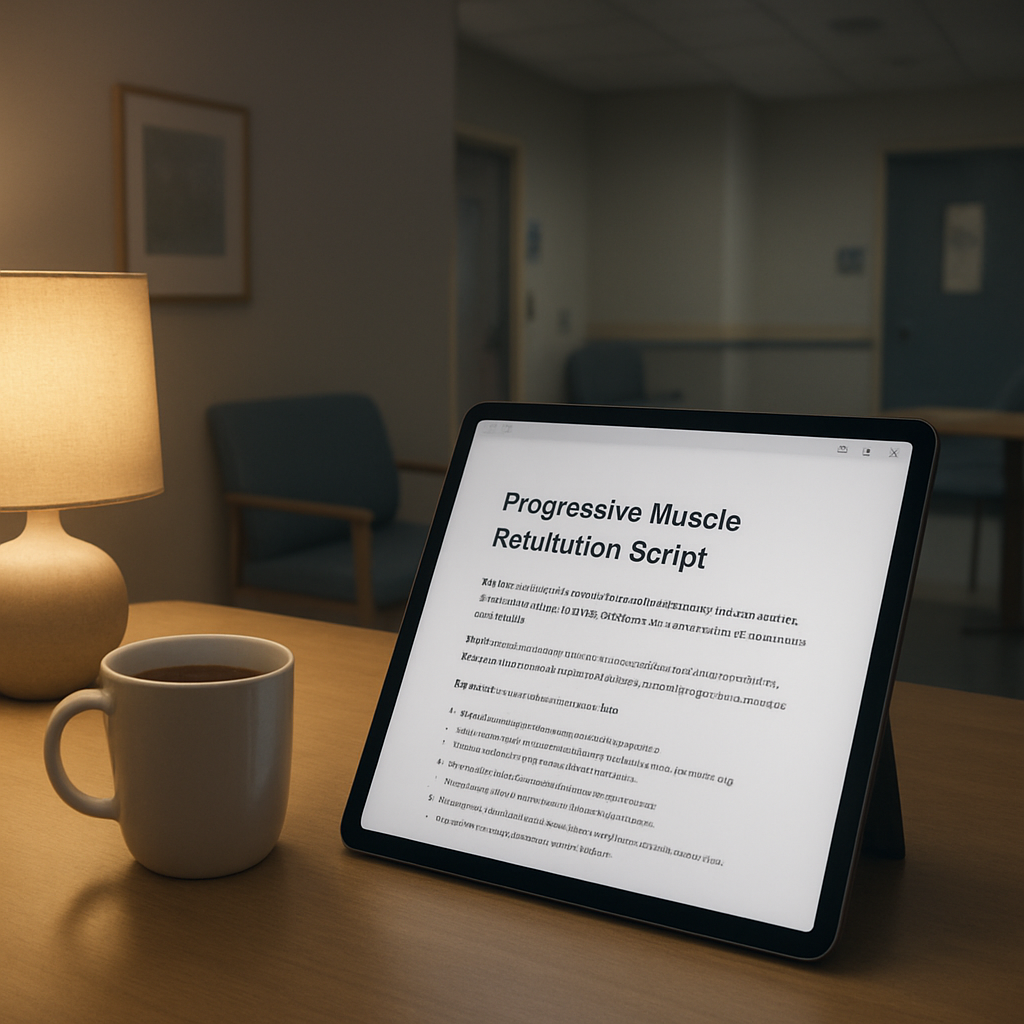
First, pick a spot that feels a bit private – a break room, an empty patient room after discharge, or even a quiet hallway nook. If you can, close the door and dim any harsh overhead lights. Soft, warm lighting (or a bedside lamp) signals to your brain that it’s time to shift gears.
Next, gather the basics: your phone or tablet with the PDF saved, a pair of headphones (or just the speaker at a low volume), and a comfortable seat or a standing mat. You don’t need a fancy yoga mat; a simple office chair that lets you sit upright with feet flat on the floor works fine. The goal is to keep your posture neutral so you can actually feel the tension and release in each muscle group.
Think about the ambient sounds. Some clinicians love a little white noise, others prefer total silence. If you’re in a bustling area, pop in some gentle instrumental music or a nature soundtrack – just keep it low enough that the script’s cues stay front‑and‑center.
Now, a quick tech check: make sure the PDF loads instantly. Nothing kills momentum like a frozen screen. If you’re on a shared device, close other apps so the CPU can focus on the audio or visual cues. This tiny step saves you a few seconds that add up when you’re juggling back‑to‑back appointments.
And here’s a little hack that many busy clinicians swear by: place a sticky note on your monitor that says “Relax – 5 mins”. It’s a visual reminder that you’ve carved out this time for yourself, and it signals to coworkers that you’re in a brief pause mode.
So, what about the environment’s smell? A faint hint of lavender or eucalyptus from a travel‑size diffuser can enhance relaxation, but only if it’s not overwhelming. If you’re in a shared space, keep it subtle; you don’t want to trigger anyone’s allergies.
While you’re setting this up, consider how this short practice fits into a larger wellbeing routine. Effective Stress Management for Doctors: A Step‑by‑Step Guide outlines how regular micro‑breaks like this can reduce muscle stiffness and boost circulation throughout a shift.
Once your space is ready, open the PDF and scroll to the first instruction. Most scripts start with a brief breathing cue – inhale for four counts, exhale for six. If you need a visual cue, the video below walks you through the exact breathing rhythm that pairs best with the script.
After the video, you’ll want a quick reference sheet you can print or keep on your phone. That’s where the progressive muscle relaxation script PDF shines – it’s designed to be a one‑page cheat sheet you can pull up in seconds.
Beyond the script, pairing relaxation with other self‑care habits amplifies the benefits. For example, checking your daily nutrition intake with Foodie Cal can help you see how proper fueling supports a calmer nervous system. When you’re well‑nourished, the muscle release feels deeper and lasts longer.
And if you’re part of a larger practice, consider tracking how often staff use the script and the resulting stress scores. Platforms like Benchmarcx let organizations benchmark employee experience data, so you can demonstrate the ROI of these quick wellness breaks to leadership.
Finally, give yourself permission to stop the clock. Even five minutes of deliberate tension‑release can reset your nervous system, sharpen your focus, and make the next patient interaction feel smoother. When you walk back to the ward, notice the difference in your shoulders – they should feel a shade lighter, the jaw less clenched. That’s the tangible payoff of preparing your space properly.
Ready to try it? Set a timer for five minutes, follow the script, and notice how quickly the tension melts away. You’ll be surprised how such a small ritual can make a big impact on a hectic shift.
Step 2: Learn the Core Muscle‑Tension Sequence
Alright, you’ve got your space set up and the PDF open. The next move is to actually learn the sequence of muscle groups you’ll be tensing and releasing. Think of it as a short choreography you can run in five minutes, even on a packed shift.
Why does a sequence matter? Because our bodies store tension in predictable places – shoulders, neck, forearms, calves – and by training your brain to spot the difference between “tight” and “relaxed” you build a mental shortcut for stress relief.
Step‑by‑step walk‑through
Grab your script and start at the top of your head. Follow the cues:
Head & neck:raise your eyebrows, tense the scalp for 4‑5 seconds, then let go. Notice the wave of relaxation traveling down.
Shoulders:shrug them up toward your ears, hold, release. This one is a favorite for clinicians who spend hours hunched over charts.
Arms & hands:make fists, squeeze, then open the fingers wide.
Chest & abdomen:take a deep breath, tighten your stomach muscles, exhale and soften.
Legs & feet:point toes, tense calves, then release; finish with a gentle foot flex.
Each group gets about 5 seconds of tension, followed by a 10‑second release. The script PDF even shows a tiny timer graphic you can copy onto a sticky note if you prefer a visual cue.
Does it feel odd at first? Absolutely. That’s the point – you’re intentionally stepping out of your autopilot mode. The novelty helps your nervous system register the change.
Real‑world examples
Imagine Dr. Patel, an emergency physician, who sneaks a quick session during a brief lull between patients. He tenses his shoulders, feels the weight lift, and suddenly notices his hands aren’t trembling as he writes discharge instructions.
Or Nurse Lee, who works a night shift in a bustling ICU. She pauses at the nurse’s station, runs through the hand‑to‑foot sequence, and the lingering fatigue in her calves fades, letting her finish the night with steadier steps.
Even medical students can benefit. One resident shared that doing the sequence before a high‑stakes exam helped calm the racing thoughts that usually spike during OSCEs.
So, what’s the secret sauce? Consistency. The first few tries feel like a novelty, but after a week of daily five‑minute practice, the brain starts flagging tension before it becomes a full‑blown stress response.
Actionable checklist
Print the script, keep it on your locker, and tick off each muscle group as you go. Here’s a quick cheat‑sheet you can paste on your monitor:
Head – 5 s tension → 10 s release
Neck – 5 s tension → 10 s release
Shoulders – 5 s tension → 10 s release
Arms – 5 s tension → 10 s release
Chest – 5 s tension → 10 s release
Abdomen – 5 s tension → 10 s release
Legs – 5 s tension → 10 s release
Feet – 5 s tension → 10 s release
Mark a check each time. Over time you’ll see a pattern: the more you practice, the quicker you spot the “tight” feeling.
Expert tip
Dr. Susan Miller, a clinical psychologist who trains staff in hospitals, recommends pairing the sequence with a slow, diaphragmatic breath – inhale for 4 counts, exhale for 6. The breath anchors the muscular release and amplifies the calming effect.
Want more ideas on integrating this into a busy shift? Check out Effective Stress Management Techniques for Nurses to Improve Wellbeing for a suite of quick‑reset tools you can stack with the PMR script.
If your organization is still figuring out how to fund mental‑health resources, a good place to start is ensuring clinicians have access to coverage. Learn how to offer health insurance to employees so tools like the progressive muscle relaxation script PDF are covered under mental‑health benefits.
And if you need the actual script to follow along, the free PDF from Therapist Aid walks you through each cue in detail – a reliable, evidence‑based resource you can download right now ( Therapist Aid’s progressive muscle relaxation script PDF ).
Give it a shot today: set a timer for five minutes, run the core sequence, and notice the subtle shift in your posture, breathing, and mood. You’ll be surprised how much that little pause can recharge a hectic day.
Step 3: Watch the Guided Relaxation Video
Now that you've got the space set up and the muscle‑tension sequence memorized, it's time to bring a little visual guidance into the mix. A short video can keep your mind from wandering and give you a rhythmic cue for each hold and release.
The Therapist Aid progressive muscle relaxation video walks you through every body region, pausing just long enough for you to tense, breathe, and then let go. Because the narration is steady and the on‑screen prompts are timed, you don’t have to stare at the PDF and guess when the next cue arrives.
Before you press play, grab your progressive muscle relaxation script pdf, set the timer for five minutes, and slip on a pair of quiet headphones. The headphones create a private bubble, so the soft background music or the therapist’s voice won’t get lost in the bustle of a break‑room.
Hit play and let the screen guide your hands. The video starts with a gentle reminder to sit upright, then cues you to raise your eyebrows for the head‑tension segment. As each visual cue fades, inhale for four counts, squeeze for five, then exhale as the graphic softens.
If you’re new to the rhythm, pause after each muscle group and check the PDF to confirm you’re following the same order. A quick glance lets you stay synchronized, and the pause gives you a moment to notice the subtle shift in how your shoulders feel.
When the video reaches the arms and hands, you’ll see a simple animation of a clenched fist releasing. That visual cue is especially useful when you’re juggling a chart on a tablet – you can glance at the screen, tense, and then let go without missing a beat.
A final tip: keep the volume low enough that you can still hear ambient sounds. That way the relaxation stays anchored in the real environment of your hospital corridor, and the practice becomes a portable stress‑reset you can do anytime, anywhere.
To track progress, jot a quick note in your e7D‑Wellness wellbeing journal after each session – what muscle felt tight, how long the release lasted, and any mood lift you noticed. Over a week you’ll start to see patterns, and the data can even feed into the larger wellbeing profile you build with e7D‑Wellness.
If you’re curious how a structured wellbeing assessment can amplify these micro‑breaks, check out our comprehensive guide on measuring healthcare professional wellbeing .
Give the video a try during your next shift change. In just a few minutes you’ll feel the tension melt, the mind clear, and you’ll be ready to return to patient care with a steadier hand and a calmer head.
You don’t have to stick to the exact five‑minute length either. If you have a ten‑minute lull, simply let the video run twice or slow the playback speed to 0.9× – the slower pace gives you extra time to notice subtle sensations. Likewise, if you’re pressed for time, trim the clip to the sections you need most (shoulders, neck, and back) and treat it as a quick reset. The flexibility of a digital video means you can tailor it to any break length, keeping the progressive muscle relaxation script pdf as your anchor while the screen does the heavy lifting.
Step 4: Compare Printable vs. Digital Formats
We’ve set up the space, learned the sequence, and watched the video. Now the real choice: a printed progressive muscle relaxation script pdf you can hold, or the same file on your phone, tablet, or computer.
Print‑outs feel reliable
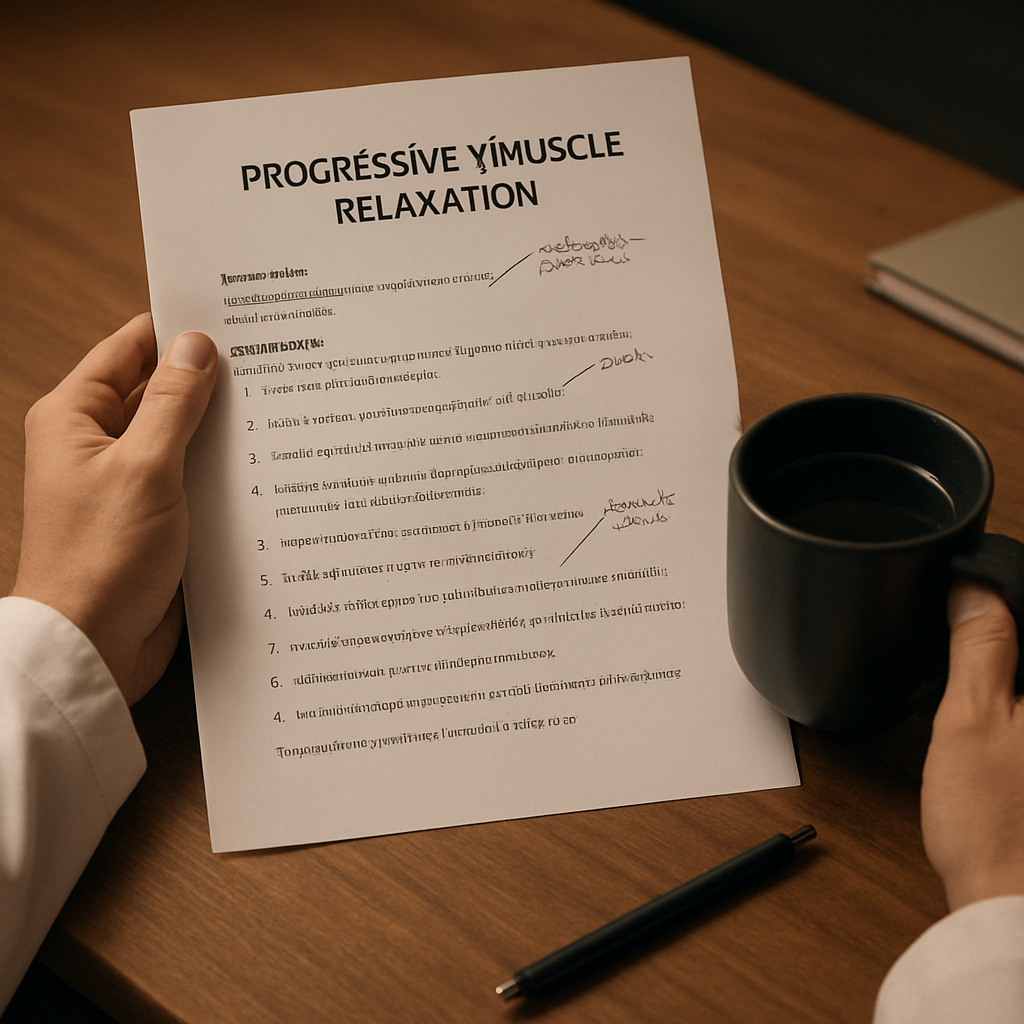
Paper doesn’t need a charger, Wi‑Fi, or a steady hand. A laminated sheet can live on a locker door, slip into a pocket, or be taped to a break‑room table. You can tick each muscle group with a pen, which gives a tiny sense of accomplishment that a screen can’t match.
Imagine you’re in a sterile room with no internet. You pull out the sheet, follow the cues, and you’re done – no “app crashed” anxiety.
Digital files bring flexibility
On a device you can zoom, search, and jump straight to the shoulder cue when you’re pressed for time. Most phones let you pair the PDF with a short audio track, so you can practice hands‑free while you’re charting.
Because most clinicians already carry a phone, a digital script means one less piece of paper to lose, and you can back‑up your notes in the cloud for later review.
What to compare
Factor | Printable | Digital |
Portability during rounds | Fits in a pocket; no glare. | Swipe‑able; can hide in badge holder. |
Annotation | Pen marks, stickers. | Highlight, comment, sync. |
Durability | Can tear; laminate helps. | Never runs out of ink; battery dependent. |
Use the table as a quick checklist: if you need fast scribbles, paper wins; if you need searchable cues, go digital.
Hybrid solution
Most of us end up using both. Print the one‑page cheat sheet for the core sequence and keep the full PDF on your device for deeper dives. You can even print a QR code on the sheet that opens the digital version – a tiny bridge between the two.
Try this tomorrow:
Print the first page, laminate it, and tape it inside your locker.
Save the full PDF to your phone’s Files and add a home‑screen shortcut.
During a break, glance at the printed cue, then open the phone for the audio cue or to skip ahead if you’re short on time.
That workflow gives you the tactile reassurance of paper and the convenience of digital without sacrificing either.
If you need a quick reference for building a mixed kit, Self‑care checklist PDF walks you through assembling printable and digital pieces side by side.
And for proof that regular practice sticks, Therapist Aid notes that consistent PMR sessions turn stress‑reduction into a lasting habit according to Therapist Aid’s progressive muscle relaxation script PDF . The format you pick matters less than the habit you keep.
Bottom line: consider where you spend most of your break, how you like to interact with instructions, and whether you need a fallback when technology quits. Choose the format that fits, and you’ll find the progressive muscle relaxation script pdf becomes a seamless part of your shift, not a gimmick.
Give yourself a week to test both sides. Notice if the printed cue feels more grounding during a noisy hallway, or if the digital version saves you seconds when you’re sprinting between patients. Whichever wins, the habit stays the same – a few minutes of intentional tension and release that resets your nervous system and boosts your focus for the next patient.
Step 5: Customize and Save Your Personal Script
Alright, you’ve walked through the space, memorized the sequence, and even tried a video. Now it’s time to make the progressive muscle relaxation script pdf truly yours – a little cheat‑sheet that feels like it was written for the exact moments you face on shift.
Ever notice how a plain PDF can feel a bit…clinical? That’s because it’s missing the personal flavor that tells your brain, “Hey, this is my reset button.” So let’s sprinkle some personality on it.
Pick your personal touches
First, grab the blank version of the script. Look at each cue – “tension in shoulders,” “release in hands” – and ask yourself, “What language would actually make me smile in a hectic hallway?” Maybe you swap “tension” for “tight‑as‑a‑rope,” or you add a tiny reminder like “think of the coffee you’re about to sip.” The goal isn’t to rewrite the science, just to make the words click for you.
And if you like visual cues, draw a simple icon next to each muscle group – a little cloud for “release,” a lightning bolt for “tense.” Those doodles act like mental post‑its that keep you on track without glancing at your phone.
Add your own cues
Next, consider layering in a breath count or a micro‑affirmation. For example, after the shoulder squeeze you could whisper, “I’m steady, I’m ready.” A quick breath‑in for four counts, hold, exhale for six – that rhythm anchors the muscle work and doubles the calming effect.
Need inspiration? Check out Effective Stress Management for Doctors: A Step‑by‑Step Guide for ideas on pairing brief affirmations with physical cues. It’s a handy reference when you’re figuring out what resonates with you.
Save in a way that works for you
Now the practical part: where does this custom script live? If you love the tactile feel of paper, print a single‑page version, laminate it, and slip it into your locker. A laminated sheet won’t rip, and you can tick each line with a dry‑erase marker – instant satisfaction every time you finish a group.
If you’re more digital‑savvy, save the PDF to a dedicated “Wellness” folder on your phone and add a home‑screen shortcut. Most smartphones let you rename the icon, so you could call it “5‑Min Reset” and it’ll sit right beside your patient‑note app.
Pro tip: back up the file to a cloud service (Google Drive, OneDrive) and sync it across devices. That way, if your phone battery dies, you still have a printable copy waiting at the nurse’s station.
Make it a habit
Customization is only half the battle – you have to actually use it. Stick a reminder on your badge or on the inside of your scrubs pocket. When you feel that familiar tightness in your jaw, that visual cue will prompt you to pull out the script and start the sequence.
Set a recurring calendar event titled “Personal PMR Reset.” Even a 5‑minute block labeled in your schedule signals to your brain that this isn’t optional; it’s part of the workflow. After a week, you’ll notice the script feels less like a task and more like a trusted ally.
And don’t forget to review the script every month. Maybe you’ve discovered a new muscle group that needs extra love, or perhaps an affirmation no longer feels authentic. Updating the document keeps it fresh and reinforces the habit loop.
Finally, celebrate the small wins. After a successful session, jot a quick note in your e7D‑Wellness journal: “Shoulders relaxed, mood lifted.” Seeing that progress in black and white makes the practice stick.
Customizing your progressive muscle relaxation script pdf turns a generic tool into a personal safety net you can deploy anytime, anywhere. It’s the difference between a one‑size‑fits‑all brochure and a pocket‑sized coach that knows exactly how you think and feel.
Conclusion
We've walked through why a progressive muscle relaxation script pdf can feel like a pocket‑sized coach for a hectic shift.
First, you set a calm corner, then you learned the simple tension‑release sequence, watched a quick video, compared print versus digital, and finally made the script your own.
Notice how each step only takes five minutes? That's the sweet spot for busy clinicians who need a reset without dropping patient care.
So, what’s next? Grab the free PDF, add a personal note or two, and schedule a recurring “PMR Reset” on your calendar. When you feel that tightness in your shoulders or jaw, let the script be the first thing you reach for.
Remember, the habit sticks when you celebrate the tiny wins – a few seconds of deeper breathing, a calmer mind, a smoother hand‑off. Those moments add up to a healthier, more resilient you.
And if you ever wonder whether five minutes really matters, think about the cumulative effect of doing this once a day for a week. You’ll likely notice lighter shoulders, steadier hands during procedures, and a clearer head when charting. That’s the power of consistency over flash‑in‑the‑pan tricks.
Ready to make the progressive muscle relaxation script pdf a regular part of your routine? Let’s start today; your future self will thank you.
FAQ
What exactly is a progressive muscle relaxation script pdf and how do I use it during a busy shift?
Think of the PDF as a tiny cheat‑sheet that walks you through tensing and releasing each muscle group, one after another. You open it on your phone or a printed card, set a timer for five minutes, and follow the cues – raise your eyebrows, squeeze your shoulders, let go, and repeat down the body. Because it’s broken into bite‑size steps, you can slip it into a quick break between patients without missing a beat.
Do I need any special equipment or a quiet room to get results?
Not at all. The beauty of the progressive muscle relaxation script pdf is that it works in a hallway, a locker, or even a standing‑room‑only break area. All you really need is a chair or a place to sit upright, a timer, and the willingness to focus for a few seconds. If background noise is unavoidable, try low‑volume headphones or a soft hum – the script’s instructions are designed to be clear enough to follow amid mild distraction.
How long should each muscle group be tensed and released for optimal benefit?
Most clinicians find a 4‑5 second squeeze followed by a 10‑12 second release hits the sweet spot. That timing lets your nervous system notice the contrast between tension and relaxation without feeling rushed. The PDF usually marks each cue with a little clock icon, so you can glance quickly and stay on track. If you have extra minutes, you can extend the release a bit to deepen the calm.
Can I customize the script to fit my own routine or preferences?
Absolutely. Grab a printed copy and add a short personal reminder next to each cue – maybe a quick affirmation like “I’m steady,” or a visual doodle that makes you smile. If you’re digital‑savvy, edit the PDF with a simple annotation tool and save it to your “Wellness” folder. Personalizing the language turns a generic guide into a pocket‑sized coach that feels like it was written just for you.
How often should I practice with the progressive muscle relaxation script pdf to see lasting results?
Consistency beats intensity here. Aim for a five‑minute session once per shift, or at least once a day if your schedule allows. After a week of daily practice, many clinicians report lighter shoulders, steadier hands, and a clearer mind during charting. The key is to treat it like any other vital sign check – a brief, regular habit that adds up to big gains in resilience.
Is there any scientific backing that shows this technique actually reduces stress?
Yes. Progressive muscle relaxation was pioneered by Dr. Edmund Jacobson in the 1920s and has been validated in countless clinical studies as a reliable way to lower physiological arousal. When you systematically tense and release muscles, you trigger a parasympathetic response that slows heart rate and eases breathing. The script PDF simply packages that evidence‑based method into a format you can grab on the fly.
What should I do if I miss a session or feel too rushed to follow the script?
Don’t sweat it – the habit is forgiving. If you miss a break, just slide the script into your next available pause, even if it’s only two minutes. You can skim the key cues – shoulders, neck, hands – and still get a noticeable reset. The goal isn’t perfection; it’s giving yourself a quick mental reset whenever you can, so the next patient benefits from a calmer, more focused you.
Bonus: Downloadable PDF Checklist
Ever wish you had a tiny cheat‑sheet that walks you through the whole progressive muscle relaxation script pdf in under a minute? That’s exactly what this bonus checklist gives you – a printable one‑pager you can tape to your locker or keep on your phone’s home screen.
It breaks the sequence into eight rows: head, neck, shoulders, arms, chest, abdomen, legs, feet. Each row has a “tension” column (4‑5 seconds) and a “release” column (10‑12 seconds), plus a little checkbox so you can literally tick off each step as you go. The act of checking off feels oddly satisfying, and it nudges your brain to notice the shift from tight to relaxed.
How do you actually use it on a hectic shift? Grab the PDF, flip it open, set a timer for five minutes, and follow the arrows. If you only have two minutes, just skim the shoulder, neck, and hand rows – those are the hotspots for clinicians.
Pro tip: laminate the sheet and attach a magnetic strip to your whiteboard. That way you never have to hunt for it, and the magnetic cue becomes a visual reminder to pause before the next patient.
Download the checklist now, personalize a line or two (maybe add “think of your favorite coffee”), and let it become the quick‑reset button you didn’t know you needed.


Comments