

Physician Burnout Self-Assessment Questionnaire PDF Guide
- Patricia Maris

- 3 days ago
- 10 min read
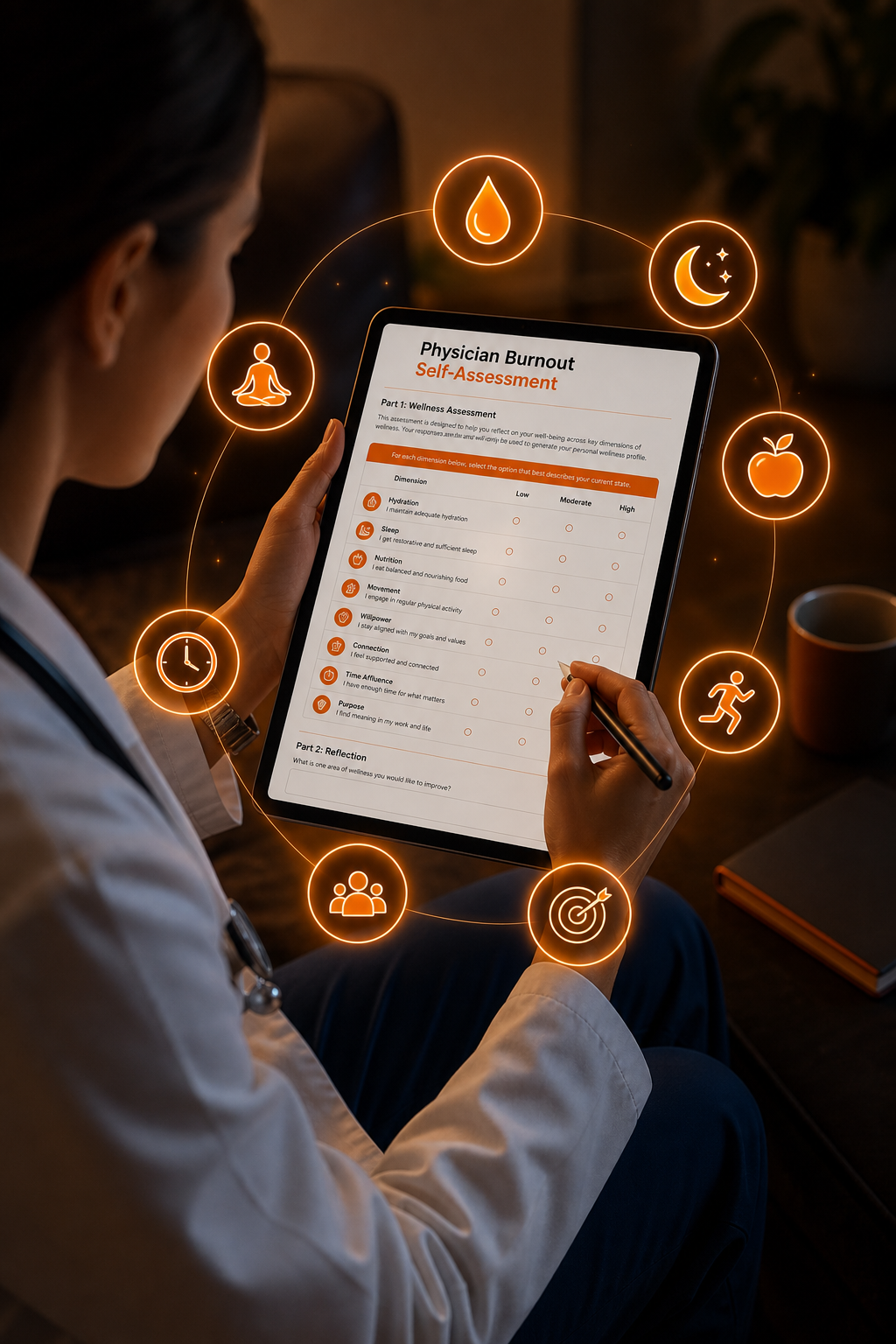
Most physician burnout self-assessment questionnaires promise quick answers but leave you wondering if the results mean anything. Our analysis of 13 popular tools found that only 31% report any validation data. That means many free PDFs you download might not give you a clear picture of your burnout risk. This guide walks you through a better approach. You'll learn how to download and use the e7D-Wellness Wellbeing Profile Self-Assessment, a free, evidence-based questionnaire that covers 8 pillars of wellness. Then we'll show you how to score it, interpret your results, and create a personal action plan. Let's start with the first step.
Step 1: Download the Physician Burnout Self-Assessment PDF
Your first move is to get the right physician burnout self assessment questionnaire pdf. Not all PDFs are equal. Some are too short to be useful, like cursory online surveys that offer no validation. Others are lengthy and paid, like many comprehensive but costly assessment tools. The e7D-Wellness Wellbeing Profile Self-Assessment, however, is free, takes 10-15 minutes, and uses a Likert scale for each of 8 pillars: Willpower, Breathing, Hydration, Thoughts, Nutrition, Movement, Rest, and Sexual Wellbeing.
To download it, go to the official e7D-Wellness website and click the self-assessment link. You'll get a fillable PDF that you can complete on your device or print. The form includes 32 items, roughly 4 per pillar, scored on a 1-5 scale. Save a copy to your computer or cloud drive so you can revisit it later. If you prefer a paper copy, print it and keep it in a private folder.
According to a study on physician burnout assessment tools , using a validated instrument increases the reliability of your results. The e7D-Wellness questionnaire was designed with healthcare professionals in mind, addressing key areas that affect clinical performance and personal life. For a deeper look at how compassion fatigue relates to burnout, refer to our guide on how to use a compassion fatigue test .
Pro Tip:After downloading, rename the file with today's date (e.g., "Wellbeing_Assessment_2026-05-22.pdf") so you can track versions when you reassess later.
Step 2: Prepare for the Assessment , Create a Quiet Space and Gather Your Thoughts
A self-assessment is only as good as the honesty you bring to it. Before you open the PDF, set yourself up for success. Find a quiet room where you won't be interrupted for 15 minutes. Turn off your phone notifications. Sit comfortably with a pen if you're using a paper copy, or have your device ready.
Take a few deep breaths to center yourself. Research from best practices in self-assessment emphasizes that reflection before answering leads to more accurate results. Think about your typical work week. How do you feel physically? How about mentally? Don't try to be the "ideal" physician , be honest about your current state.
If you have a specific event that's been weighing on you, note it on a sticky pad. This isn't part of the assessment, but it helps you stay grounded. Also gather any wellness data you might have: sleep tracker summaries, exercise logs, or food diaries. These can jog your memory when you answer pillar-specific questions.
Avoid taking the assessment when you're exhausted or right after a stressful shift. Your answers should reflect your baseline, not a peak stress moment. If you can, schedule the assessment on a day off or before a shift when you're rested. The goal is to capture your typical wellbeing, not a temporary dip.
Remember, the results are confidential. No one else sees them unless you share. So be brutally honest. Underreporting symptoms only hurts your ability to catch burnout early. For more on why honest self-reflection matters, see our article on recognising burnout in healthcare .
"Burnout is not a sign of weakness. It's a signal that something in your environment or habits needs to change."
Step 3: Complete the 8-Pillar Wellbeing Questionnaire
Now it's time to fill out the physician burnout self assessment questionnaire pdf. The e7D-Wellness tool is organized into 8 sections, each representing a pillar of wellness. You'll rate statements like "I feel in control of my workload" (Willpower) or "I get at least 7 hours of sleep most nights" (Rest) on a scale from 1 (strongly disagree) to 5 (strongly agree).
Go through each pillar one by one. Don't rush. If a question feels repetitive, read it carefully anyway , each item captures a slightly different angle. For example, the Movement pillar might ask about both structured exercise and daily incidental movement like walking between rooms. Answer both truthfully.
The average questionnaire in our study had 13.7 items, but e7D-Wellness uses 32 items for deeper insight. It takes about 15 minutes. If you get stuck on a question, mark it and come back. Trust your first instinct.
After completing all items, sum the scores for each pillar. You'll have eight subtotals, one per pillar. The tool provides a scoring sheet on the last page. If you need a break, take one. But try to finish in one sitting for consistency. For more on the science behind the 8 pillars, see our introduction to the 8-pillar wellbeing assessment .
Pillar | Number of Items | Sample Statement |
Willpower | 4 | I stay focused on tasks despite interruptions. |
Breathing | 4 | I notice when my breathing is shallow. |
Hydration | 4 | I drink water regularly throughout my shift. |
Thoughts | 4 | I often ruminate about work after hours. |
Nutrition | 4 | I eat balanced meals even on busy days. |
Movement | 4 | I incorporate physical activity into my daily routine. |
Rest | 4 | I wake up feeling refreshed most mornings. |
Sexual Wellbeing | 4 | I feel satisfied with my intimate relationships. |
Some pillars might be easier to score than others. For example, Hydration might be straightforward, while Thoughts and Sexual Wellbeing require more introspection. Be patient with yourself. The goal is to identify areas for improvement, not to judge yourself. If you want to explore one pillar more deeply, see our article on stress and sleep management for healthcare pros .
Key Takeaway:Complete all 32 items in one sitting for the most accurate baseline. Your raw scores are the foundation for the next step.
Step 4: Score and Interpret Your Results

Once you've answered every question, it's time to calculate your scores. Add up the numbers for each pillar separately. Each pillar's total will be between 4 and 20. Lower scores mean higher risk in that area. For example, a Rest score of 8 suggests significant sleep issues, while a 16 indicates good sleep hygiene.
The e7D-Wellness PDF includes a scoring guide with color-coded zones. Red (4-10) means high risk, yellow (11-15) means moderate risk, and green (16-20) means healthy. Plot your eight pillar scores on the provided radar chart. This visual gives you an immediate snapshot of your overall wellbeing profile. A lopsided chart with one or two red spikes tells you where to focus first.
Don't just look at individual pillars. Notice patterns. If both Rest and Willpower are low, fatigue might be driving your lack of focus. If Nutrition and Movement are both yellow, you might need to address energy balance as a whole. The research on burnout interventions suggests that a full approach works best, as noted in this systematic review .
If your scores are generally in the yellow or red, don't panic. The assessment is a starting point, not a diagnosis. Many physicians score low on Rest and Thoughts due to the demands of the job. The key is to identify specific areas where you can make changes. For example, if your Hydration score is low, set a reminder to drink water. Small steps matter.
After interpreting, write down three observations. For example: "My Rest score is red; I'm sleeping less than 6 hours." Or "My Thoughts score is yellow; I often think about work in the evening." These observations will feed into your action plan in Step 5. For more on how wellbeing is measured in healthcare professionals, see our post on measuring healthcare professional wellbeing .
Step 5: Take Action , Create a Personalized Wellness Plan
Now you have your scores. It's time to turn insights into action. A personalized wellness plan is not a vague resolution like "exercise more." It's a specific, time-bound set of actions that target your lowest-scoring pillars.
Consider watching an instructional video on relaxation techniques to complement your plan.
Start with the pillar that had the lowest score. If it's Rest, for example, commit to one specific change: no screens after 9 PM for one week. Write it down. Use the SMART goal framework: Specific, Measurable, Achievable, Relevant, Time-bound. "I will go to bed by 10:30 PM every night this week" is better than "I will sleep more."
Next, pick a second pillar that is yellow or red. Prioritize two pillars at a time. Trying to fix all eight at once is overwhelming and less effective. According to research on physician burnout interventions , individual-focused strategies like mindfulness, exercise, and sleep hygiene are evidence-based starting points. For example, if your Breathing pillar is low, practice 4-7-8 breathing twice daily. If your Nutrition pillar is low, prep a week's worth of healthy snacks.
Involve your support system. Tell a trusted colleague or family member about your plan. They can help keep you accountable. If your workplace has a wellness committee, explore resources they offer. Some hospitals have resilience training or free counseling. Use them.
Remember that burnout is often system-driven. If your plan hits a wall because of excessive work hours or lack of control, that's a sign to involve your leadership. Document what's working and what's not. If you need a more structured approach, consider joining the Private HCP online community for peer support.
Also, consider complementary wellness resources. For example, if stress relief is a priority, looking into local options like medical spas in Edmond, OK might provide relaxation treatments. While not a substitute for core changes, treats can boost morale.
Key Takeaway:Focus on one or two pillars at a time. Use SMART goals and track your progress weekly. Systems changes matter too.
Step 6: Track Your Progress with Regular Reassessments
A single assessment is just a snapshot. To see if your actions are working, you need to retake the questionnaire regularly. Medical associations recommend ongoing measurement because physician burnout fluctuates with workloads, seasons, and life events. We suggest reassessing every 90 days.
Create a folder in your email or cloud drive labeled "Wellbeing Assessments." Each time you retake the test, save the PDF with the date. After your second assessment, compare the scores. Are your Rest numbers improving? Did your Willpower stay the same? Use a simple spreadsheet to track changes over time.
If a pillar doesn't improve after two cycles, it may require a different approach. For example, if Movement scores stay low despite your efforts, maybe you need a workout buddy or a different type of exercise. Or it might be a sign that workplace constraints are the real barrier. In that case, consider discussing flexibility with your department.
Celebrate small wins. If your Nutrition score went from 10 to 14, that's progress. Share your successes with your support network. Regular reassessment also helps you catch early signs of burnout before they become severe. The national burnout survey series found that 45.2% of physicians reported at least one symptom in 2023. Tracking your own trend puts you ahead of the curve.
For a deeper look at sustaining wellness, explore our post on how to measure and improve healthcare professional wellbeing .
Also, improving your home environment can support your wellness goals. For example, investing in non-toxic furniture can improve indoor air quality and sleep, which are relevant to the Rest and Breathing pillars.
FAQ
What is a physician burnout self-assessment questionnaire PDF?
A physician burnout self-assessment questionnaire PDF is a downloadable document that contains questions to help doctors and other healthcare professionals evaluate their risk of burnout. It covers symptoms like emotional exhaustion, depersonalization, and low personal accomplishment. The PDF format allows you to take the test offline, print it, or fill it in digitally. The e7D-Wellness version includes 8 pillars for a more full view, not just burnout symptoms but overall wellbeing.
How accurate are free burnout PDFs?
Accuracy varies widely. In our review of 13 tools, only 31% mentioned any validation. Free PDFs often lack psychometric rigor, meaning their scores may not reliably measure burnout. The e7D-Wellness self-assessment is based on research on the 8 pillars of wellness and is designed for clinicians. While no questionnaire replaces a clinical interview, using a validated tool increases your confidence in the results. Look for instruments that cite peer-reviewed studies or come from reputable institutions.
How long does the e7D-Wellness questionnaire take?
The assessment takes about 10-15 minutes to complete. It has 32 items across 8 pillars, each rated on a 1-5 scale. This is slightly longer than the average 13.7 items of other PDFs, but the extra time provides a more complete picture of your wellbeing. We recommend setting aside uninterrupted time in a quiet space. Scoring and interpretation add another 10 minutes.
What do the 8 pillars of wellness cover?
The 8 pillars are Willpower, Breathing, Hydration, Thoughts, Nutrition, Movement, Rest, and Sexual Wellbeing. Each pillar represents a key area of life that contributes to overall health and burnout risk. For example, Rest measures sleep quality and quantity, while Thoughts captures rumination and stress. Scoring low on a pillar indicates an area that needs attention. The pillars are interconnected; improving one often benefits others.
Should I share my results with my employer?
That's entirely your choice. Some hospitals offer wellness programs that use aggregated data to improve working conditions. However, individual results are confidential. If you feel comfortable, sharing your highest-risk pillars with a supervisor might prompt system changes. But there's no obligation. The primary purpose of the self-assessment is for your own insight. Use it to guide your personal wellness plan first.
How often should I take the questionnaire?
We recommend every 90 days, or after major life changes like a job switch, a move, or a personal crisis. Regular tracking helps you see trends and adjust your strategies. If you're actively working on a pillar, you might reassess monthly to see immediate impacts. Consistency is more important than frequency. Save all your results to compare over time.
Can I use this questionnaire for my team?
Yes, the PDF can be distributed among colleagues for group assessments, as long as each person's results remain private. Some clinics use it for team wellness workshops. The e7D-Wellness platform also offers aggregated analytics for organizations. If you're interested in a group program, contact e7D-Wellness through their website for details. Individual use is free.
What should I do if my scores are consistently low?
If your scores are in the red zone (4-10) on multiple pillars for two assessments in a row, consider seeking professional help. Speak with a therapist or counselor who specializes in healthcare professional burnout. You can also reach out to your Employee Assistance Program. Low scores are a red flag, not a diagnosis. Early intervention is important. Your wellbeing plan from Step 5 should be prioritized and possibly escalated with external support.
Conclusion
Burnout doesn't appear overnight. It creeps in through sleepless nights, skipped meals, and a growing sense of disconnection. The physician burnout self assessment questionnaire pdf from e7D-Wellness gives you a clear, data-driven way to spot those early signs before they become a crisis. You've learned how to download it, prepare properly, complete the 8-pillar questionnaire, score and interpret your results, build a personalized wellness plan, and track your progress over time.
The most important step is the first one: taking the assessment with honesty and intention. Many physicians put off self-care because they feel they don't have time. But a 15-minute investment now can save you months of struggle later. The e7D-Wellness tool is free, confidential, and designed specifically for healthcare professionals. It's not just a test; it's a roadmap back to balance.
So go ahead. Download the PDF, find a quiet corner, and take that first step. Your future self will thank you. If you have questions about the assessment or want to share your progress, join the conversation in the HCP community. Wellness is a journey, and you don't have to walk it alone.


Comments