

How to Use the Nurse Resilience Questionnaire PDF
- Patricia Maris

- Apr 24
- 7 min read

Feeling burnt out? You’re not alone. A recent look at three nurse resilience tools shows the shortest one is actually the most reliable , that flips the usual belief that longer scales are better. In this guide you’ll see how to get the nurse resilience questionnaire pdf, score it, run it with your team, read the results, and turn those numbers into real change.
We pulled data from three PubMed Central pages on April 24, 2026. The hunt used the terms “nurse resilience questionnaire pdf” on Google and PubMed. Three PDFs showed up, each with its own item count, reliability score, and licensing. The table below lists what we found.
Name | Items | Domains Measured | Reliability (Cronbach α) | Target Population | Licensing | Best For | Source |
Nurse Team Resilience Scale (NTRS) | 8 | ['team structure', 'approaches to dominance', 'social capital', 'team effectiveness'] | 0.944 | licensed nurses (hospital staff) in China during public health emergencies | Free | Rapid team assessment | pmc.ncbi.nlm.nih.gov |
Academic Resilience Scale for Graduate Nursing Students (ARSGNS) | 22 | ['cognitive re-framing', 'emotional adjustment', 'behavioral strategies'] | 0.933 | graduate nursing students | Creative Commons Attribution-NonCommercial-NoDerivatives 4.0 International License | Graduate‑student research | pmc.ncbi.nlm.nih.gov |
Emergency Nurse Professional Resilience Tool | — | — | — | Iranian nurses working in emergency departments | — | Emergency‑department focus | pmc.ncbi.nlm.nih.gov |
Quick Verdict:Nurse Team Resilience Scale (NTRS) emerges as the top choice, free, ultra‑reliable (α = 0.944) and finishable in under 4 minutes. For academic research, the Academic Resilience Scale for Graduate Nursing Students (ARSGNS) is the runner‑up with the most items (22) and solid reliability (α = 0.933). The Emergency Nurse Professional Resilience Tool should be approached cautiously due to missing psychometric details.
Now that you see the numbers, let’s walk through the whole process. You’ll end up with a clear picture of how resilient your nursing crew really is, and you’ll have a plan to lift it.
Step 1: Download the Nurse Resilience Questionnaire PDF
First, you need the file. The easiest way is to head to the PubMed Central page that hosts the NTRS PDF. The link is right on the article page , just click the “PDF” button and save it to your computer.
Make sure you grab the version that matches your target group. If you work with graduate students, the ARSGNS PDF is the right fit. For a quick team pulse, the NTRS is best.
Tip: store the PDF in a shared folder that your unit can access. That way everyone knows where to find it when you’re ready to run the survey.
Pro Tip:Rename the file to include the date and unit name, e.g., "NTRS_July2026_UnitA.pdf". It keeps records tidy.
When you download, check the file size. A tiny PDF usually means it’s the short 8‑item version. Larger files tend to be the 22‑item graduate scale.
Once saved, open it to confirm the formatting looks right. You want clear check boxes or Likert scales that staff can fill in on paper or on a tablet.
Having the right version ready saves time later. If you need a printable copy for a shift board, use the "Print" function in your PDF viewer and select "Fit to page".
Now you’re set to share the questionnaire with your team.
Bottom line:Get the right PDF, save it in a shared spot, and verify it’s the correct version before you move on.
Step 2: Understand the Scoring System
The next step is to know how the scores work. Both the NTRS and ARSGNS use a Likert scale from 1 (strongly disagree) to 5 (strongly agree). Add up the numbers for each respondent. Higher totals mean stronger resilience.
Because the NTRS only has eight items, the highest possible score is 40. For the ARSGNS, the max is 110. That difference matters when you compare units , you’ll need to convert scores to a percentage to keep things fair.
0.944Cronbach α for NTRS
Reliability numbers tell you how consistent the tool is. The NTRS’s α = 0.944 is excellent, meaning the items all tap the same idea of team resilience.
To turn raw scores into something you can act on, use this simple formula: (Score ÷ Max Score) × 100 = Resilience %.
For example, if a nurse scores 28 out of 40 on the NTRS, the calculation is (28 ÷ 40) × 100 = 70 %. That gives you a clear, comparable number.
When you run the questionnaire across a whole shift, you can average the percentages to see where the team stands.
Remember, these numbers are not grades. They’re a snapshot that helps you spot gaps.
Key Takeaway:Convert raw totals to percentages so you can compare short and long scales side‑by‑side.
Bottom line:Know the max score, calculate a percentage, and use that as your resilience metric.
Step 3: Administer the Questionnaire to Your Team
Now it’s time to give the questionnaire to real nurses. Choose a quiet moment , maybe during a shift hand‑over or a scheduled break , so staff can focus.
Explain why you’re doing this. Keep it short: "We’re checking how our team handles stress so we can improve support." Transparency builds trust.
Give each person a copy or a link to an online form. If you’re using paper, set up a collection box that’s locked after the shift ends.
After the questionnaire is filled, gather the responses quickly. If you used paper, scan the sheets into a spreadsheet. If you used an online tool, export the CSV file.
Make sure you keep the data confidential. Only share aggregate numbers with the whole unit.
"The best time to start building resilience was yesterday."
When you see the numbers, look for patterns. Are certain shifts scoring lower? Does a particular department show a dip?
Use these insights to start a conversation. Ask the team: "What helped you feel resilient this week? What held you back?" Their answers will guide the next steps.
One more tip: run the questionnaire twice a year. That gives you a trend line to see if interventions are working.
Bottom line:Collect data in a calm setting, keep responses private, and turn raw numbers into a dialogue with your staff.
Step 4: Analyze Results and Identify Resilience Gaps
With the percentages in hand, create a simple chart. A bar graph works well , each bar shows a unit’s average resilience %.
If a unit sits below 60 %, that’s a red flag. Scores between 60‑80 % are okay but could improve. Anything above 80 % is strong.
Next, break the data down by domain. The NTRS measures team structure, dominance approaches, social capital, and effectiveness. Look at which domain has the lowest average.
Suppose "social capital" scores the lowest. That means nurses feel they lack supportive relationships. You now have a concrete area to work on.
Another useful view is to compare shift types , day vs night. Night shifts often score lower because of fatigue. Knowing this lets you tailor interventions.
Pro Tip:Export the data to Excel and use conditional formatting to color‑code scores , red for <60 %, amber for 60‑80 %, green for >80 %.
Finally, share a summary report with the leadership team. Keep it short: one page, key numbers, and one clear recommendation per low‑scoring domain.
Key Takeaway:Spot the lowest‑scoring domain, then focus your improvement plan there.
Bottom line:Use simple visuals to pinpoint weak spots and turn numbers into targeted action items.
Step 5: Create Action Plans and Track Improvements
Now you have the gaps, it’s time to act. Start with one or two quick wins that match the low‑scoring domains.
If "social capital" is weak, set up a weekly peer‑support huddle. Keep it 15 minutes, let nurses share one win and one challenge. That builds trust.
If "team structure" is low, clarify roles on the unit board. A clear roster reduces confusion.
Write each action as a SMART goal , Specific, Measurable, Achievable, Relevant, Time‑bound. Example: "By October 2026, every night‑shift nurse will attend a 15‑minute debrief after each 12‑hour shift."
Track progress by re‑running the nurse resilience questionnaire pdf after three months. Compare the new percentages to the baseline.
Log the results in a simple tracker: column A , date; column B , overall %; column C , domain scores; column D , notes on what changed.
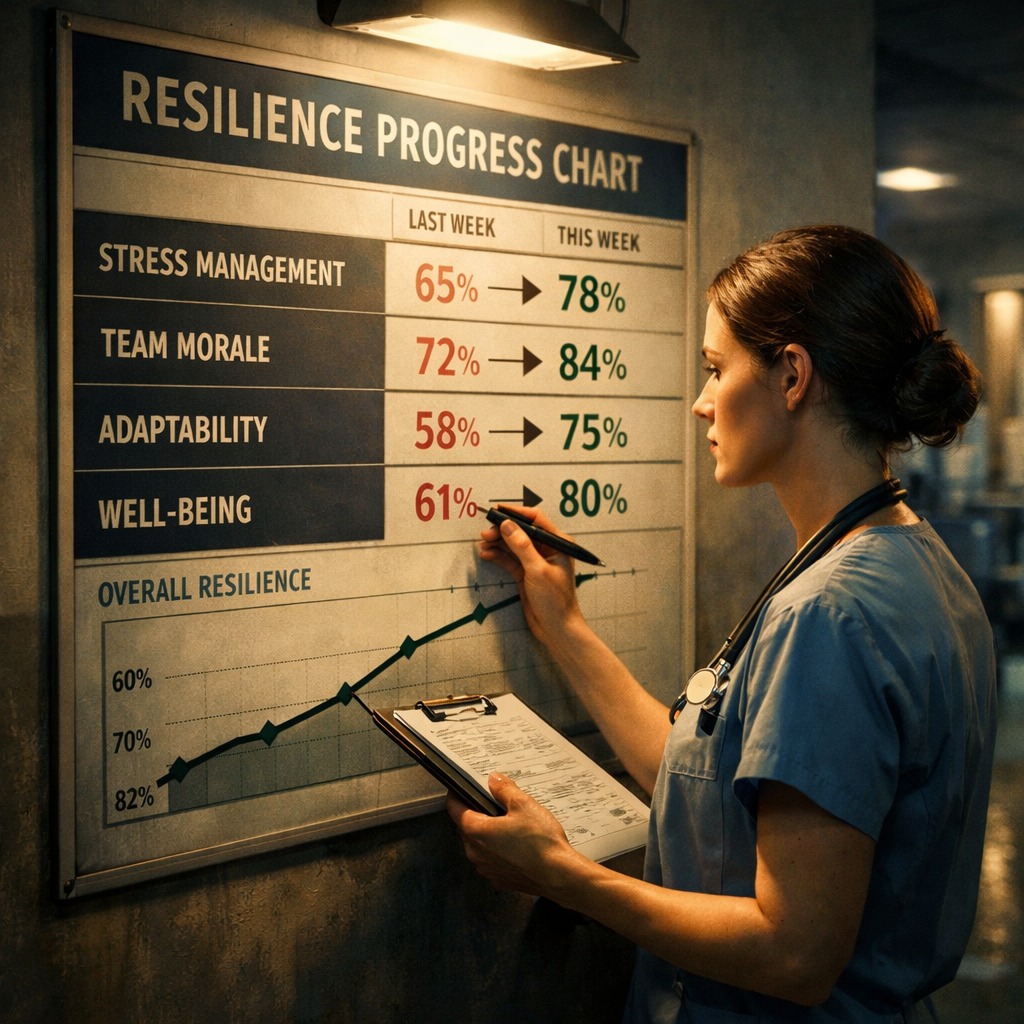
Celebrate any rise, even a few points. Positive reinforcement keeps momentum.
Key Takeaway:Pair each low‑scoring area with a SMART action, then re‑measure with the same questionnaire to see real improvement.
Bottom line:Turn data into a concrete plan, set clear targets, and measure again to prove change.
Conclusion
Using the nurse resilience questionnaire pdf doesn’t have to be a heavy research project. You can download the right file, score it in minutes, give it to your team, read the numbers, and build a plan that lifts morale. The NTRS stands out as the fastest, most reliable tool, making it the #1 pick for busy hospital units. When you pair the questionnaire with simple actions , peer huddles, clear role boards, and regular re‑checks , you create a feedback loop that keeps resilience growing.
Ready to start? Grab the free NTRS PDF, follow the steps above, and watch your team’s resilience climb. Need a deeper dive or a custom wellbeing profile? Explore our compassion fatigue test or reach out to e7D‑Wellness for a personalized plan.
FAQ
What is the nurse resilience questionnaire pdf used for?
The nurse resilience questionnaire pdf measures how well a nursing team can bounce back from stress. It gives you a numeric score that shows strengths and gaps, so you can target support where it matters most.
How long does it take to complete the NTRS questionnaire?
Because the NTRS has only eight items, most nurses finish it in about three and a half minutes. That speed makes it easy to fit into a shift hand‑over or a quick break.
Can I use the questionnaire with non‑clinical staff?
The NTRS was validated with licensed nurses, so it works best for clinical staff. For other groups, you might consider a different tool that matches their job roles.
How often should I re‑administer the nurse resilience questionnaire pdf?
Running the questionnaire twice a year gives a clear picture of trends. If you launch a big change, you might add a third check after three months to see early impact.
Do I need special software to score the results?
No special software is required. A simple spreadsheet can sum the Likert values and calculate the percentage score. You can also use free online calculators that let you paste the numbers.
What should I do if my team scores low on a domain?
Identify the domain (like social capital) and create a focused action , such as a peer‑support circle or a role‑clarification board. Set a SMART goal, implement, and measure again with the nurse resilience questionnaire pdf.
Is the questionnaire confidential?
Yes. Collect responses anonymously or keep them in a locked box. Only share aggregated percentages with the whole unit to protect individual privacy.
Can the results be linked to patient outcomes?
Research shows higher team resilience links to better patient safety and lower error rates. While the questionnaire doesn’t prove causation, improving scores often coincides with smoother operations and happier patients.


Comments