

How to Use a Wellbeing Questionnaire for Clinicians
- Patricia Maris

- May 31
- 11 min read

Did you know that 27% of the 62 clinician wellbeing questionnaires reviewed in a recent analysis lack any reported validation? That means many tools claiming to measure burnout or resilience may not actually measure what they say. Without a valid instrument, you risk acting on misleading data. This guide walks you through five usable steps to select, administer, and act on a wellbeing questionnaire for clinicians. By the end, you'll know exactly how to use evidence-based tools to support your own wellbeing or that of your team.
Step 1: Understand the 8 Pillars of Wellness
Before you pick up any questionnaire, you need a clear picture of what "wellbeing" really means for clinicians. Burnout is just one piece. A complete view covers eight interconnected pillars: willpower, breathing, hydration, thoughts, nutrition, movement, rest, and sexual wellbeing. These pillars come from frameworks like the e7D-Wellness 8 Pillars Framework, which maps each pillar to specific behaviors and risk factors.
A worker well-being questionnaire takes a similar full approach, splitting worker wellbeing into five domains: workplace policies, work organization, physical environment, health status, and community. Both frameworks show that isolating one area, like emotional exhaustion, misses the bigger picture. A clinician who sleeps poorly and skips meals will score high on burnout but might not see the root causes.
Why start here? Because the questionnaire you choose must cover the pillars that matter to your context. If your team struggles with sleep and nutrition, a tool that only measures emotional burnout won't give you actionable data. Some worker well-being questionnaires are freely available and cover those broader domains, but they can be long and designed for researchers. For busy clinicians, you want a validated tool that hits the pillars quickly.
Here's a quick breakdown of the eight pillars and why each matters:
Willpower, the ability to stay focused and resist impulsive stress responses. Diminished willpower is often the first sign of burnout.
Breathing, shallow or irregular breathing patterns indicate high stress. Simple breathwork can lower heart rate and improve decision-making.
Hydration, even mild dehydration affects mood and cognition. Clinicians on long shifts often forget water.
Thoughts, negative self-talk and rumination are early markers of compassion fatigue. Tools like a compassion fatigue test track this.
Nutrition, erratic meal patterns worsen energy and focus. Skipping breakfast correlates with higher burnout scores.
Movement, sedentary hours and poor posture contribute to physical pain and mental fatigue. Micro-movement breaks help.
Rest, sleep quality, not just quantity. Shift work disrupts circadian rhythms and recovery.
Sexual wellbeing, often neglected but directly tied to intimacy, self-image, and overall satisfaction.
Each pillar influences the others. When you pick a questionnaire, check if it covers at least half of these pillars. If it only screens for burnout, it's a flashlight, not a floodlight. The e7D-Wellness Wellbeing Profile assesses all eight pillars and gives you a personalized profile. That's the kind of depth you need for real action.
Key Takeaway:A full wellbeing questionnaire that covers multiple pillars gives you a truer picture of clinician health than a single-domain burnout scale.
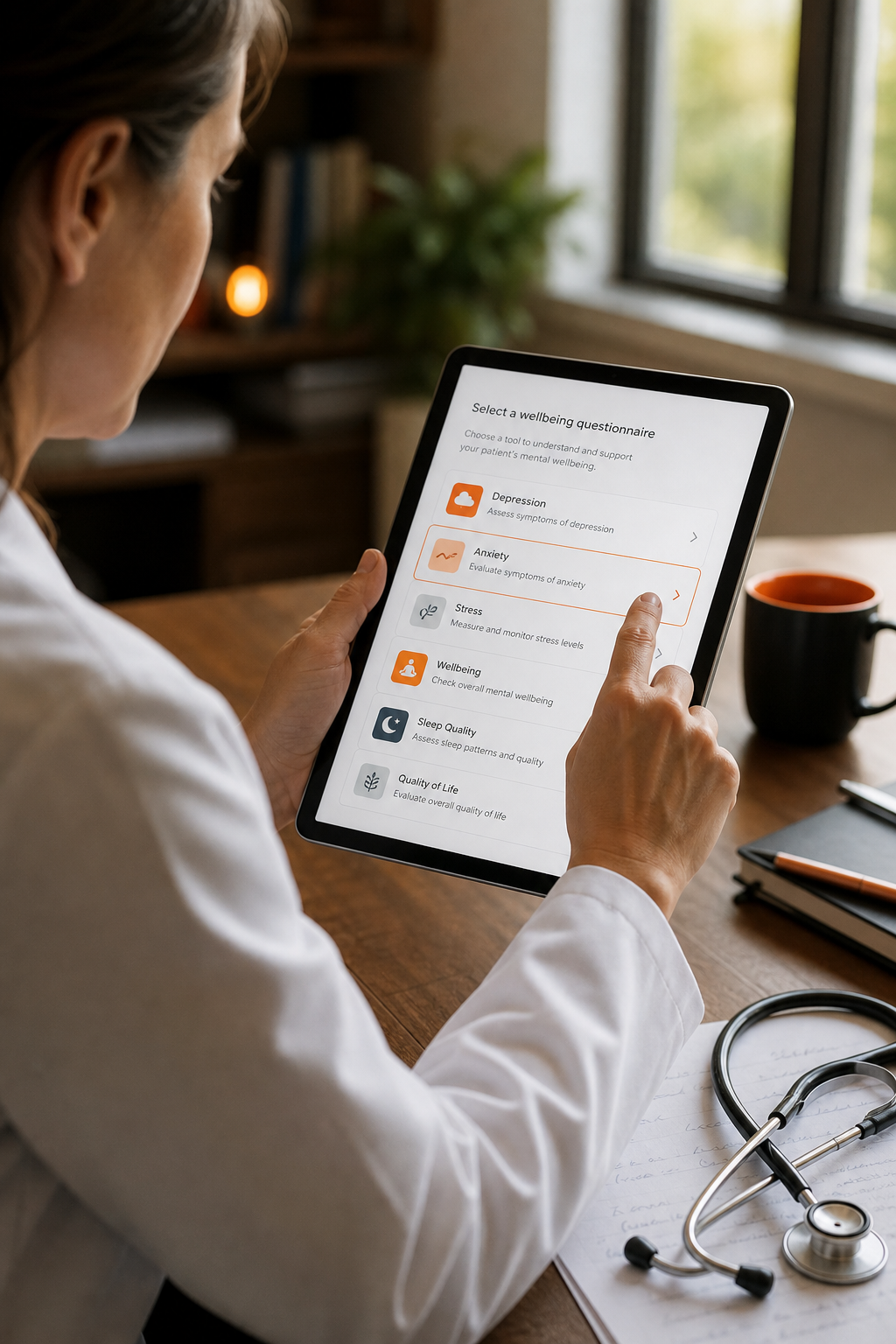
Step 2: Select or Design the QuestionnaireNow that you know what pillars matter, it's time to choose a questionnaire. You have three routes: use an existing validated tool, combine items from multiple tools, or design your own. I'll walk you through each option with specific examples.Option 1: Use a pre-validated instrument. The gold standard is the Maslach Burnout Inventory (MBI), but it costs money and takes 10-15 minutes. For a quicker screen, the MBI single-item measure correlates 0.79 with the full scale and has 83.2% sensitivity. Free alternatives include the Copenhagen Burnout Inventory (CBI), which measures burnout in personal, work-related, and client-related domains and is the only scale with proven cultural invariance. A 60-second well-being index validated for physicians is also available. For a complete tool, the MarisGraph covers all eight pillars with personalized reporting.Option 2: Combine questions from multiple sources. If your organization needs something tailored, you can pull items from public-domain questionnaires like the NIOSH WellBQ or the Patient Health Questionnaire-9 (PHQ-9) for depression screening. The NIOSH WellBQ can be freely reproduced, so you can cherry-pick items on work stress, health status, and community. However, mixing items from different scales reduces validity you won't have normative benchmarks. For a low-stakes internal audit, this is acceptable. For research or high-stakes decisions, stick with a validated tool.Option 3: Design your own. Writing your own questions gives you maximum flexibility but opens the door to bias and low reliability. If you go this route, follow best practices: keep questions simple, use consistent Likert scales, avoid double-barreled questions, and pilot test with a small group. The Copenhagen Burnout Inventory offers a public-domain example of a well-designed questionnaire you can adapt.Whichever route you choose, prioritize validity. A tool with no reported validation is a shot in the dark. Check for Cronbach's alpha above 0.70 and test-retest reliability. The MBI-HSS MP has reported alpha values as low as 0.58 for some subscales, so even popular tools have weaknesses. The MarisGraph is validated for clinicians and offers a multidimensional risk profile.Decision table for selecting a questionnaire:Step 3: Administer the Questionnaire EffectivelyAdministration is where many wellbeing initiatives fall apart. Even a perfect questionnaire yields useless data if clinicians don't trust the process or complete it honestly. Follow these best practices to get high-quality responses.Guarantee anonymity. This is non-negotiable. Clinicians fear that their answers might affect their job, licensure, or reputation. Use a third-party platform that doesn't collect IP addresses or timestamps tied to individuals. The standard wellbeing questionnaire guidelines explicitly state: "Do not collect names or other potentially identifying information." If you must track trends over time, assign anonymous codes that only the participant knows. e7D-Wellness uses a confidential self-assessment model precisely to protect clinicians' privacy.Time it right. Don't send the survey during a pandemic surge, end-of-year reports, or Monday mornings. Aim for a neutral workweek with no major deadlines. The best time is often mid-week, mid-morning, when clinicians have settled into their routine but aren't yet exhausted. Provide a window of at least 5-7 days to complete it, with one reminder.Keep it short. Respect their time. A 60-second tool like a brief wellbeing check or a 5-minute e7D-Wellness check works far better than a 20-minute questionnaire. The 11-item Brief digital engagement survey shows that short instruments can still have strong reliability. If you must use a longer tool, split it into two parts sent on separate days.Communicate the 'why'. Before sending, explain what you'll do with the data. Will you create individual action plans? Compare aggregate scores to past surveys? Share resources? Clinicians need to see the loop from questionnaire to change. Use a short email or staff meeting to explain: "We're using this to identify group trends so we can offer better support, not to single anyone out."Offer multiple formats. Some clinicians prefer paper, others online. A reputable online platform for worker wellbeing provides an online platform for the standard wellbeing questionnaire. Make sure the format is mobile-friendly because many clinicians take surveys on their phones during breaks.For recurring check-ins, consider a quarterly pulse survey. Long intervals lose momentum; too frequent risks fatigue. A compassion fatigue test every three months can track changes without overburdening staff.Step 4: Analyze and Interpret the Results Once the data comes in, resist the urge to jump straight to fixing problems. Start with a systematic analysis. The goal is to identify patterns, not blame individuals. Here's a step-by-step process. 1. Clean the data. Remove incomplete responses (less than 80% completion) and check for straight-lining (same answer for every question). If 10% of respondents rushed through, flag those records. 2. Calculate domain scores. For a tool like the e7D-Wellness assessment, each pillar has a score from 0-100. For other standardized burnout inventories, scores often range from 0-100 with a cutoff of 50 for high burnout. Compare your group's average to established benchmarks. Well-being indices can provide national norms for healthcare professionals. If your team's average is significantly worse, that's a red flag. 3. Look for cluster patterns. Are certain pillars consistently low? For example, if 70% of your nurses score low on "Rest" and "Hydration", that's a systemic issue. Use a radar chart to visualize the eight pillars across departments. 4. Compare subgroups. Break down results by role (physician vs. nurse), shift (day vs. night), or tenure (new vs. experienced). Night shift workers often score lower on rest and nutrition. You might find that junior residents have low willpower scores while attendings struggle with thoughts. Below is a sample interpretation table for a hypothetical e7D-Wellness assessment profile: 5. Identify top priorities. Focus on the 2-3 lowest-scoring pillars that affect the most people. For example, if both rest and breathing are high-risk, start with a sleep intervention because poor sleep worsens all other pillars. 6. Validate with qualitative feedback. Follow up with focus groups or individual interviews to understand the 'why' behind the numbers. A low movement score might reflect poor break room setup, not lack of will. "But what if my sample is small?" Even with 10-20 clinicians, you can spot trends. Compare individuals to established norms, not just their peers. The e7D-Wellness moral injury resource can help interpret scores in context.Step 5: Create Personalized Action PlansAnalysis is meaningless without action. Now turn those risk scores into specific plans, both at the individual and organizational levels.For individuals: Provide each clinician with a personalized wellbeing report that lists their top three priorities and suggested resources. For example, if someone scores high-risk on rest, recommend a sleep hygiene checklist, a power nap guide, and the Progressive Muscle Relaxation Script PDF. If thoughts are a concern, offer a gratitude journal. For breathing, a quick 4-7-8 breathing exercise. Keep the plan simple: just three habits to start, with weekly check-ins.For teams: If a whole department scores low on movement, implement hourly stretch reminders and standing desks. If nutrition is a problem, stock healthy snacks in the break room and schedule protected lunch breaks. Some clinics have found success with a "wellness buddy" system where colleagues hold each other accountable.Track progress. Re-administer the questionnaire every 3-6 months. The e7D-Wellness dashboard shows changes in individual pillar scores over time. Celebrate small wins a 10-point improvement in rest is a sign that a new sleep protocol is working. If scores worsen, revisit the action plan.Address systemic barriers. Sometimes the obstacle isn't individual behavior but organizational culture. If clinicians report that they have no time to move, the solution isn't a pedometer challenge, it's scheduling changes. Use the gratitude journal prompts PDF as a starting point for reflective practice, but also advocate for system-level support.For example, if hydration scores are low, provide reusable water bottles and ensure water fountains are accessible. If rest is poor, consider shift rotation policies that allow recovery time. The action plan should be a partnership: the organization creates a supportive environment, and the clinician commits to personal micro-habits.As a quick self-care option, some clinicians use crystal bracelets for anxiety as a non-clinical stress anchor, but this is complementary to evidence-based strategies like the ones above.FAQHow often should clinicians complete a wellbeing questionnaire?Frequency depends on the tool's length and purpose. For a complete assessment like the MarisGraph, every 6 months is enough to track trends. For a quick pulse survey like a widely used well-being index, quarterly works well. Avoid monthly surveys unless you're tracking a specific intervention because response rates drop with over-surveying. Always balance data needs with survey fatigue.What is the best validated wellbeing questionnaire for clinicians?The "best" depends on your goal. For a quick burnout screen, a validated well-being index for physicians takes 60 seconds. For a multidimensional view covering burnout, workload stress, resilience, and overall wellbeing, the MarisGraph offers strong validation. The Maslach Burnout Inventory is the most cited but requires purchase and takes longer. The Copenhagen Burnout Inventory is excellent for culturally diverse teams.Can I use a free questionnaire instead of a paid one?Yes, several free validated options exist. The government-developed WellBQ is completely free and covers five domains. The Copenhagen Burnout Inventory is also free for research and non-commercial use. The single-item burnout measure is free and highly sensitive. Free tools may lack the depth of paid ones, but they are still evidence-based. Just check that the tool you choose has published psychometric data.How do I ensure my questionnaire results are anonymous?Use a third-party platform that doesn't collect IP addresses, email addresses, or other identifiers. Assign random participant codes that only the clinician knows. Avoid demographic questions that could identify individuals in small departments (e.g., "What is your exact age?" instead use age ranges). Clearly communicate that raw data will only be reported as group averages. The WellBQ guide offers detailed recommendations.What should I do if a clinician scores very high on burnout?Do not ignore it. Reach out privately (if you have consent) with a supportive message and offer resources: an Employee Assistance Program, a peer support group, or a list of mental health professionals trained in treating healthcare workers. Avoid giving medical advice yourself. The MarisGraph report provides risk-appropriate resource links. Follow up within a week to see if they accessed support.What is the difference between burnout and compassion fatigue?Burnout is cumulative exhaustion from chronic workplace stress, characterized by emotional depletion, depersonalization, and reduced personal accomplishment. Compassion fatigue is a more specific form of distress resulting from caring for patients who suffer; it includes secondary traumatic stress and a reduced ability to empathize. A full questionnaire should distinguish between the two. The MarisGraph and the Professional Quality of Life Scale (ProQOL) both capture this difference.How can I encourage clinicians to take the questionnaire seriously?Start by communicating the purpose and how results will be used. Share examples of past improvements from the data. Keep the survey short and anonymous. Offer a small incentive like a 5-minute break or entry into a drawings. Most importantly, act on the results: if clinicians see that their feedback led to real changes, they'll participate more earnestly next time. Transparency builds trust.Should I compare my team's scores to national benchmarks?Yes, if the tool provides them. A widely used well-being index publishes physician norms. The WellBQ has a growing benchmarking database. Benchmarks help you understand whether a score of 40 on burnout is average or alarming. However, internal comparisons over time are more actionable than cross-sectional comparisons to other organizations.ConclusionUsing a wellbeing questionnaire for clinicians isn't a one-time event, it's a feedback loop. You start by understanding the full picture of wellness across eight pillars. Then you select a tool that fits your context, whether it's the MarisGraph for depth or a rapid burnout screener for speed. You administer it with care, protecting anonymity and respecting time. When the data comes in, you analyze it systematically, focusing on patterns and priorities. Finally, you create action plans that address both individual habits and systemic barriers.The research is clear: too many questionnaires in use lack validation. Don't waste your energy on a tool that can't deliver reliable insight. Choose one with proven psychometrics, preferably one that covers multiple dimensions of wellbeing. The MarisGraph from e7D-Wellness gives you a personalized profile, actionable resources, and a pathway to track progress over time. It's designed specifically for healthcare professionals who deserve more than a burnout score.The best time to start was yesterday. The next best time is today. Pick a questionnaire, run it with your team, and take that first step toward a healthier clinical environment. Your patients will benefit, and so will you.27%of questionnaires reviewed have no reported validation, making interpretation riskyKey Takeaway:Anonymity and purpose drive honest answers. Short, anonymous, and well-timed surveys generate the most useful data.Pro Tip:Use the "SMART" framework for each action: Specific, Measurable, Achievable, Relevant, Time-bound. Instead of "sleep more," write "go to bed by 10 PM for 5 nights this week."
Pro Tip:If you're designing your own questionnaire, include at least one open-ended question like "What one thing would improve your daily wellbeing?" It often reveals issues that closed questions miss.
Pillar | Score (0-100) | Risk Level | Suggested Action |
Willpower | 45 | Medium | Micro-habit tracker; morning planning ritual |
Breathing | 30 | High | Daily 4-7-8 breathing; PMR script |
Hydration | 60 | Low | Water bottle with time markers |
Thoughts | 35 | High | Gratitude journal; cognitive reframing |
Nutrition | 50 | Medium | Meal prep guides; shift-friendly snacks |
Movement | 40 | Medium | Chair squats; stretch reminders |
Rest | 25 | High | Sleep hygiene; power nap protocol |
Sexual Wellbeing | 70 | Low | Maintain current practices |
Criterion | Best tool | Notes |
Speed (under 2 min) | Quick single-factor screener | 60 seconds, one-factor burnout |
Complete (8 pillars) | MarisGraph | Personalized report with resources |
Cultural invariance | Cross-culturally validated questionnaire | Validated across languages and countries |
Zero cost | Free public-domain tools | Freely reproducible, public domain |
Burnout specific | Single-item burnout screener | 83% sensitivity, correlates with full inventory |


Comments