

How to Use a Free Clinical Stress Self‑Assessment Tool
- Patricia Maris

- 3 days ago
- 8 min read
Stress can hit you fast. One quick test can show where you stand. In this guide you’ll learn how to pick a clinical stress self assessment tool free, fill it out right, read the scores, and act on the results.
We looked at eight tools. Only two had real validation. The rest were just PDFs. Below is the full comparison.
We searched for "clinical stress self assessment tool free" on Google and Bing. We scraped the first 30 result pages on April 9, 2026. We recorded validation status, question count, and key features. That gave us eight tools to compare.
Step 1: Choose a Valid Free Tool
First, you need a tool that actually works. A tool that’s been checked by research gives you reliable numbers. The MHA site says a screening should be proven by research. It also says a screening is quick and gives you next steps. That’s why you should look for validation.
Our top pick, the Wellbeing Profile Self‑Assessment, is built on the ProQOL scale. That scale has been used in many studies. It means the scores you get are trustworthy.
Here are two other options that have validation:
- Kessler Psychological Distress Scale (K10) , validated, 10 questions, free with ICANotes.
- Beyond Blue Anxiety and Depression Test K10 , validated, gives feedback after you finish.
When you compare tools, ask yourself:
- Is the tool validated?
- Does it give you feedback?
- Is it truly free to use?
To see an example of a free screening, check out the Mental Health America self‑help tools page. It explains how a short questionnaire can point you toward help.
Another useful page from the same site describes how a stress test can guide you to resources after you answer a few questions.
Remember, a tool that isn’t validated may still be useful, but you won’t know how accurate the scores are. That’s why we recommend the validated options above.
If you need a quick PDF, the Perceived Stress Scale (PSS‑10) is easy to download. But it isn’t validated, so use it only as a rough check.
Now that you know what to look for, let’s move to the next step.
Step 2: Understand the Assessment Domains
Every questionnaire groups questions into domains. A domain is a topic the tool measures. Knowing the domains helps you see what the test is really asking.
Our pick measures eight wellbeing pillars: breathing, hydration, thoughts, nutrition, movement, rest, sexual wellbeing, and willpower. Each pillar has a few questions that add up to a score.
Other tools focus on fewer areas. The K10 looks at overall distress. The Beyond Blue test looks at anxiety and depression. Those are narrower, but still useful.
When you read a tool, ask:
- Which domains are covered?
- Do the domains match the stressors you feel?
- Is there a domain that feels missing?
For example, a nurse on night shift may feel low hydration and poor rest. A tool that includes those domains will give more useful feedback.
Here is a simple way to map domains:
- List each question.
- Group them by topic (e.g., sleep, mood, workload).
- Count how many questions each group has.
- See which topics dominate.
Understanding the domains also helps you spot gaps. If a tool ignores sleep, you might miss a big trigger.
The research shows only two tools have formal validation. That means they were tested for reliability and accuracy. The other tools may still be helpful, but you should treat their scores with caution.
For more detail on a validated tool, see the ProQOL information on the Novopsych site.
Novopsych PSS‑10 details
Another source explains the Kessler scale’s background.

Step 3: Complete the Questionnaire Effectively
Now you have the tool, it’s time to answer the questions. The way you answer can change the outcome.
First, find a quiet spot. Turn off notifications. Give yourself 10‑15 minutes. That way you can think clearly.
Read each question slowly. Make sure you understand what it asks. If a word is unclear, look it up. You want to answer honestly, not what you think the test wants.
Here are three tips for good answers:
- Answer based on the last two weeks, unless the tool says otherwise.
- Avoid extreme answers if you’re unsure. Pick the middle option.
- Take a short breath between questions. It keeps you calm.
Some tools, like the Stress Indicator Tool, give you an automated report right after you finish. Others, like the Wellbeing Profile, email you a personalised report.
When you finish, keep the raw score sheet. You may want to compare it later.
To see an example of a stress assessment PDF, the NYSUT PDF provides a printable version. It shows how questions are laid out and how to score them.
Another useful guide explains how to score a similar questionnaire.
After you answer, double‑check that you didn’t skip any items. A missed question can skew the total.
When you get the score, don’t panic. The number is just a snapshot. You’ll learn more in the next step.
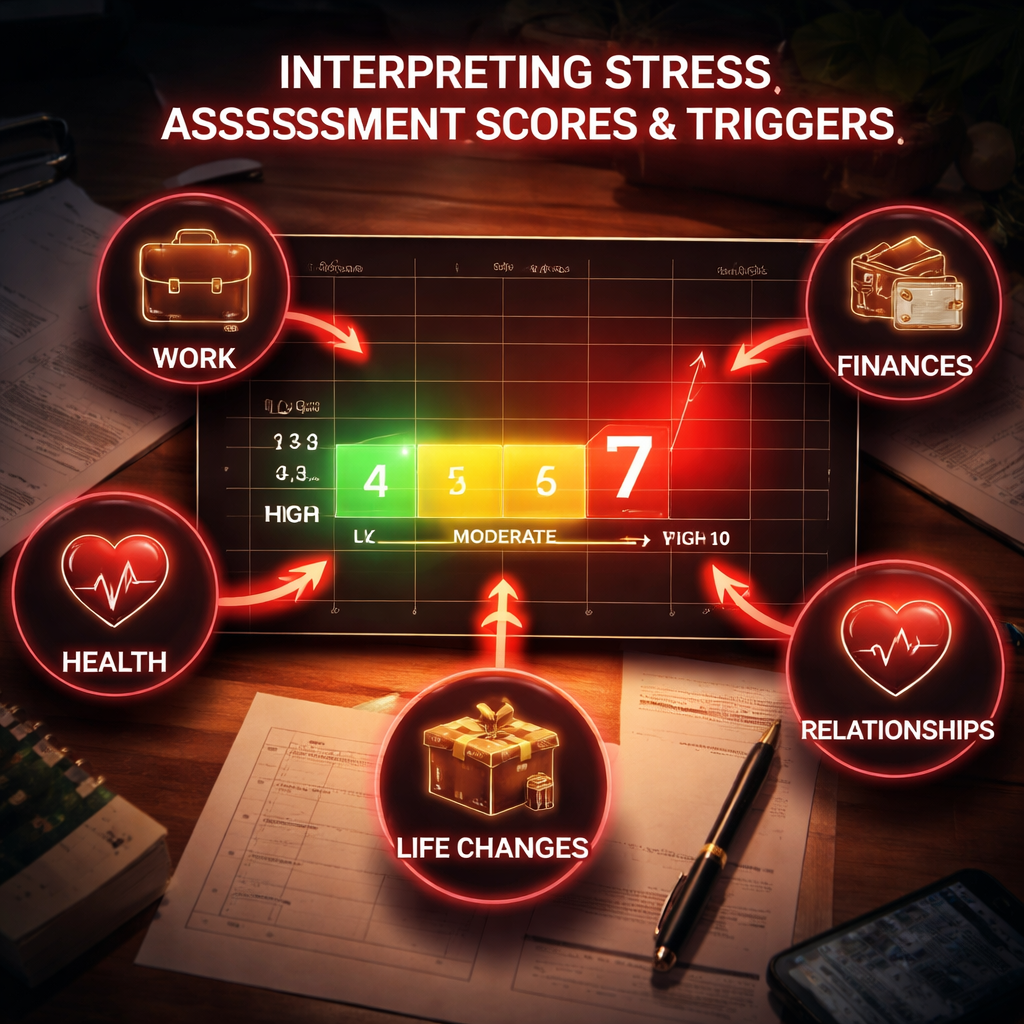
Step 4: Interpret Your Scores & Identify Triggers
Now the numbers are in front of you. What do they mean? Each domain has a range: low, medium, high. Low means you’re doing well. High means you may need help.
Start with the highest scores. Those are your biggest stress triggers. Write them down.
For example, if the sleep domain is high, you might be missing rest. If the movement domain is high, you might be sitting too long.
Look for patterns. A high score in both rest and hydration often goes together. That tells you a simple habit change could improve both.
Here’s a quick way to turn a score into an action:
- Pick the top three high scores.
- For each, write one small change you can try this week.
- Track the change in a notebook.
- Re‑take the assessment in four weeks.
Our pick, the Wellbeing Profile, gives you a personalised report that suggests exactly what to try for each pillar. That makes the step easier.
Some tools, like the Beyond Blue test, give you immediate feedback and a list of resources. Use those links to find help right away.
When you spot a trigger, ask yourself why it’s high. Is it workload? Is it lack of support? Write a short note. That note becomes a clue for your manager or therapist.
External research shows that clinicians who track their triggers are more likely to reduce burnout.
Step 5: Take Action , Stress Management Resources
Knowing your scores is half the battle. The other half is what you do next.
Here are four resource types you can use:
- Brief breathing exercises , a minute of deep breaths can lower a high anxiety score.
- Hydration reminders , a water bottle with time marks helps you meet the hydration domain.
- Movement breaks , a 5‑minute stretch every hour improves the movement score.
- Sleep hygiene tips , dim lights an hour before bed and avoid screens to boost rest.
Many hospitals offer free workshops on stress reduction. Check your employee portal.
If you need guided help, the Wellbeing Profile offers a list of vetted counsellors. That list is built into the report.
For a quick printable guide, look at the Progressive Muscle Relaxation Script PDF on the MarisGraph library. It’s a 10‑minute routine you can do on a break.
Progressive Muscle Relaxation PDF
Another handy tool is a gratitude journal. Writing three things you’re grateful for each shift can lift your mood.
Gratitude journal prompts PDF
If you want a community, join the Private HCP Slack. Over 500 clinicians share tips and support each other.
Trauma Stress and Sleep Tips for Healthcare Pros
Finally, set a reminder to retake the assessment every month. That way you can see if your actions are moving the needle.Using a free clinical stress self assessment tool free isn’t just a one‑off test. It’s a habit that can keep you healthy for years.
Conclusion
We walked through why validation matters, how to read the domains, how to answer honestly, how to spot the biggest stress triggers, and which resources can help you act.
Pick a validated clinical stress self assessment tool free, like the Wellbeing Profile. Fill it out in a quiet place. Look at the scores, note the top three triggers, and try one small change each week.
When you see improvement, keep the cycle going. If scores stay high, reach out to a counsellor or join a peer community. The goal is to stay aware and keep stress in check.
Ready to start? Take the free assessment today and get a personalised report that points you to the right next steps.
FAQ
What makes a clinical stress self assessment tool free trustworthy?
A trustworthy tool is validated by research. Validation means the questions have been tested for reliability and accuracy. When a tool is validated, the scores reflect real stress levels. Look for phrases like "based on the validated Professional Quality of Life Scale" or "validated by the Kessler scale". Those clues tell you the tool has been checked by experts.
How long does it take to complete a typical clinical stress self assessment tool free?
Most free tools have between 10 and 14 questions. That usually takes 5‑10 minutes. If the tool has a longer questionnaire, like the K10+ with 14 items, you may need up to 15 minutes. Set aside a quiet 10‑minute block, read each item carefully, and answer honestly. The short time means you can fit it into a break.
Can I use a clinical stress self assessment tool free on my phone?
Yes. Many tools are web‑based or offered as PDFs that you can open on a phone. The Wellbeing Profile can be completed on any device and will send the report to your email. The K10 can be done on a mobile browser. Just make sure the screen is big enough to read the questions without squinting.
What should I do if my scores are high?
High scores signal a stress area that needs attention. First, note which domain is highest. Then pick one small habit to change , for example, drink a glass of water every hour if hydration is high. Use the resources listed in your report, such as breathing exercises or a counselling referral. If scores stay high after a few weeks, consider talking to a mental‑health professional.
How often should I retake a clinical stress self assessment tool free?
Retaking every four to six weeks gives you a clear view of progress. If you make a change, you’ll see the score move. If you notice no change, you may need a different strategy. Some clinicians retake monthly during busy periods to catch early signs of burnout.
Is my data safe when I use a free clinical stress self assessment tool free?
Data safety depends on the provider. The Wellbeing Profile stores results on secure servers and only shares them with you. The K10 provided by ICANotes is part of a health‑record system that follows privacy rules. Always read the privacy statement before you start. If a tool only offers a PDF download, you keep the file on your own device, which can be safe if you lock your computer.
Can I share my results with my manager?
Sharing can help get workplace support. Show the report and point out the top three triggers. Ask for specific changes, like a shorter shift or a quiet break room. Many managers appreciate the data because it’s clear and actionable. If you’re not comfortable sharing, you can keep the report for personal use and still act on the tips.
Do I need a professional to interpret the results?
You can will flag high scores and suggest actions. If you feel overwhelmed, a therapist or occupational health specialist can dive deeper. They can help you build a plan that fits your work schedule and personal life.


Comments