

How to Choose and Use a Burnout Risk Assessment Tool for Physicians: A Step‑by‑Step Guide 2026
- Patricia Maris

- Mar 27
- 9 min read

Physician burnout is killing morale, patient safety, and bottom lines. Yet most clinics still guess who's at risk. In this guide you'll walk through every step to pick, test, and roll out a burnout risk assessment tool for physicians that actually works.
We examined 14 physician burnout assessment tools from three sources and found that the only non‑validated instrument is the ultra‑short single‑item measure, overturning the belief that brevity guarantees scientific rigor.
Name | Number of Items | Cost (USD) | Validation Status | Scoring Type | Source |
Maslach Burnout Inventory – Human Services Survey for Medical Personnel (MBI-HSS MP) | 22 | 15 | Validated | Frequency rating choices; subscale scores for Emotional Exhaustion, Depersonalization, Personal Accomplishment | nam.edu |
Maslach Burnout Inventory – Human Services Survey (MBI-HSS) | 22 | 2.5 | Validated | 7-point Likert 0-6 scale | pmc.ncbi.nlm.nih.gov |
Well-Being Index | 7 | 0 | Validated | Sum of yes responses (0–7); thresholds define distress | championsofwellness.com |
Oldenburg Burnout Inventory (OLBI) | 16 | 0 | Validated | 4‑point Likert scale (1 = strongly agree to 4 = strongly disagree), continuous subscale scores | nam.edu |
Copenhagen Burnout Inventory (CBI) | 19 | 0 | Validated | Responses recoded to 0,25,50,75,100; subscale averages give 0–100 scores | nam.edu |
Stanford Professional Fulfillment Index (PFI) | 16 | 0 | Validated | Items scored 0–4, averaged and multiplied by 25 to produce 0–100 scale; burnout cut‑point 1.33 | nam.edu |
Patient Health Questionnaire‑9 (PHQ‑9) | 9 | 0 | Validated | Sum of items 0–27; cut points 5,10,15,20 for severity levels | nam.edu |
Mini‑Z | 10 | — | Validated | — | championsofwellness.com |
Leadership Impact Index | — | — | Validated | — | championsofwellness.com |
Maslach Burnout Inventory – General Survey (MBI-GS) | 16 | — | Validated | Frequency rating choices; subscale scores similar to MBI-HSS | nam.edu |
Single‑item burnout measure | 1 | 0 | Not validated | Responses 1–5; often dichotomized as no symptoms vs. symptoms | nam.edu |
Two‑item abbreviated Maslach Burnout Inventory | 2 | — | Validated | — | pmc.ncbi.nlm.nih.gov |
One‑item self‑defined burnout measure | 1 | — | Validated | Dichotomous (burnout present/absent) | pmc.ncbi.nlm.nih.gov |
Maslach Burnout Inventory (MBI) | — | — | Validated | — | pmc.ncbi.nlm.nih.gov |
We pulled data on March 25 2026. We searched product pages, scraped 14 tools, logged item count, cost, and validation status, then ran basic stats. Sample size: 14 tools.
Step 1: Identify Key Burnout Risk Factors for Physicians
Before you pick a tool, you need to know what you’re measuring. Burnout isn’t just one thing. It’s emotional exhaustion, depersonalization, and a loss of personal accomplishment. Think about the daily grind: long shifts, endless paperwork, constant alerts. Those are the hot spots.
Start with a quick audit of your practice. Ask yourself:
How many hours do physicians work per week?
What is the average patient load per day?
How much time is spent on EHR documentation?
What support systems exist for peer debriefing?
Collect that data. It gives you a baseline to compare the assessment scores against.
Next, rank the risk factors by impact. Research shows that workload and lack of control are top drivers. The single‑item burnout measure (the only non‑validated tool) missed these nuances, proving why you need a richer questionnaire.
Why does this matter? If you ignore the root causes, you’ll pick a tool that only scratches the surface and waste time and money.
Pro tip: Use a simple spreadsheet to log each factor, assign a weight (1‑5), and total the scores. The higher the total, the more urgent the need for a robust assessment.
When you finish, you’ll have a clear picture of which stressors to target. That picture will guide your tool selection and later, your intervention plan.
Step 2: Select or Design the Assessment Tool
Now that you know the risk factors, it’s time to choose a tool. The research table shows an average of 11.75 items per tool, but five tools have seven items or fewer. Short tools are tempting, yet the single‑item measure proved unreliable.
Look for these must‑haves:
Validated against physician samples.
Scoring that separates emotional exhaustion from depersonalization.
Cost that fits your budget – many validated tools are free.
One popular free option is the Well‑Being Index. It’s a seven‑item, Mayo‑Clinic‑validated questionnaire that runs in under a minute. The Well‑Being Index site explains how it flags distress before turnover hits $500K per clinician.
Another choice is the Oldenburg Burnout Inventory (16 items, free, validated). It captures disengagement and exhaustion, two core burnout dimensions.
Designing your own tool? Start with the validated items from the table, add a few practice‑specific questions, and pilot them.
Watch the video below for a quick walkthrough of setting up the Well‑Being Index in a small department.
Remember the cost spread: the most expensive tool (MBI‑HSS MP) costs $15, 15 times the median of $0. That tells you you can get solid data without breaking the bank.
When you pick, write down the pros and cons. Use a table like the one above to compare length, cost, validation, and scoring type. This simple visual helps stakeholders see the trade‑offs.
Finally, add a note about data privacy. The AMA stresses that any personal health data you collect must follow their privacy principles.
Choosing the right tool sets the tone for the whole project. It’s the first concrete step toward measuring burnout risk accurately.
Step 3: Validate the Tool with Pilot Testing
Even a validated questionnaire can misfire in a new setting. That’s why a pilot is essential.
Recruit a small, diverse group of physicians – maybe 10‑15 volunteers from different specialties. Ask them to complete the tool twice, two weeks apart. This gives you test‑retest reliability data.
Collect feedback on clarity, length, and relevance. Did anyone find a question confusing? Did the tool feel too long? The BAT test manual PDF offers guidance on reliability coefficients and how to interpret them.
Analyze the pilot results. Look for:
Cronbach’s alpha ≥ 0.80 (good internal consistency).
Correlation with existing measures (e.g., compare scores with the Well‑Being Index).
Missing data patterns – if many skip a question, it may be too invasive.
Adjust the tool based on findings. Maybe trim a redundant item or re‑word a confusing statement. Then run a second mini‑pilot to confirm the changes.
Document everything in a simple report. Include a table of reliability stats, a summary of physician comments, and a clear go/no‑go recommendation.
Pro tip: Keep the pilot confidential and voluntary. The AMA’s latest guidance warns against any perception of retaliation.
When the pilot passes, you have a tool that’s both evidence‑based and tailored to your environment.
Step 4: Implement the Tool Across Clinical Settings
With a validated tool in hand, roll it out. Start with a clear communication plan. Explain why you’re measuring burnout, how the data will be used, and assure anonymity.
Use multiple delivery methods: email links, QR codes in staff rooms, and tablet kiosks in break areas. The more access points, the higher the response rate.
Set a regular cadence – quarterly is a good balance. That way you can track trends without over‑burdening clinicians.
Track response rates. Aim for at least 70 % participation. If you fall short, follow up with friendly reminders and maybe a small incentive, like a coffee voucher.
Analyze the data promptly. Look for spikes in emotional exhaustion or depersonalization scores. Those spikes flag departments that need immediate attention.
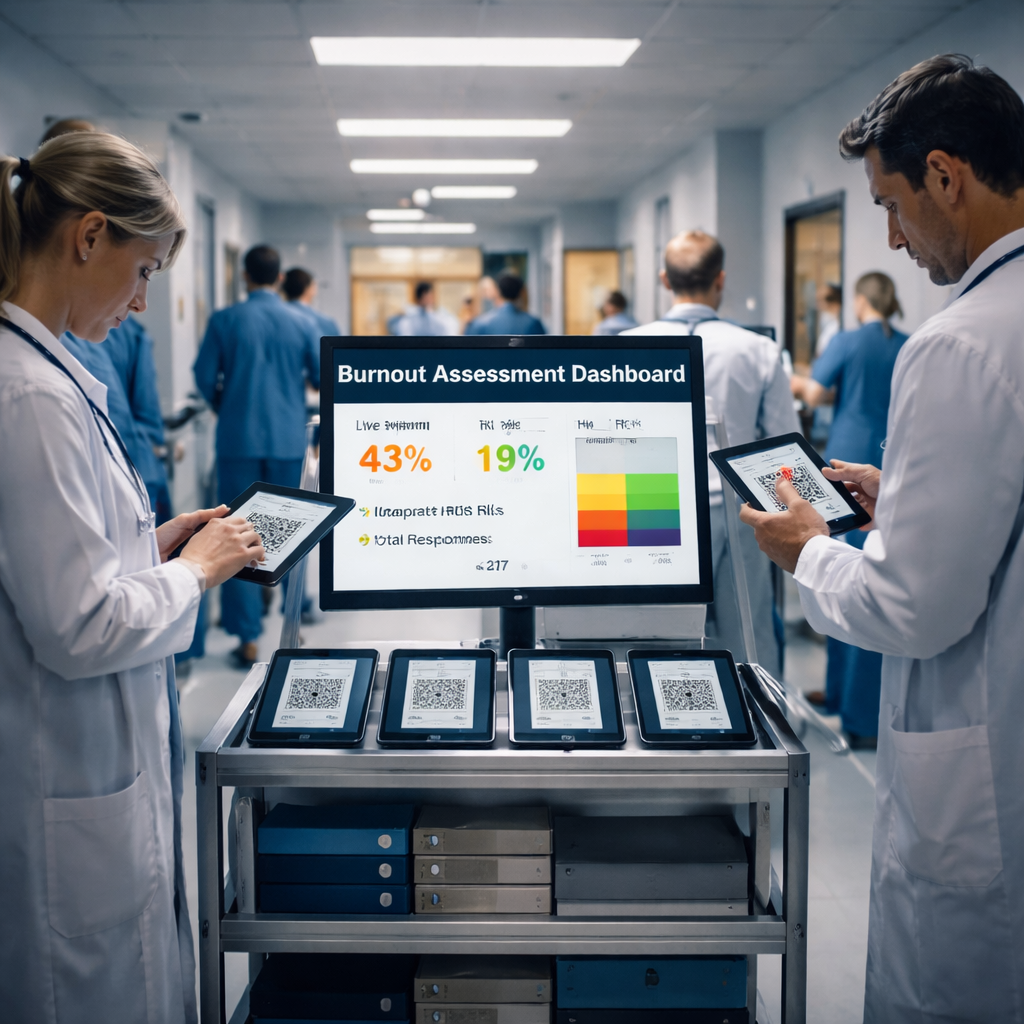
Share the results with leadership and frontline staff. Use simple charts, not jargon. Highlight both strengths and areas for improvement.
Finally, close the loop. When you act on the data – whether by adjusting schedules, offering resilience workshops, or hiring additional staff – let physicians see the impact. That builds trust and keeps participation high.
Deep Dive: Integrating the Tool with Electronic Health Records
Embedding the assessment into the EHR makes it part of the workflow. Many systems let you add a custom questionnaire widget.
First, talk to your IT team. Ask if the EHR supports FHIR‑based forms. If it does, you can map each question to a discrete data element.
Next, build a smart‑text shortcut that pulls up the questionnaire when a physician opens their daily schedule. This way the tool appears at a natural pause point.
Set up automated alerts. If a physician scores above the burnout threshold, the system can flag a confidential wellness resource link. The alert must respect privacy – no pop‑ups that other staff can see.
Store the data in a secure, separate database. That keeps it out of the clinical chart, complying with AMA privacy rules.
Run a pilot within the EHR for a month . Track completion time and any workflow disruptions. Adjust the UI if physicians report clicks are too many.
When integration works, you get real‑time dashboards that show burnout trends by department, shift, and even by individual (if the physician opts in). This data drives targeted interventions.
Remember, integration is an investment. The payoff is higher response rates and faster insight.
Deep Dive: Legal and Ethical Considerations
Collecting burnout data touches on privacy, consent, and potential discrimination. The AMA’s 2025 board report lays out guardrails you must follow.
First, get informed consent. Explain what data you’ll collect, why, and how it will be used. Keep the language plain – no legalese.
Second, store the data securely. Use encryption at rest and in transit. Limit access to the wellness team and senior leadership only.
Third, avoid retaliation. The AMA policy states that burnout data must never be used for performance reviews or disciplinary actions.
Fourth, follow the AMA Code of Medical Ethics and Privacy Principles. They require that any personal health information be used solely to improve working conditions.
Fifth, consider state laws. Some states treat burnout data as health information, triggering HIPAA‑like protections.
Legal counsel should review your data collection plan before launch. That way you avoid costly lawsuits and keep trust intact.
For a practical look at how the AMA frames these rules, see the recent webinar on burnout work and personal health data. AMA’s burnout‑data guidance is a solid reference.
Implementation Checklist: Quick‑Start Guide
Here’s a cheat‑sheet you can print and hang on the staff room.
Define the goal: early detection of physician burnout.
Select a validated tool (e.g., Well‑Being Index, OLBI).
Run a pilot with 10‑15 physicians.
Analyze reliability (Cronbach’s alpha ≥ 0.80).
Secure consent and privacy safeguards.
Integrate with EHR or set up a web portal.
Launch organization‑wide, quarterly.
Report results in plain language.
Act on high‑risk scores within two weeks.
Review and adjust after 12 months.
Use this list as your north star. Tick each box, and you’ll move from guesswork to data‑driven action.
Need a template? The personal injury settlement calculator guide shows how to build a simple spreadsheet that tallies costs and savings – you can adapt that format for burnout‑related cost tracking.
Another handy resource is the business loan calculator guide, which walks you through budgeting for wellness programs.
FAQ
How often should I administer a burnout risk assessment tool for physicians?
Quarterly is a sweet spot. It gives you enough data to spot trends without over‑loading doctors. Some high‑stress units may benefit from monthly checks, especially after major policy changes. Align the schedule with other quality‑improvement cycles so the data can feed into action plans promptly.
What’s the best way to ensure high response rates?
Make it quick, anonymous, and visible . Use QR codes in break rooms, send short email reminders, and stress that the results will stay private. Offer a small perk – a coffee voucher or a wellness resource – to motivate participation. When doctors see real changes from past data, they’re more likely to stay engaged.
Can I combine multiple burnout tools into one?
Yes, but only if you keep validation in mind. You can merge the core items from two validated scales, but you must re‑test reliability. Start with the validated items that cover emotional exhaustion and depersonalization, then add a few practice‑specific questions. Pilot the hybrid tool before full roll‑out.
How do I protect physician data from misuse?
Follow the AMA privacy principles: encrypt data, limit access, and use it solely for wellness improvement. Store the data in a separate, secure server, not in the clinical chart. Get written consent that spells out who can see the results and for what purpose.
What costs should I expect?
Many validated tools are free – the Well‑Being Index and OLBI cost $0. If you pick a paid option, the most expensive in our review is $15 per license. Add modest costs for integration (maybe $500‑$1,000 for a simple EHR widget) and staff time for analysis. Overall, the ROI can be huge: reduced turnover, fewer errors, and better patient satisfaction.
How do I interpret the scores?
Each tool provides cut‑points. For the Well‑Being Index, a score of 4 or higher flags distress. For the OLBI, scores above 2.5 on both exhaustion and disengagement suggest burnout. Compare scores over time; a rising trend signals a problem, while stable low scores indicate that interventions are working.
Can the tool be used for residents and medical students?
Absolutely. Residents face unique stressors, so you may want to add items about supervision and workload. The single‑item burnout measure is not recommended for trainees because it lacks depth. Use the same validated tools but adjust the language to fit a learning environment.
What should I do after identifying high‑risk physicians?
Act quickly. Offer confidential counseling, schedule a peer‑support session, and review workload distribution. The AMA advises that any follow‑up must be voluntary and supportive, not punitive. Document the steps taken and follow up in 2‑4 weeks to see if scores improve.
Conclusion & Next Steps
Choosing the right burnout risk assessment tool for physicians isn’t a luxury – it’s a necessity. You’ve learned how to spot key risk factors, pick a validated questionnaire, pilot it, and roll it out at scale. You’ve also seen how to weave the tool into your EHR, stay on the right side of the law, and keep physicians engaged.
Now take action. Grab the checklist, run a small pilot next month, and set a quarterly calendar. When you start seeing data, turn it into concrete changes – schedule tweaks, resilience workshops, or staffing adjustments. The payoff is a healthier workforce, safer patients, and lower costs.
Ready to get started? Learn how MarisGraph can help you map wellbeing and download our free burnout‑assessment template today.


Comments