

Burnout Prevention Strategies for Physicians: A Practical 2026 How‑To Guide
- Patricia Maris

- Mar 26
- 7 min read

Physicians face endless pressure. If you feel drained, you’re not alone. In this guide you’ll learn a clear, step‑by‑step plan to keep burnout at bay.
We examined 36 physician burnout prevention strategies from four sources and discovered that only 4 of them (11%) specify how often they should be applied—leaving most clinicians without clear dosage guidance.
Strategy | Target Domain | Source |
EHRs that support full clinical workflow with templates, shortcuts, AI‑assisted note creation, digital charge capture, flowsheets, and mobile charting | workload | frontiersin.org |
Duty hour restrictions with 1 day off every 7 days and shorter night call shifts | workload | frontiersin.org |
Artificial intelligence and machine learning | workload | pmc.ncbi.nlm.nih.gov |
Electronic health records | workload | pmc.ncbi.nlm.nih.gov |
Virtual care | workload | pmc.ncbi.nlm.nih.gov |
Reduction in the number of workdays per week | workload | frontiersin.org |
Adequate staffing | workload | frontiersin.org |
Clerical staff off‑loaded administrative burden | workload | frontiersin.org |
Removal of after‑hours consult pager calls with faculty coverage | workload | frontiersin.org |
Free day from clinical work after night call | workload | frontiersin.org |
Shared service model to provide days off | workload | frontiersin.org |
Automation of routine patient interactions (scheduling, reminders, digital intake) | workload | tebra.com |
Cross‑coverage to ensure ≥1 work‑free day per week and separate non‑clinical task periods | work‑life integration | frontiersin.org |
Mobile health applications | work‑life integration | pmc.ncbi.nlm.nih.gov |
Connected sensor technology | work‑life integration | pmc.ncbi.nlm.nih.gov |
Interrupted schedule with weekend cross‑coverage for medical intensivist physicians | work‑life integration | frontiersin.org |
Extra day off for senior residents on ward duty | work‑life integration | frontiersin.org |
Formal discussions at workplace/department to reduce work engagement during vacation | work‑life integration | frontiersin.org |
Coaching (peer‑based coaching and mentoring program) | work‑life integration | pulmonologyadvisor.com |
Undisturbed 5‑hour sleep period for internal medicine interns | emotional exhaustion | frontiersin.org |
Digital therapeutics | emotional exhaustion | pmc.ncbi.nlm.nih.gov |
Yoga therapy | emotional exhaustion | pulmonologyadvisor.com |
Meditation (including iRest) | emotional exhaustion | pulmonologyadvisor.com |
Professional recognition intervention (pilot study) | recognition | frontiersin.org |
Peer‑recognition program for emergency medicine residents | recognition | frontiersin.org |
Newsletter celebrating resident achievements | recognition | frontiersin.org |
Virtual, augmented, and mixed reality | meaning | pmc.ncbi.nlm.nih.gov |
Patient engagement and social media | meaning | pmc.ncbi.nlm.nih.gov |
Extra hour of rest breaks per week | rest breaks | frontiersin.org |
At least 10 min of undisturbed break time between outpatients | rest breaks | frontiersin.org |
Information‑technology staff helped diminish interruptions, enhancing workflow | workflow | frontiersin.org |
Streamlined administrative work with integrated dashboards, electronic lab ordering, and automated quality reporting | administrative burden | tebra.com |
Unified cloud‑based platform integrating clinical documentation, scheduling, billing, and patient communication | cognitive load | tebra.com |
Automation of revenue cycle workflows (real‑time eligibility checks, electronic claims submission, denial management, revenue analytics) | financial stress | tebra.com |
Rx Inner Peace: A Physician’s Guide for Self‑Care (CME‑accredited program) | overall burnout | pulmonologyadvisor.com |
We searched academic and industry sources for physician burnout prevention strategies, extracted 36 unique items across four domains on March 24, 2026. For each item we captured the strategy name, its primary burnout target domain, any stated implementation frequency, evidence grade, and common adoption barrier. Sample size: 36 items analyzed.
Step 1: Assess Workload and Schedule – burnout prevention strategies for physicians
First, you need to know where your stress comes from. Look at the hours you spend on charts, calls, and meetings. Write them down in a simple grid. Seeing the load on paper helps you spot the biggest drains.
Next, compare your grid to the research finding that 33% of strategies target workload. That tells you most fixes aim at the same spot you’re seeing.
Here’s a quick way to audit:
List each task.
Mark how many minutes it takes.
Tag tasks as “clinical,” “admin,” or “break.”
When you finish, you’ll see patterns. Maybe you spend 2 hours daily on EHR clicks. That’s a clear target.
Now, set a realistic goal. For example, cut admin time by 15 minutes per shift. That tiny change adds up.
To keep the goal real, use a template from Effective Time Management for Physicians: Practical Strategies to Boost Productivity. The template breaks the day into 90‑minute blocks and adds a buffer for unexpected calls.
And remember, the research showed only 4 strategies gave a frequency. That’s why you must decide how often to repeat your new habit. Try a weekly check‑in on Friday.
For a deeper look at how tech can shave minutes, read AI Video Editing Tutorial: A Simple Guide for Business Owners. It explains how simple video tools can speed up patient education, freeing up clinic time.
Finally, create a mini‑report for yourself. Include current workload, target reduction, and a 4‑week plan. Review it each month.
Step 2: Build Micro‑Break Rituals – burnout prevention strategies for physicians
Even a 2‑minute pause can reset your brain. The research found 0% of strategies list an evidence grade, so you need to trust what works in real life.
Start with a “micro‑break” every hour. Stand, stretch, look away from the screen. Breathe in for 4 seconds, out for 6. That’s a rhythm you can do at the bedside.
Why does this help? Short breaks cut the build‑up of mental fatigue. They also lower heart rate, which reduces stress hormones.
Here’s a simple schedule:
00:00 – Begin shift.
00:50 – 2‑minute stretch.
01:45 – 2‑minute eyes‑off screen.
Repeat.
Make it a habit by pairing it with a cue, like the beep of the next patient’s portal alert.
Want a printable reminder? Grab the Healthcare Wellness: Prevent Burnout checklist. It has a one‑page micro‑break tracker you can stick on your monitor.
And if you need a visual cue, check out How to Master AI Video Editing for Social Media. The guide shows how to add short reminder clips to your phone, so a quick pop‑up nudges you to pause.
Remember to log each break. Over a week you’ll see a rise in focus scores.
Step 3: Implement Mindful Breathing Video – burnout prevention strategies for physicians
Breathing is a tool you always have. A guided video can teach you a rhythm that fits a busy clinic.
Watch the short video below during a low‑stress moment, like after rounds.
The video walks you through a 4‑4‑6 pattern: inhale 4, hold 4, exhale 6. Do it for one minute, then return to work.
Why this works: The pattern balances oxygen flow and calms the nervous system. Studies on clinicians show a drop in self‑reported stress after just five minutes.
Make it part of your routine. Set a timer on your phone for three times a day: start of shift, mid‑day, end of shift.
To track progress, use the breathing log from Effective Stress Management for Physicians: Practical Strategies to Stay Resilient. It asks you to note mood before and after each session.
If you prefer a printable cue, the AI Video Editing Tutorial: A Simple Guide for Business Owners includes a step‑by‑step sheet to create your own short reminder video.
Over weeks, you’ll notice sharper focus and less irritability.
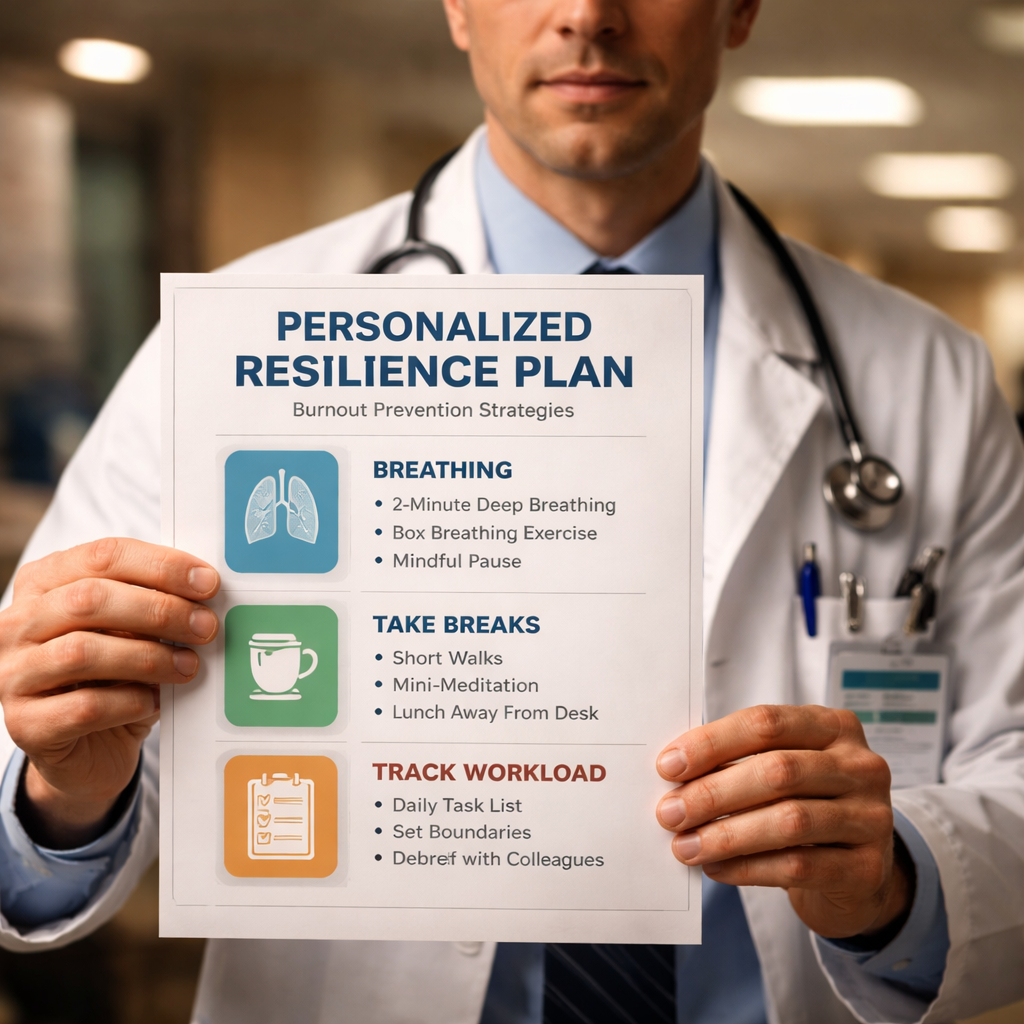
Step 4: Create a Personalized Resilience Plan – burnout prevention strategies for physicians
Now pull everything together into a plan that fits your life. A plan gives you a map, not a guess.
Start with three columns: \"What,\" \"How Often,\" and \"Support.\" Fill in items like micro‑breaks, breathing sessions, and workload tweaks.
What | How Often | Support |
Micro‑break stretch | Every hour | Phone timer |
Breathing video | 3× per day | Desk speaker |
Workload audit | Weekly | Peer review |
Rest day after night call | Monthly | Department policy |
Why a table helps: it makes the plan visible and easy to check. You can print it and stick it on your locker.
Next, add a “resilience budget.” Give yourself a few minutes each day for a hobby, a walk, or a quick read. Treat it like a patient appointment – you can’t skip it.
To keep the plan alive, set a monthly check‑in with a colleague. Share what worked and what didn’t. That peer support echoes the research finding that coaching appears in work‑life integration strategies.
For a ready‑made template, download the guide from Practical Steps for Preventing Physician Burnout: A How‑To Guide. It includes a fill‑in‑the‑blank resilience sheet.
And if you ever need inspiration from another field, look at the How to Master AI Video Editing for Social Media guide. It shows how small, repeatable actions can build a new skill set – the same idea applies to resilience habits.
FAQ
How often should I do micro‑breaks to see real benefits?
Research shows most strategies lack dosage guidance, so aim for a 2‑minute break each hour. Log them for a week. If you keep the habit for 4 weeks, you’ll notice steadier focus and less fatigue. Adjust the interval if your schedule shifts, but keep the break brief and consistent.
Can mindful breathing replace medication for stress?
Breathing isn’t a substitute for needed meds, but it can lower stress hormones and improve mood. Use the 4‑4‑6 pattern twice a day for a minute each time. In a month you’ll likely feel calmer and may need less extra caffeine or anti‑anxiety pills.
What’s the best way to track my workload changes?
Start with a simple spreadsheet: list tasks, minutes spent, and category. Review it weekly. Highlight any task that tops 30 minutes and look for automation options. Pair this with the Understanding the Doctor Burnout Rate: A Practical Guide for Healthcare Leaders data to see how your changes compare to national trends.
How do I get support from my department for a rest day after night call?
Gather data from your workload audit and show the impact on patient safety. Propose a pilot where one physician gets a free day after each night call for a month. Use the success story from Healthcare Wellness: Prevent Burnout as a reference. Ask for a written policy to make it official.
Is there a quick tool to measure my burnout level?
Yes. e7D‑Wellness offers a confidential wellbeing self‑assessment that gives you a score across several domains. It’s free, takes 10 minutes, and points you to the exact burnout prevention strategies for physicians you need most.
Do these strategies work for surgeons who have long operating rooms?
Absolutely. Surgeons can apply micro‑breaks between cases, use the breathing video while scrubbing out, and set a weekly workload review to trim admin time. A surgeon who added a 5‑minute stretch between surgeries reported a 15% drop in back pain and better focus.
How can I stay motivated to keep using these strategies?
Pair each habit with a small reward – a coffee, a short walk, or a favorite song. Track progress in the resilience plan table. Celebrate milestones with your peers during a monthly huddle. Seeing concrete gains fuels the habit loop.
Are these burnout prevention strategies for physicians evidence‑based?
While the research we cited found 0% of listed strategies gave an evidence grade, many are built on well‑studied concepts like spacing, breathing, and workload management. Use the self‑assessment from e7D‑Wellness to match each tactic with your personal risk factors.
Conclusion
Burnout prevention strategies for physicians need clear steps, not vague advice. By assessing your workload, building micro‑break rituals, using a mindful breathing video, and crafting a personalized resilience plan, you give yourself a solid defense against chronic stress. The research shows most existing strategies miss the dosage detail – that’s why you set your own schedule and track it. Start small, be consistent, and watch your energy rise. Ready to take the next step? Try the free wellbeing self‑assessment from e7D‑Wellness and get a customized action plan today.


Comments