

Free Burnout Risk Assessment for Nurses: A Step-by-Step Guide
- Patricia Maris

- 9 hours ago
- 10 min read
Nurse burnout is real, it's measurable, and it tends to creep up before you notice it. The problem is that free, nurse-specific assessment tools are genuinely hard to find , our research found only one publicly available PDF, and it comes from a pharmaceutical company rather than a nursing body. This guide walks you through every step: spotting early warning signs, choosing and downloading the right tool, reading your score, and deciding what to do next.
Step 1: Recognise the Early Warning Signs of Nurse Burnout
Your goal here is simple: know what you're looking for before you pick up a pen or open a PDF. Burnout doesn't arrive all at once. It builds quietly, often hiding behind what looks like a hard week or a difficult rotation.
The early signs split into three clusters. Emotional exhaustion shows up first , you feel drained before a shift starts, you're irritable with colleagues, and small frustrations feel disproportionately heavy. Then comes depersonalisation: you notice yourself going through the motions with patients, feeling detached in ways that worry you. Last is reduced personal accomplishment , a creeping sense that nothing you do is good enough, even when the clinical outcome is fine.
Physical signals matter too. Disrupted sleep that isn't just shift-related, persistent headaches, or getting sick more often than usual are all early indicators worth taking seriously. Research on burnout in high-workload settings like ICUs and emergency departments consistently finds that it is shaped by a combination of occupational stress, shift demands, and individual coping capacity , none of which shows up on a standard vital-signs chart.
Why do early signs matter? Because burnout at the moderate stage responds well to targeted strategies. At the severe end, the interventions needed are much more intensive, and time off work often becomes unavoidable.

If you're recognising two or more of these signals right now, you're in the right place. The next step is finding a tool that actually measures where you sit on the burnout spectrum , not just confirming that work is hard.
For a related look at how stress compounds across caregiving roles, the compassion fatigue test guide from e7D-Wellness breaks down the overlap between compassion fatigue and classic burnout, which is useful context before you score yourself.
Step 2: Choose the Right Free Burnout Risk Assessment PDF for Nurses
Here's something counterintuitive: the landscape of free, nurse-specific burnout PDFs is almost empty. When we searched specifically for downloadable, no-cost tools aimed at nurses, we found only a small number of publicly available options. One is the AstraZeneca Burnout Self-Test, hosted within their COVID-19 support toolkit. That's a pharma company providing the tool, not a nursing association, not a health department. It's a legitimate resource, but its origins matter for how you interpret and weight the results.
A second option worth knowing is the Self-Care Burnout Self-Test from PALA. It's aimed at helping professionals broadly, so it applies well to nurses even if it wasn't built exclusively for clinical settings.
Tool | Provider | Nurse-Specific? | Format | Best For | Limitation |
Burnout Self-Test | AstraZeneca | No — general HCP | Free PDF download | Quick self-screen; pandemic-era framing | No item count or time estimate published; pharma source |
Self-Care Burnout Self-Test | PALA | No — helping professions broadly | Free PDF download | Clinicians in counselling or allied health roles | Not validated specifically for ICU or acute care nurses |
e7D-Wellness Wellbeing Assessment | e7D-Wellness | Yes — built for HCPs | Online (confidential, evidence-based) | Full wellbeing profile with 8-pillar scoring | Requires a free account; not a static PDF |
Validated clinical burnout instrument (ICU/ED nursing research) | Academic/research setting | Yes — nurses in ICU/ED settings | Academic instrument | High-acuity nursing research or self-audit | Not available as a consumer PDF; requires access to the published study |
The AstraZeneca tool is the only free nurse burnout self-test available as a direct PDF download from a publicly accessible URL. You can access it via AstraZeneca's COVID-19 toolkit PDF. Keep in mind it was originally packaged as pandemic mental-health support, so some framing reflects that period rather than standard nursing workflows.
Burnout in high-workload settings like ICUs and emergency departments is shaped by factors specific to those environments, which is why validated clinical instruments developed for those contexts can be valuable — though they are typically accessible only through academic channels rather than as consumer downloads.
If you want a tool designed specifically around clinical roles , with scoring that maps to actionable pillars rather than a single burnout number , e7D-Wellness offers a confidential wellbeing self-assessment built for healthcare professionals. It's not a static PDF, but the output is far more detailed than any downloadable checklist.
Key Takeaway:Genuinely free nurse burnout PDFs that are publicly available remain rare, and the most accessible option comes from a pharmaceutical company. Use it as a starting point, not a final word.
Step 3: Download and Complete Your Burnout Risk Assessment PDF
Once you've picked your tool, completion quality matters as much as which tool you chose. A rushed, distracted attempt produces a score that doesn't reflect your real state.
First, time it right. Don't complete the assessment immediately after a difficult shift or right before you go on. Give yourself ten quiet minutes , a break room, a parked car, anywhere without an interruption. Set a timer if that helps you stay focused.
Answer based on the last two to four weeks, not your worst day ever and not an optimistic version of how you'd like to feel. This is the most common mistake. If you answer how you wish things were, the score is meaningless. The whole point of a self-assessment is a clear mirror, not a flattering one.
Read each item slowly, even the ones that feel repetitive or obvious. Burnout scales are designed to catch patterns across slightly different framings of the same underlying construct , emotional exhaustion, detachment, sense of efficacy. Skimming leads to inconsistent answers that skew the total.
When you finish, write down your total score and any sub-scores. Keep this in a notebook or a notes app. You'll need it for comparison when you retest in a few weeks. If the tool you're using doesn't give you sub-scores, note which individual items you rated highest , those are your pressure points.
Nurses working in high-acuity units should consider retesting on a four-to-six week cycle rather than quarterly. Burnout in ICU and emergency settings is shaped by shift demands and environmental stressors that shift quickly , making more frequent check-ins genuinely useful rather than excessive.
For a structured approach to tracking scores across time, the nurse resilience self-test guide from e7D-Wellness walks through a two-week retesting cycle with a simple tracking table you can copy into any notebook.
Pro Tip:Complete your assessment at the same time of day each retest cycle. Energy and mood fluctuate across shifts , controlling for time of day makes your scores more comparable.
Step 4: Interpret Your Burnout Risk Score Accurately
A score without a frame is just a number. Here's how to read it properly.
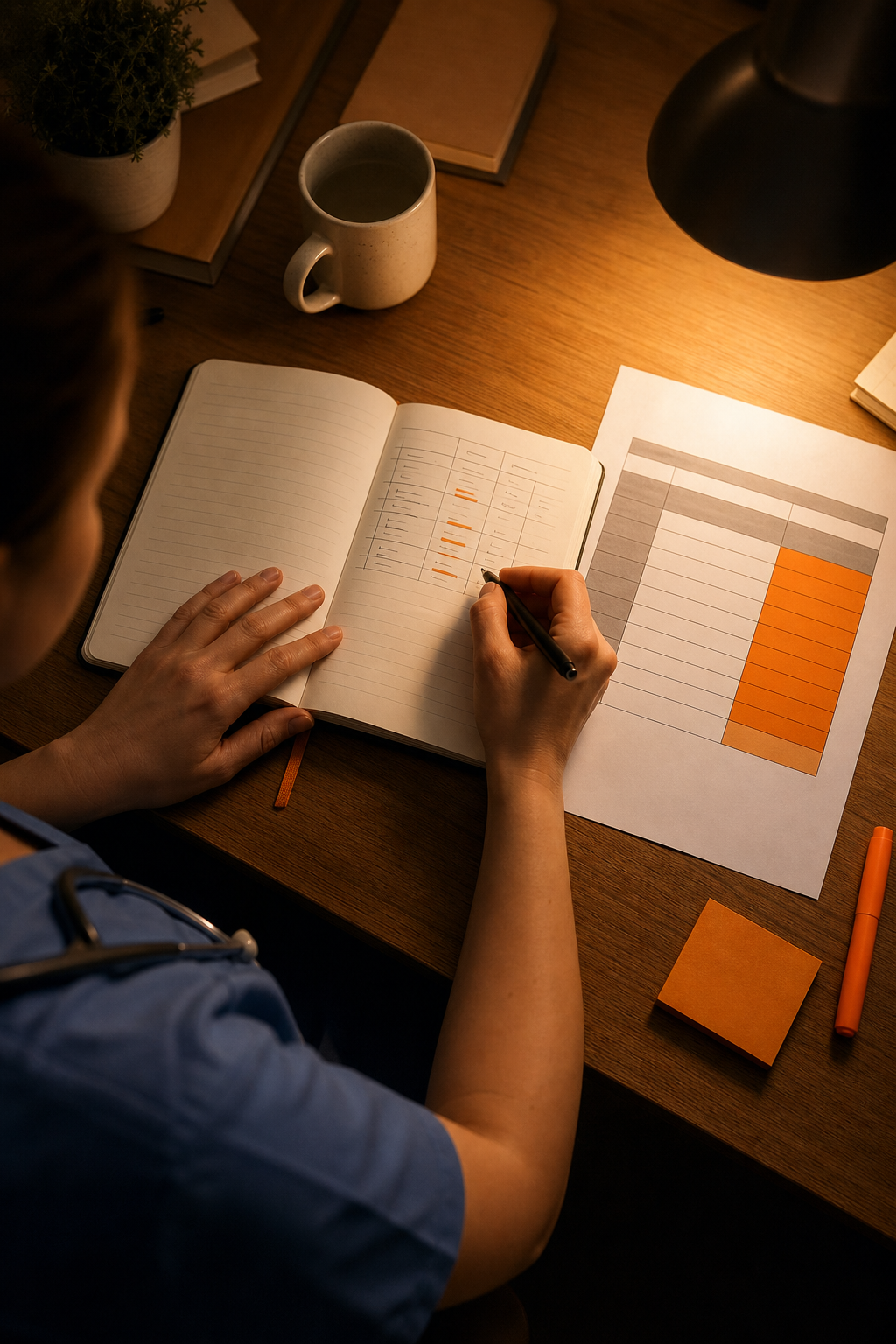
Most free burnout tools use a simple three-band system. A low total suggests your current workload stress is manageable and your coping resources are holding. A moderate score means warning signals are present , you're not in crisis, but doing nothing is a bad idea. A high score points to significant burnout risk and warrants immediate action, whether that's speaking with a supervisor, accessing an employee assistance programme, or seeking professional support.
Don't read a single number in isolation. Look at which questions drove your highest ratings. If your top-scoring items all cluster around emotional exhaustion rather than depersonalisation, the intervention looks different than the reverse. Emotional exhaustion often responds well to workload adjustments and rest anchors. Depersonalisation, where you feel disconnected from patients, tends to point toward relational and meaning-of-work strategies.
One honest caveat: the free PDFs available right now don't include validated scoring guides in the same way a clinical instrument does. Some academic burnout scales carry strong psychometric properties , high internal consistency and test-retest reliability , making them robust research tools. The AstraZeneca Burnout Self-Test was built for quick screening, not clinical diagnosis. Treat your score as directional signal, not a clinical verdict.
If your score lands in the moderate or high band, don't dismiss it because you've felt this way before and managed. Persistence is the point. Sustained moderate burnout is harder on the body and mind than short acute spikes, and it tends to worsen without deliberate intervention.
For nurses who want to map their score against a broader wellbeing framework, the healthcare worker wellbeing index calculator guide on e7D-Wellness shows how to translate raw scores into dimension-by-dimension risk areas , emotional, occupational, social, and physical , and then connect each to a specific action.
Step 5: Take Action on Your Results With Evidence-Based Strategies
Reading your score is step four. Acting on it is where things actually change. The actions that work aren't grand overhauls , they're small, repeatable habits attached to things you already do.
If your score is in the low band, the priority is protection. Keep doing what's working. Schedule a retest in eight weeks. The only tweak at this level is making sure you're tracking the pillars that keep burnout low: sleep consistency, at least one recovery activity per week, and staying connected to colleagues rather than isolating between shifts.
For moderate scores, pick two pressure points from your assessment and build one small action around each. For example:
If emotional exhaustion is high: try a five-minute breathing reset between patients. A structured 4-7-8 breath pattern takes less time than charting a note.
If work-life boundary blurring is a factor: set a hard stop on checking clinical messages during days off, even for one day per week to start.
If sleep disruption is a driver: fix your anchor sleep time , the time you wake up , before worrying about when you go to bed.
For high scores, this is the point where self-management alone isn't enough. Talk to someone. That might be a supervisor, a peer, your GP, or an occupational health service. Many hospital systems have employee assistance programmes that include confidential counselling , these exist for exactly this reason, and using them is not a sign of weakness in your clinical competence.
Physical movement matters more than most nursing wellness programs acknowledge. Long shifts mean the body carries sustained tension. Short exercises , even knee and lower-body strengthening movements done in a break room , reduce the physical load that compounds emotional exhaustion. Physical recovery and emotional recovery aren't separate problems; they run together.
Whatever your score, document the date and your plan. One concrete habit, one timeline, one retest date. That's the whole action plan at this stage. Complexity is the enemy of follow-through when you're already depleted.
Step 6: Go Deeper With e7D-Wellness Confidential Wellbeing Assessment
The free PDFs available are useful starting points. But they give you a single number, not a map. e7D-Wellness was built specifically for healthcare professionals who need more than a traffic-light result.
The e7D-Wellness wellbeing assessment works across eight pillars: Willpower, Breathing, Hydration, Thoughts, Nutrition, Movement, Rest, and Sexual Wellbeing. Each pillar generates its own sub-score, so instead of a single burnout number, you get a profile that shows exactly where your resilience is holding and where it's eroding. That specificity matters because the intervention for a nurse whose Rest score is low looks completely different from one whose Thoughts or Boundary-setting scores are the issue.
The assessment is confidential. You control the data, and results are not shared with employers. That confidentiality removes the barrier that stops many nurses from completing honest self-assessments , the fear that poor results might affect their standing at work.
After you complete the assessment, e7D-Wellness provides data-driven insights and access to resources matched to your specific pillar gaps. If Rest is your lowest pillar, you get sleep-specific strategies for shift workers. If Movement is the gap, you get routines that fit in the margins of a 12-hour shift. For stress resilience specifically, the stress resilience score calculator guide on e7D-Wellness walks through how to map your sub-scores to a two-pillar action plan , a method that works equally well for nurses and physicians.
Think of the PDF assessments in this guide as the quick triage step. e7D-Wellness is the follow-up investigation. Both have a place in a sustainable burnout risk management routine.
If you've already completed a free burnout PDF and want to build on those results, the e7D-Wellness assessment is the logical next step. It takes eight to ten minutes and gives you a wellbeing profile that stays useful long after a single score would have faded from memory.
FAQ
Is there a completely free burnout risk assessment specifically for nurses?
Yes, but the options are limited. The only publicly available free burnout self-test PDF designed for healthcare workers is the AstraZeneca Burnout Self-Test, originally part of a COVID-19 support toolkit. It's a general HCP tool, not nurse-specific. For a nurse-focused wellbeing profile, e7D-Wellness offers a confidential online assessment built around clinical roles.
How long does a burnout self-assessment take to complete?
Most free burnout PDF tools take five to ten minutes if you answer without stopping. Longer clinical instruments can take a similar amount of time. The e7D-Wellness assessment is eight to ten minutes. The key is doing it in one uninterrupted sitting , stopping and restarting produces inconsistent answers and skews your score.
What score means I'm at high burnout risk?
It depends on the specific tool. Most free PDF burnout self-tests use a three-band system: low, moderate, and high risk. High scores across emotional exhaustion, depersonalisation, or reduced personal accomplishment sub-scales indicate significant risk. Any score in the high band is a signal to act now , not to wait and see if the next rotation feels better. If no scoring guide came with your PDF, read the items you rated highest and treat those as your priority areas.
Can I use a burnout assessment PDF to show my employer I need support?
A self-assessment result is not a clinical diagnosis, so it carries no formal weight in most HR processes. That said, it can be a useful starting point for a conversation with occupational health, a manager, or an employee assistance programme counsellor. It gives you specific language , emotional exhaustion, workload mismatch, boundary erosion , rather than a vague complaint. Frame it as evidence you've noticed a pattern, not a demand for immediate change.
How often should nurses complete a burnout risk assessment?
For most nurses, a four-to-six week retest cycle is enough to track meaningful change without obsessing over short-term fluctuations. Nurses in high-acuity settings , ICU, ED, night shifts , benefit from checking in more often because their burnout drivers shift faster. After starting any new habit or coping strategy, retesting in two to three weeks gives you real data on whether it's working.
What's the difference between burnout and compassion fatigue?
Burnout is a response to chronic workplace stress , it centres on exhaustion, disconnection, and loss of effectiveness. Compassion fatigue is specifically a cost of caring: secondary traumatic stress absorbed through close contact with patients in pain or distress. The two overlap heavily in nursing, which is why assessing both gives a clearer picture. High scores on both require different recovery strategies running in parallel.
Conclusion
Free nurse burnout PDFs are scarce, and the ones that exist are general rather than purpose-built for clinical roles. Use the AstraZeneca or PALA tools as a first screen, follow the completion and interpretation steps in this guide, and then move to e7D-Wellness for a full eight-pillar wellbeing profile that tells you not just where you're burning out, but exactly which pillars to work on first. Start with an honest ten-minute assessment today , your score is the most useful data point you have.


Comments