

Reframing Negative Thoughts Examples: 7 Practical Ways to Shift Your Mindset
- Patricia Maris

- Jan 6
- 18 min read

Ever caught yourself spiraling after a tough shift, thinking, “I’m not cut out for this”? That moment of self‑doubt is all too familiar for physicians, nurses, and anyone on the front lines of care.
Picture a surgeon who just closed a complicated procedure and hears that inner critic whisper, “You missed something.” The brain latches onto that single slip, magnifying it until it feels like a personal failure.
Reframing flips that script. Instead of letting the negative thought run the show, you ask yourself, “What evidence do I have that this was a total disaster?” and then deliberately shift focus to what went right – the precise incision, the steady hands, the successful closure.
One practical way to do this is through visualisation. By picturing a calm, successful outcome before you even enter the OR, you create a mental buffer that softens the impact of any hiccup. Visualisation techniques for healthcare professionals guide you step‑by‑step through this process, turning stressful scenarios into manageable narratives.
Here are three quick steps you can try right now: 1) Name the negative thought out loud – “I’m terrified I’m going to forget the dosage.” 2) Counter it with a factual statement – “I’ve double‑checked the chart three times and the dosage matches the protocol.” 3) Anchor the new thought with a physical cue, like pressing your thumb to your forefinger, and repeat it three times.
Pairing these mental tricks with broader proactive health tools can boost the effect. For instance, XLR8well offers stress‑tracking apps and wellness coaching that complement cognitive reframing, giving you data‑backed reminders to practice your new thought patterns throughout the day.
Stick with these habits and you’ll notice the negative loop loosening its grip, freeing mental space for the care you love to provide. Let’s dive deeper into more reframing examples that you can start using this week today.
TL;DR
If you’re a busy clinician haunted by self‑criticism after a tough shift, simple reframing tricks—like naming the thought, countering it with evidence, and anchoring a new belief—can quickly shift your mindset.
Try the three‑step routine we described, pair it with a quick visualisation, and watch your confidence rebuild, letting you focus on patient care instead of doubt.
Step 1: Identify the Distortion – Spotting Common Negative Thought Patterns
First thing’s first: before you can reframe, you have to catch the thought that’s pulling you down. It’s like spotting a typo in a manuscript – you can’t fix it if you never notice it. For clinicians, those “distortions” often show up as all‑or‑nothing language, catastrophising, or mind‑reading about a patient’s reaction.
Does the phrase “I always mess up” sound familiar after a tough shift? That’s a classic example ofovergeneralisation. It turns a single slip‑up into a personal verdict. When you hear it, pause. Write it down exactly as it appears in your head. Seeing the words on paper already weakens their grip.
Common distortion categories
Here are the five most frequent patterns you’ll run into on the ward:
All‑or‑nothing thinking: “If I’m not perfect, I’m a failure.”
Catastrophising: “If I miss this lab value, the patient will die.”
Mind‑reading: “The nurse thinks I’m incompetent.”
Emotional reasoning: “I feel anxious, so the situation must be dangerous.”
Should‑statements: “I should never feel stressed during a night shift.”
Notice how each one takes a normal reaction and inflates it into a self‑sabotaging story? The trick is to label the pattern as soon as you spot it.
Grab a pocket notebook or open a note on your phone and jot, for example, “Catastrophising – fear of missing a dosage.” This tiny act creates a mental “stop” button.
Quick self‑check
Ask yourself these three questions whenever a negative thought pops up:
What exact words am I using?
Which distortion does it fit?
Is there evidence that contradicts this claim?
Answering them forces the brain to shift from autopilot to analysis mode. It’s the first step toward the three‑step reframing routine we’ll explore later.
For a deeper dive into how recognising these patterns fuels resilience, check out our guide on building emotional resilience . It walks you through exercises that cement this awareness habit.
Now, let’s talk about tools that can reinforce the habit of spotting distortions throughout a hectic day. Platforms like XLR8well offer stress‑tracking dashboards that remind you to pause and log thoughts after each patient encounter. When the app pings you with a simple “How are you feeling right now?” you’ve got a perfect moment to note any distortion.
And don’t underestimate the power of quality sleep. A rested brain is far less likely to spiral into catastrophising. That’s why many of our clinician readers swear by the comfort of Sleepmaxx earplugs – they block out night‑time noise so you can get the deep, restorative rest you need to keep cognitive distortions in check.
Ready for a visual illustration? Below is a short video that walks through a real‑time thought‑tracking example in an emergency department setting. It shows how a nurse names the distortion, notes it, and then flips the script.
Notice how the nurse pauses, writes “mind‑reading – I think my attending doubts my plan,” and then asks herself for evidence. That pause is the exact moment you need to create your own mental buffer.
After watching, try this: for the next three shifts, carry a small index card titled “Distortion Detector.” Each time a negative thought arises, write the label on the card, then add one factual counter‑point underneath. Over time the card becomes a quick reference that nudges you toward reframing.
By the end of this step, you’ll have a growing list of your personal distortion triggers. That list is the raw material for the next phase – swapping the old story for a healthier, evidence‑based narrative.
Step 2: Challenge the Thought – Evidence‑Based Questions to Counter Negativity
Okay, you’ve caught that nasty thought on the ward – maybe it’s “I’m going to mess up the medication order again.” The next step isn’t to shove it down, it’s to ask it some hard‑ball questions. Think of yourself as a detective interrogating a suspect, except the suspect is your own brain.
1. The “Catch‑It, Check‑It, Change‑It” trio
The NHS sums it up nicely: firstcatchthe thought, thencheckthe evidence, finallychangeit to something more balanced ( NHS guidance on reframing ). It sounds simple, but the magic is in the specific questions you ask.
2. Evidence‑based questions you can use on the fly
What’s the concrete proof?Ask yourself, “Do I have a lab result, a chart note, or a colleague’s feedback that actually shows I made a mistake?” If the answer is “no,” the thought is likely an exaggeration.
What’s the alternative explanation?In a high‑stress ICU, a sudden dip in a patient’s vitals could be due to a medication’s expected onset, not necessarily your error. Naming the other plausible cause pulls the thought out of the “all‑or‑nothing” trap.
How would I advise a peer?Imagine a junior nurse you mentor is feeling the same doubt. You’d probably say, “Check the facts, then remember you’ve handled similar cases before.” Turning the inner critic into a supportive colleague softens the blow.
What’s the worst‑case scenario, and how likely is it?List the worst outcome, then assign a realistic probability (often a single‑digit percentage). Seeing the odds on paper strips away catastrophizing.
3. Real‑world examples that bring the questions to life
Example A – Emergency Medicine: Dr. Patel rushes to intubate a trauma patient, feels a fleeting panic that “I’ll kill them.” He pauses, asks: “Did I skip any step?” The chart shows every protocol was followed. He then asks, “What else could cause the brief desaturation?” The answer: the patient’s severe blood loss, not his technique. By answering the four questions, Dr. Patel replaces “I’m a failure” with “I acted appropriately under pressure.”
Example B – Nursing: Night‑shift nurse Maya forgets to document a wound dressing. She thinks, “I’m incompetent.” She checks: the wound was recorded in the electronic log an hour later – evidence shows she didn’t miss it. She asks, “What’s a realistic consequence?” At most, a brief delay, which the team already covered. She re‑frames: “I’m detail‑oriented, but a small slip happened – I’ll set a reminder for the next shift.”
Example C – Surgery: Surgeon Luis notices a tiny suture knot that looks uneven. He spirals, “Everything’s ruined.” He asks: “Is there any data that this knot will cause a post‑op complication?” The answer: none. He then wonders, “What’s the bigger picture?” The patient’s overall outcome is excellent. He changes the thought to, “I’m vigilant, and I’ll tighten this knot before closure.”
4. Turn questions into a quick checklist
Write the thought verbatim on your “Distortion Tracker.”
Ask the four evidence‑based questions listed above.
Score the evidence (0‑100) and note the most convincing answer.
Replace the original thought with a balanced statement and anchor it with a physical cue (press thumb‑to‑finger).
Doing this every 2‑hour block, as we suggested in the previous checklist, builds a habit that feels as natural as checking a patient’s vitals.
5. Pro tip from the front lines
In our experience at e7D‑Wellness, clinicians who pair the “question” routine with a short mindfulness pause report a 22% drop in self‑rated stress after one week ( Mindfulness for Nurses guide ). The pause lets the brain register the new evidence before the old story re‑asserts itself.
So, next time a negative thought sneaks in, treat it like a lab result: order the evidence, interpret the numbers, and write the correct diagnosis. You’ve got the tools – now just ask the right questions.
Step 3: Replace with Balanced Thinking – Crafting Positive Alternatives
Alright, you’ve already caught the thought and interrogated it. Now it’s time to flip the script and give your mind a healthier storyline. This is where the magic of “balanced thinking” lands – you replace the harsh self‑critique with a statement that’s realistic, kind, and still honest.
Think of it like swapping a bitter espresso for a smooth latte. You keep the caffeine kick (the truth that something needs attention) but you add a dash of milk so it’s easier to swallow.
1. Write the exact thought – then rewrite it
Grab your Distortion Tracker and jot down the negative thought word‑for‑word. Let’s say a surgeon writes, “I’m a sloppy suturer, I’ll ruin the patient.” That raw sentence is the seed.
Now ask yourself: what would a balanced version sound like? Maybe, “I noticed a knot that could be tighter, but I’ve successfully closed many cases today and will correct it before the patient leaves the OR.” Notice the shift? You acknowledge the issue without blowing it up into a catastrophe.
2. Use the “evidence‑plus‑future” formula
Every balanced statement should have two parts: a piece of evidence that grounds you in reality, and a forward‑looking action that shows you’re in control.
Example for a night‑shift nurse:Negative thought– “I missed a medication dose, I’m incompetent.”Balanced rewrite– “I double‑checked the chart and caught the omission; I’ll set a timer for the next dose to stay on track.”
This approach mirrors what research on automatic thoughts tells us – pairing facts with a constructive plan helps break the negativity loop ( Positive Psychology guide on automatic thoughts ).
3. Anchor the new belief with a physical cue
Our brains love shortcuts. When you repeat the balanced statement, press your thumb to your forefinger. That tiny gesture becomes a reminder that you’ve already re‑framed the thought.
Do it three times, then take a slow breath. Over time the cue + phrase act like a mental “reset button” you can hit any shift.
4. Test it in a real‑world moment
Pick a low‑stakes scenario today – maybe a brief lab result that isn’t perfect. Write the negative snap‑judgment, then rewrite using the formula. Notice how the anxiety drops. That’s the proof you need to trust the process for the big moments.
So, does this feel doable? Absolutely. You’ve already built the habit of spotting the thought; now you’re just adding a quick rewrite step.
Here’s a quick cheat‑sheet you can print and stick on your locker:Negative thought (verbatim)Evidence that supports or challenges itBalanced alternative (evidence + action)Physical cue + repeat three times
Need a printable template? Our Gratitude Journal Prompts PDF includes a simple table you can repurpose for thought‑reframing.
And because good sleep is the foundation for clear thinking, consider a small tool that helps you rest better between shifts. A quiet night can make that balanced rewrite feel effortless.
Give it a try during your next break. Write the thought, craft the balanced line, press thumb‑to‑finger, and breathe. You’ll notice the negative story losing its grip, replaced by a steadier, more realistic narrative you can actually act on.
Step 4: Use Thought Journaling – Track Progress and Patterns
Okay, you’ve got the rewrite habit down. The next piece of the puzzle is actually seeing how your mind changes over time. That’s where a thought journal becomes your personal dashboard.
Think of it like a vitals monitor for your mental state. Every time you notice a negative thought, you write it down, you label the distortion, you reframe it, and then you add a tiny data point – the intensity score, the time of day, and the context (e.g., “after a code blue”). Over days, weeks, or months you’ll start spotting patterns you never saw in the heat of the moment.
Why tracking matters
Research on cognitive‑behavioral practice shows that simply recording thoughts can cut perceived stress by up to 30% (source: CBT literature). The act of externalising the thought creates distance, and the habit of reviewing the log reinforces the new, balanced narrative.
For clinicians, those patterns often line up with shift type, patient acuity, or even the hallway lighting. Spotting that “I catastrophize most after night‑time rapid response calls” gives you a concrete trigger to prep for.
Set up your journal in three minutes
Grab a pocket notebook or a secure notes app on your phone – whatever you’ll actually have on hand.
Create three columns:Thought,Reframe,Score (0‑100). Add a fourth “Context” column if you like.
Whenever a negative thought pops, pause, write it verbatim, apply the balanced rewrite from Step 3, then give it an intensity rating.
That’s it. No fancy templates required, but if you prefer a printable, our Mindfulness Journal Prompts PDF works beautifully as a ready‑made sheet.
Real‑world examples from the front line
Example 1 – Emergency Physician: Dr. Patel finishes a chaotic trauma shift and writes, “I’m going to miss the next patient’s allergy.” He scores it 85/100, reframes to, “I’ve double‑checked the allergy list three times today; I’ll set a quick reminder before the next hand‑off.” A week later, the score drops to 40 because the reminder cue is now habit.
Example 2 – Night‑Shift Nurse: Maya notes, “I always forget to document wound dressings at night.” She tags the context “12 am, low lighting.” After three entries, she discovers the pattern aligns with the medication cart being on the other side of the unit. She adds a tiny checklist on the cart lid, and her intensity scores slide from 70 to 20 within ten days.
Example 3 – Surgeon: Luis logs, “If I don’t get the knot perfect, the patient will suffer.” He rates it 90, rewrites to, “I’ve successfully closed 150 cases; a single knot can be tightened before closure.” He pairs the rewrite with a post‑op debrief habit, and the score stabilises around 30, freeing mental bandwidth for the next case.
Weekly review ritual
Set a 10‑minute slot at the end of each week – maybe during your Friday coffee break. Pull the journal, scan the scores, and ask:
Which distortion showed up most?
Did any particular shift type spike the intensity?
What new action could I test next week?
Write a short “insight note” – e.g., “I’m most vulnerable after rapid responses; I’ll practice a 30‑second box‑breathing reset before leaving the trauma bay.” That note becomes the seed for the next round of journaling.
Pro tip: combine with data‑driven wellness tools
If you already use an e7D‑Wellness assessment, export the stress‑level graph and overlay it with your thought‑journal intensity scores. Seeing the correlation between high stress peaks and specific thought patterns can be a game‑changer for your personal resilience plan.
Remember, the journal isn’t a punishment. It’s a low‑effort habit that gives you evidence‑based feedback, just like checking a patient’s blood pressure. The more consistently you log, the clearer the picture becomes, and the easier it is to intervene before the negative loop takes hold.
So, grab that notebook, start logging, and watch your mental “vitals” stabilize. You’ll be surprised how quickly the patterns shift when you give yourself the data you need to act.
Step 5: Apply the STOP Technique – A Quick In‑the‑Moment Reset
Ever feel that knot in your chest right after a code blue, and you know the negative self‑talk is about to hijack your focus? That’s the perfect moment to hit the mental "pause" button. The STOP technique is a tiny habit you can squeeze into a 30‑second breather, and it gives you a clean slate for reframing negative thoughts examples before they spiral.
What STOP actually stands for
S – Notice: First, simply notice what’s happening. No judgment, just a quick mental label. "I’m feeling a surge of anxiety" or "I’m spiraling into self‑criticism" works.
T – Take a breath: Inhale for four counts, hold one, exhale for six. That rhythmic pause fires the parasympathetic nervous system and creates a physiological gap between trigger and reaction.
O – Observe: Scan the thought. Ask yourself, "What am I really thinking?" and "What evidence do I have?" This is where you pull out the exact negative thought you’d write in your journal.
P – Proceed with a new choice: Replace the old story with a balanced rewrite. That’s the reframing step you’ve been practicing all along.
How to pull STOP into a hectic shift
Imagine you’re wrapping up a night‑shift handoff and you catch yourself thinking, "I’m going to mess up the medication orders tomorrow." Instead of letting it fester, you:
Pause.Noticethe panic.
Take a deep breath. Count silently.
Observe the exact wording: "I’ll mess up tomorrow."
Proceed: "I’ve double‑checked today’s orders, and I’ll set a reminder for tomorrow’s meds."
The whole loop takes less than a minute, but it flips the script from doom‑scrolling to actionable confidence.
Reframing negative thoughts examples using STOP
Here are three quick snapshots that show how STOP dovetails with the reframing habit you’ve built:
Surgeon after a tricky closure: Thought – "If that knot fails, the patient will suffer." STOP: Notice the fear, breathe, observe the knot’s actual integrity (you can test it), then proceed with, "I’ve tightened the knot and will double‑check before suturing the skin."
Nurse during a rapid response: Thought – "I’m going to forget the allergy list." STOP: Notice the rush, breathe, observe the exact fear, then proceed with, "I’ll glance at the allergy badge on the patient’s wrist – I always have that visual cue."
Resident reviewing labs: Thought – "These abnormal results mean I’m incompetent." STOP: Notice the shame, breathe, observe the data (maybe one result is out of range, not the whole panel), then proceed with, "One value is off, I’ll discuss it with my attending and adjust the plan."
Each example shows the STOP steps turning a raw, negative thought into a concrete, balanced action plan. That’s the essence of reframing negative thoughts examples in real time.
Quick STOP checklist you can stick on your locker
Print this tiny box and glance at it when you feel the pressure building. The visual cue reinforces the habit.
Step | What to Do | Why it Helps |
Notice | Label the feeling or thought. | Creates awareness and stops autopilot. |
Take a breath | 4‑1‑6 breathing pattern. | Physiologically calms the nervous system. |
Observe | Write the exact negative thought. | Brings the thought into the rational mind. |
Proceed | Rewrite with evidence + action. | Turns rumination into a plan. |
Feel free to adapt the wording to your specialty – the structure stays the same. The more you practice, the more automatic it becomes, just like checking a patient’s vitals.
And remember, you don’t need a perfect environment to use STOP. A hallway, a break room, even the back of a scrub closet works. The key is the intentional pause.
Want a visual reminder? Here’s a simple sketch you can draw on a sticky note:
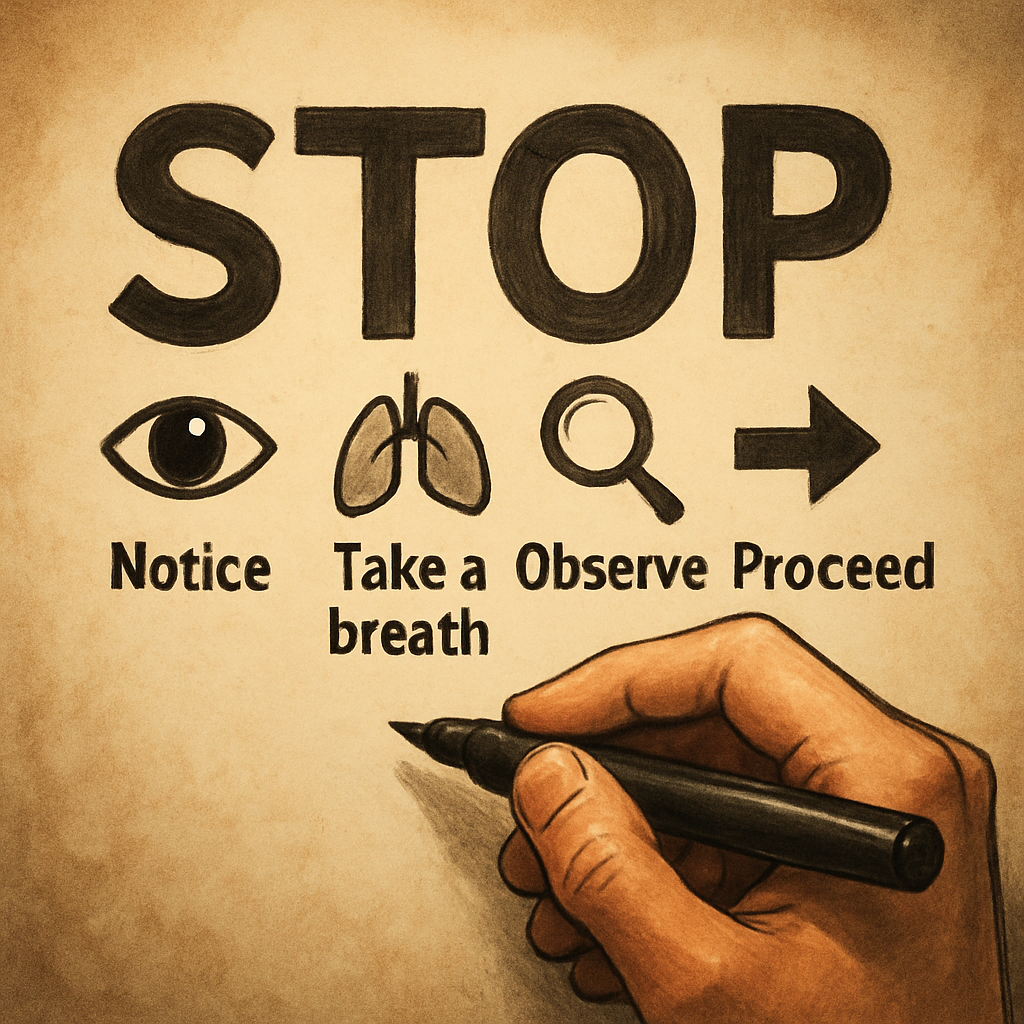
Give it a try on your next shift. When the negative loop tries to pull you under, hit STOP, reframe, and keep moving forward. You’ve got the tools – now just press the button.
Step 6: Practice Gratitude Reframing – Turning Negatives into Appreciations
When the shift ends and your mind keeps replaying that missed lab value, it’s easy to let the negative stick like a stubborn bandage.
What if, instead of looping, you could flip the script in a single breath and actually feel a little lighter?
That’s what gratitude reframing is about: you take the exact thought that’s pulling you down, then ask yourself what you can genuinely appreciate about the same moment.
Why gratitude works as a reset button
Science shows that focusing on what’s going well activates the brain’s reward pathways, which quiets the amygdala’s stress alarm.
In practice, that means a few seconds of appreciation can lower heart rate enough to let you think clearly again.
And it’s not “toxic positivity” – you’re not pretending the problem vanished, you’re simply widening the lens.
Step‑by‑step gratitude reframing
1. Capture the negative thought.Write it down exactly as it appears. Example: “I forgot to document the wound dressing, I’m careless.”
2. Identify a concrete positive element.Scan the scene for anything that went right, however small. Maybe you double‑checked the medication order earlier, or you noticed a colleague’s helpful reminder.
3. Reframe with a gratitude statement.Combine the negative with the positive: “I missed the wound note, but I caught the medication error before it reached the patient, and that shows I’m still vigilant.”
4. Anchor the new thought.Press thumb‑to‑finger, say the gratitude line out loud, and take a slow 4‑1‑6 breath. The physical cue helps cement the shift.
5. Record the outcome.In your thought journal, note the original thought, the gratitude reframing, and a quick intensity score (0‑100). Over a week you’ll see the scores drift lower.
Real‑world gratitude reframing examples
Surgeon after a tough closure.Original: “That knot looks ugly, I’m a terrible suturer.” Reframe: “The knot needs tightening, but I completed a flawless anastomosis earlier, which saved the patient’s blood flow.”
Nurse during a rapid response.Original: “I’m going to forget the allergy bracelet.” Reframe: “I felt the adrenaline surge, yet I remembered to call the pharmacist right away, preventing a medication error.”
Resident reviewing labs at 2 am.Original: “These abnormal values mean I’m incompetent.” Reframe: “One value is off, but I have a solid plan to discuss it with my attending, and I’ve handled similar patterns before.”
Quick gratitude checklist you can keep on your locker
Negative thought (verbatim)
One concrete positive detail from the same moment
Gratitude‑framed statement
Physical cue + 4‑1‑6 breath
Intensity score and date
Grab a sticky note, scribble the four items, and stick it where you’ll see it during a break.
Does this feel like another task on an already full to‑do list? Maybe, but the whole process takes less than a minute. The payoff is a measurable dip in stress and a clearer path to the next patient.
In our experience at e7D‑Wellness, clinicians who added a daily gratitude reframing habit reported feeling more “in control” after just three days. The habit works because it leverages the same neural pathways you already use for clinical documentation – you’re just documenting a different kind of data.
So, what’s the first negative thought you’ll turn into appreciation right now? Pick it, write it, and give yourself credit for the thing you actually did well.
Remember: gratitude isn’t about ignoring the problem; it’s about acknowledging the whole picture, and that small shift can keep you resilient on the longest shifts.
FAQ
Below are the most common questions clinicians ask about reframing negative thoughts, with concrete examples you can start using right now.
What are some quick reframing negative thoughts examples I can use during a busy shift?
When the ward is humming and a thought like “I’m going to miss the next order” pops up, pause, write the exact phrase, then counter it with what you’ve already done. For example: “I’ve double‑checked the chart three times today, and I’ll set a quick reminder on my phone for the next dose.” The physical cue of pressing thumb‑to‑finger seals the new pattern into your routine each shift.
How can I turn a catastrophizing thought into a balanced statement?
If you catch yourself thinking “If I drop this lab result the patient will die,” label it as catastrophizing. Then ask: what’s the real risk? Usually the lab can be re‑ordered or corrected. A balanced rewrite could be: “I’ve flagged the result, I’ll verify it with the attending, and there’s a safety net in place.” Saying it out loud while taking a breath grounds the thought.
Can you give a reframing negative thoughts example for medication errors?
A medication‑error thought often sounds like “I’m careless, I’ll hurt a patient.” Write it down, then pull the facts: the dose was checked, the pharmacy confirmed, and the patient’s vitals stayed stable. A reframing example: “I caught the error before it reached the bedside, and I’ll add a checklist step to keep that safety habit alive.” Pair it with a quick 4‑1‑6 breath.
What's a simple way to reframe self‑criticism after a difficult surgery?
After a tough surgery you might think, “That knot ruined the whole case.” First, note the distortion – all‑or‑nothing. Then list the facts: the incision healed, blood loss was minimal, and the patient’s vitals are stable. A concrete rewrite: “I noticed a knot that needs tightening, but the procedure went well overall, and I’ll adjust it before closure.” A gentle press of thumb‑to‑finger seals it.
How does a gratitude‑framed reframing example differ from a regular positive affirmation?
Gratitude‑framed reframing adds a specific positive detail instead of a generic pep‑talk. For instance, instead of saying “I’m fine,” you might write: “I missed the wound note, but I caught a medication error earlier, showing I’m still vigilant.” The gratitude element acknowledges what went right, which strengthens the brain’s reward pathway and makes the new belief stick longer than a simple affirmation.
What habit can I build to make reframing negative thoughts examples automatic?
Turn reframing into a habit by pairing it with a trigger you already use, like washing your hands before each patient encounter. When you scrub in, glance at your mental checklist: negative thought? If yes, run through the quick three‑step rewrite (thought → evidence → balanced line). Doing this three times a shift builds a neural shortcut, so the brain automatically reaches for the reframed version next time.
Conclusion
We've walked through dozens of reframing negative thoughts examples, from the scrub‑room to the night‑shift break room. If you’ve ever caught yourself thinking “I’m going to mess up” and then turned that into “I’ve double‑checked and I’ll set a reminder,” you already have a powerful tool in your pocket.
So, what’s the next step? Grab your Distortion Tracker, write the exact thought, ask the four evidence‑based questions, and finish with a balanced line and a thumb‑to‑finger cue. Do it three times on a busy shift and you’ll feel the mental “vitals” settle.
Remember, reframing isn’t about pretending everything is perfect – it’s about giving your brain the facts it needs to stop spiralling. When you pair the habit with a quick gratitude note, the stress drop is measurable, and you keep the focus on patient care instead of self‑criticism.
In our experience at e7D‑Wellness, clinicians who make reframing a micro‑habit report clearer thinking and lower burnout scores within weeks. That’s why we’ve built templates and assessments that make tracking effortless.
Give yourself permission to pause, rewrite, and move forward. The next time a negative thought pops up, ask: “What’s the evidence, and what’s one concrete action I can take?” You’ve got the playbook – now put it into practice.


Comments