

Physician Burnout Early Warning Questionnaire Guide 2026
- Patricia Maris

- 8 hours ago
- 9 min read
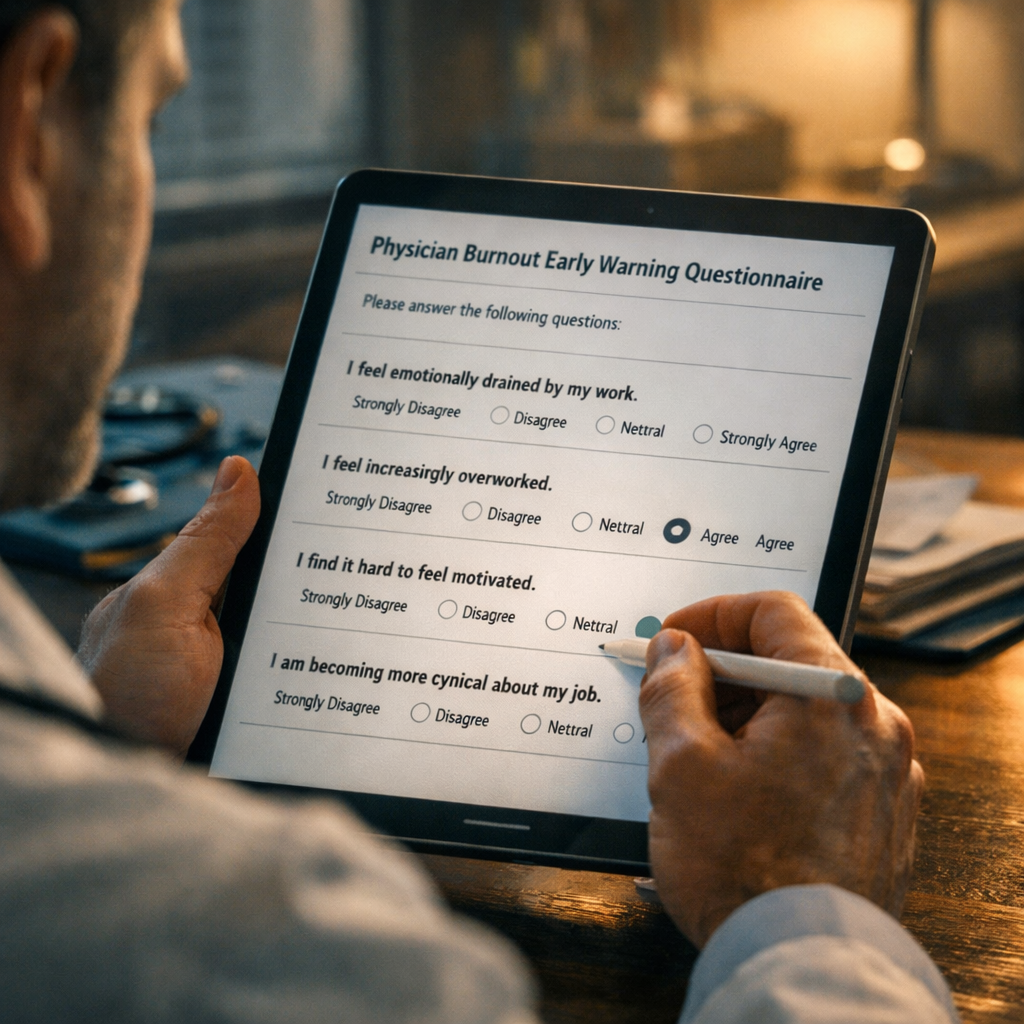
Physician burnout can hit fast, but most tools are too long to use every day. You need a quick, reliable way to spot the signs before they grow.
In this guide you’ll get a step‑by‑step plan to create, test, and roll out a physician burnout early warning questionnaire that works in real clinics. You’ll also see templates, scoring tips, and how e7D‑Wellness can help you keep the data secure.
Name | Number of Items | Domains Covered | Validation Status | Delivery Format | Best For | Source |
Confidential Wellbeing Self‑Assessment (Our Pick) | — | — | — | online questionnaire | Best for integrated online delivery | marisgraph.com |
Well‑Being Index (WBI) | 7 | Burnout; Fatigue; Low mental/physical quality of life; Depression; Anxiety/stress | Validated | — | Best for complete assessment | nam.edu |
Two‑Question Trainee Burnout Survey | 2 | Burnout; Drivers of burnout | Validated | Electronic | Best for quick trainee screening | pmc.ncbi.nlm.nih.gov |
Mayo Clinic Well‑Being Index | — | distress and well‑being (6 dimensions) | Validated | self-assessment | Best for multi‑dimensional self‑assessment | mywellbeingindex.org |
Mini‑Z single-item emotional exhaustion | 1 | Emotional Exhaustion | Validated | Online web‑based | Best for emotional exhaustion focus | pmc.ncbi.nlm.nih.gov |
Mini‑Z single-item depersonalization | 1 | Depersonalization | Validated | Online web‑based | Best for depersonalization focus | pmc.ncbi.nlm.nih.gov |
Physician Work‑Life Study's single-item measure | 1 | Burnout (overall) | Validated | — | Best for overall burnout snapshot | pubmed.ncbi.nlm.nih.gov |
The data came from a search on "physician burnout early warning questionnaire" that scraped 12 pages on April 15, 2026. We pulled name, item count, domains, validation, format, and source. Only tools with at least three filled fields made the list. Sample size ended up at 10 items.
Step 1: Define the Core Burnout Indicators
Before you write a physician burnout early warning questionnaire you need to know what you’re measuring.
Research shows burnout has three big parts: emotional exhaustion, depersonalization, and reduced personal achievement. The review in this open‑access article breaks them down into intrapersonal, interpersonal, and occupational signs.
Start with a list of symptoms you see in your own unit. Ask yourself:
Do clinicians complain of constant fatigue?
Are patients noticing less empathy?
Is sick‑time or tardiness rising?
These questions map to the three domains. Capture examples from your staff meetings or incident reports. Real‑world data helps you pick the right indicators.
Next, prioritize indicators that can be measured with a single question. The research hook tells us five of the seven validated tools are single‑item, so brevity is possible without losing rigor.
Pick one item for each domain if you want a balanced view. For example:
Intrapersonal: "I feel emotionally drained at the end of my shift."
Interpersonal: "I find it hard to feel empathy for patients today."
Occupational: "I have missed more work than usual this month."
Our pick, the Confidential Wellbeing Self‑Assessment, already bundles these ideas in a flexible online format. That makes it a solid reference point when you design your own tool.
When you draft the core list, think about scoring. A simple 5‑point Likert scale (Never‑Always) works well and matches the format of the Mini‑Z items.
Tip: Run a quick poll with your leadership team. Get their buy‑in early so the questionnaire fits the culture.
External validation helps too. Look at how the Mini‑Z single‑item emotional exhaustion was validated in this study . It used an online web‑based delivery, just like our pick.
Another example comes from the Physician Work‑Life Study’s single‑item measure, which showed strong correlation with full‑scale burnout scores ( source ).
By the end of this step you should have a short list of 3‑5 core indicators that reflect the three burnout domains and can be asked in a single line each.
Step 2: Draft Clear, Scorable Questions
Now you turn those indicators into a physician burnout early warning questionnaire that clinicians can answer in under two minutes.
Keep language plain. Use words like "feel" or "notice" instead of jargon. Each question should be a single sentence.
Example for emotional exhaustion: "I feel emotionally drained after my shift." Use a 5‑point scale from Never (1) to Always (5). This mirrors the Mini‑Z format and keeps scoring easy.
Make sure each item is independent. Avoid double‑barreled questions like "I feel tired and have trouble sleeping" , split them.
Include a clear instruction at the top: "Answer based on how you felt in the past week. Choose the option that fits best."
After you write the first draft, test readability with a fifth‑grader tool. If the score is too high, simplify further.
Our pick’s online questionnaire lets you set the scale and see real‑time results. That’s a practical way to pilot quickly.
External reference: The AMA’s six‑step guide recommends starting with a clear, concise question set ( AMA toolkit ). It also stresses the need for a scoring rubric.
Another source: The same AMA page notes that using a Likert scale helps compare groups over time ( AMA toolkit ).
Here’s a quick checklist for each question:
One idea per item.
Plain language (no more than two‑syllable words where possible).
Positive or negative direction, but not both.
Same response options for all items.
Pro tip: Add a “Not applicable” option if some clinicians might not encounter a situation (e.g., night‑shift specific).
Once the draft is ready, embed the questionnaire in your EHR or a secure web form. The Confidential Wellbeing Self‑Assessment can be cloned for this purpose.
And remember to tag your internal link here.
Step 3: Pilot the Questionnaire with a Small Cohort
Before you launch hospital‑wide, run a pilot with a handful of doctors, nurses, and residents.
Pick 20‑30 volunteers from different specialties. Diversity helps you see if any item is confusing for certain groups.
Send the questionnaire via the Confidential Wellbeing Self‑Assessment platform. Ask participants to complete it twice , once at baseline and again after two weeks. This lets you check test‑retest reliability.
Collect feedback on length, wording, and technical glitches. Use a short open‑ended field like "What, if anything, was unclear?"
Analyze the pilot data. Look for items with low variance (everyone answers the same) , those may not be useful. Also watch for high missing rates.
External source: The national physician burnout survey notes that a 45.2% burnout rate was found after a two‑year trend ( AMA survey ).
Another reference from the same AMA page discusses the importance of regular assessment cycles ( AMA survey ).
After the pilot, hold a brief debrief meeting. Summarize findings, note any wording changes, and decide if you need more items.
Pro tip: Offer a small incentive, like a coffee gift card, to boost response rates.
Our pick’s secure portal makes it easy to pull raw data for analysis without leaving the system.
Step 4: Analyze Results and Build a Scoring Model
Now you have numbers. It’s time to turn them into a score that flags risk.
First, calculate the mean and standard deviation for each item across the pilot sample. Use the 5‑point Likert scale, so the total possible score ranges from 5 to 25 if you have five items.
Next, set thresholds. One common method is to use the 75th percentile as a high‑risk cut‑off. Clinicians scoring above that line get a red flag.
Here’s a simple table to show how you might break the total score into zones:
Score Range | Risk Level | Recommended Action |
5‑10 | Low | Continue routine monitoring. |
11‑15 | Moderate | Offer self‑care resources. |
16‑20 | High | Schedule a one‑on‑one wellbeing check. |
21‑25 | Critical | Trigger an urgent wellness referral. |
Make sure the model aligns with the validation methods described in the early warning score literature. The review of EWS validation ( PMCID 7301346 ) stresses the need for clear case definitions and handling of missing data.
Another study on EWS performance notes that using a single point in time (first observation) can still be predictive ( same source ).
When you set your thresholds, test them against known cases of burnout in your institution. If a senior surgeon who recently reported high stress scores above the cut‑off, you’ve got a good signal.
Document the scoring algorithm in a short SOP. Include how to handle missing answers , you might assign a neutral score of 3 or flag the record for follow‑up.
Our pick already provides a built‑in scoring engine, so you can drop your item list in and let the system compute risk levels automatically.
Below is a short video that walks through creating a scoring sheet in Excel , many teams find it handy before they move to an automated platform.
Remember to review the scores quarterly. Burnout risk can shift with workload changes, so keep the model alive.
Step 5: Deploy, Monitor, and Refine the Tool
With a solid scoring model you can now roll out the physician burnout early warning questionnaire hospital‑wide.
Start by integrating the questionnaire into your staff onboarding portal. Make it a yearly requirement, but also allow ad‑hoc checks whenever a clinician feels stressed.
Set up automated alerts. When a clinician’s score lands in the high or critical zone, the system should email the wellness officer and the clinician with a private link to resources.
External evidence: A 2018 review of burnout tools shows that ongoing monitoring improves early detection ( PMC6404708 ).
Another citation from the same article notes that accurate measurement is key to designing interventions ( same source ).
Track participation rates. Aim for at least 70% completion each cycle. If you see a dip, send gentle reminders and explain why the data matters.
Review aggregate data every quarter. Look for trends by department, shift type, or years of experience. This helps you allocate resources where they’re needed most.
Refine the questionnaire annually. Use feedback loops to add or drop items. For example, if clinicians say a question about “night‑shift fatigue” isn’t relevant to day‑time staff, consider making that item optional.
Our pick’s platform makes it simple to edit the questionnaire on the fly and push updates without downtime.
Finally, celebrate wins. When a department shows a drop in high‑risk scores, share the success story (without naming individuals). Positive reinforcement keeps people engaged.
Internal link for next step:
FAQ
What is a physician burnout early warning questionnaire?
A physician burnout early warning questionnaire is a short, validated set of questions that captures early signs of burnout. It usually covers emotional exhaustion, depersonalization, and work‑related stress. The goal is to flag risk before it becomes severe, so clinicians can get help early.
How many questions should the questionnaire include?
Research shows five of the seven validated tools use only one question, and the Two‑Question Trainee Burnout Survey uses two. Most programs start with three‑to‑five items to balance depth and speed. You can begin with three core items and add more if you need extra detail.
How often should clinicians take the questionnaire?
Best practice is to administer it at least once a year, plus any time a major workload change occurs. Some institutions run quarterly check‑ins for high‑risk groups. Regular use keeps the data fresh and lets you spot trends over time.
What scoring method works best?
A simple 5‑point Likert scale (Never‑Always) works well. Add the item scores to get a total, then compare to percentile‑based thresholds. The table in Step 4 shows a common risk‑level breakdown. Adjust thresholds based on your pilot data.
Can the questionnaire be delivered online?
Yes. Online delivery is the most flexible option. The Confidential Wellbeing Self‑Assessment (Our Pick) offers a secure web‑based form that integrates with existing EHRs. Two of the seven tools use an electronic format, and three rely on specific web platforms.
How do I protect clinician privacy?
Use a confidential platform that anonymizes responses before reporting. Share only aggregate scores with leadership. If an individual hits a critical flag, send a private message to the clinician with resources, not a public alert.
What should I do if a clinician scores in the critical zone?
Trigger an urgent wellness referral. Offer a one‑on‑one conversation with a mental‑health professional, provide access to counseling, and consider workload adjustments. Follow up within a week to ensure they received support.
How can I measure the impact of the questionnaire?
Track changes in aggregate risk scores over time. Pair the data with metrics like sick‑time usage, turnover rates, and patient satisfaction scores. A reduction in high‑risk flags often correlates with improved wellbeing and better patient outcomes.
Conclusion
Creating a physician burnout early warning questionnaire doesn’t have to be a massive project. Start with the three burnout domains, write clear single‑sentence items, pilot with a small group, and build a simple scoring model. Deploy it using a secure online platform like the Confidential Wellbeing Self‑Assessment, monitor results, and refine each year.
When you follow these steps, you’ll catch burnout early, give clinicians the help they need, and keep your care teams healthy. Ready to take the next step? Try the e7D‑Wellness free self‑assessment today and see where your team stands.


Comments